Founding Fictions

Founding Fictions

by Elle Van Gundy
Season 1
Philosophy of A Revolution
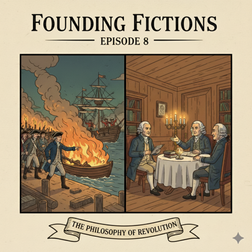
We all know the slogan "No taxation without representation," but what if the American Revolution wasn't just a political dispute, but a violent economic divorce? This episode argues that the Founders weren't just fighting a king; they were fighting an entire economic system called Mercantilism. We trace the story from a furious smuggler's riot on the Boston docks to a calm philosophical dinner in Scotland, showing how Adam Smith's The Wealth of Nations provided the economic declaration of independence that empowered the political one.
The Scottish Crucible
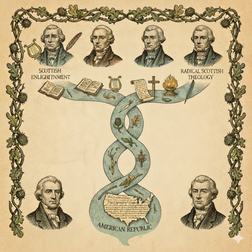
This episode of "Founding Fictions" challenges the myth that America's founding ideals were a simple inheritance from English thinkers like John Locke. Instead, it reveals the overwhelmingly Scottish roots of the revolution, tracing two powerful streams that converged in the colonies. The first is the moral philosophy of the Scottish Enlightenment (Francis Hutcheson, Thomas Reid), which provided a new language for virtue and the "pursuit of happiness." The second is a centuries-old theological tradition of radical rebellion (Samuel Rutherford), which supplied the moral and religious duty to resist tyranny. Discover how these two streams were carried to America and fused by key figures like John Witherspoon and James Wilson, forming the true ideological DNA of the Declaration of Independence and the Constitution.
The Godmother of Thanksgiving: The Invention and The Reckoning (Part 2)
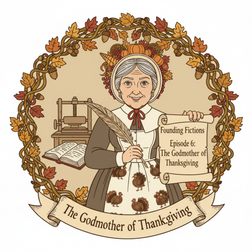
For nearly two centuries, the "First Thanksgiving" was a lost footnote in history. So how did a forgotten diplomatic meeting in 1621 become the mandatory national dinner we know today? In this episode, we peel back the layers of America’s favorite feast. We travel from the 17th-century mud of Plymouth to the industrial clamor of the 19th century to meet the "Godmother of Thanksgiving"—the magazine editor who engineered the holiday to stop a Civil War. Plus, we explore the hard history the myth tries to hide: the brutal war that followed the feast and the 1970 rebellion that changed the holiday forever.
The Truth About Thanksgiving: The Apocalypse & The Alliance (Part 1)
​Join host Elle Van Gundy as she strips away the construction paper feathers and pious legends to reveal the desperate reality of the "First Thanksgiving." In this first installment of a two-part special, we travel back to 1621 to discover that the famous feast wasn't about friendship—it was about survival. ​From the devastation of the "Great Dying" plague to the cold political calculus of Massasoit's alliance, this episode dismantles the myth of the welcoming wilderness and explores the tense military summit that history rewrote as a dinner party.
Anti-Thanksgiving
The turkey is back on the table, but can we trust the hand that serves it? In this episode, we dissect the "peace treaty" that ended the 2025 crisis. From the starvation tactics of Jamestown to the rebellion of Daniel Shays, discover why the return of SNAP benefits marks the end of the shutdown—but the beginning of a new, dangerous era for the Constitution.
The Roman Antidote: Veterans Day 2 of 2
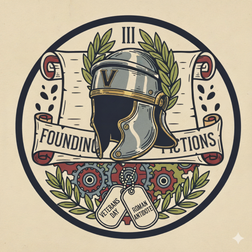
Is the G.I. Bill a monument to national gratitude, or a calculated shield against revolution? In this episode of Founding Fictions, Elle Van Gundy peels back the sentimental layers of veterans' affairs to reveal a colder, more pragmatic history. ​We trace the lineage of the Department of Veterans Affairs not to a sense of charity, but to the survival instincts of empires. From the private armies that tore apart the Roman Republic to the tear-gassed encampments of the 1932 Bonus Army in Washington D.C., we explore how the "Roman Antidote"—a system designed by Emperor Augustus to prevent military coups—became the blueprint for the American middle class.
The Newburgh Crisis: Veterans Day 1 of 2
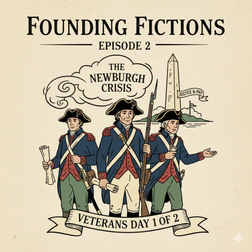
​Why is the American system for veterans built on anxiety rather than just gratitude? Host Elle Van Gundy peels back the layers of the "Standing Army" myth, connecting the near-mutiny of the Newburgh Conspiracy in 1783 to Eisenhower's modern warning about the Military-Industrial Complex. Discover how the Founders' fear of their own troops—and the dramatic moment George Washington saved the republic from a coup—shaped the way we treat the "Honored Stranger" today.
An Echo of Tyranny
Does the modern US government mirror the "tyranny" of King George? This episode uses the Declaration's grievances as a lens, comparing "swarms of officers" and "taxation without consent" to today's administrative state and executive power. We explore the Founders' constitutional "antidote" and the one thing Washington warned could destroy it all: the "spirit of party."
Revolution Gratitude What Comes After the Myth
Bonus
Host Elle Van Gundy addresses the "heavy history" of Thanksgiving and how to move from passive guilt to active responsibility. Centering the Ohenten Kariwatekwen (Haudenosaunee Thanksgiving Address) as a transformative framework, this episode outlines four practical steps to "decolonize" the holiday: educating oneself with Indigenous scholarship, performing meaningful land acknowledgments, reframing the feast to honor Indigenous food systems, and taking material action to support Indigenous sovereignty
From Founding Fathers to Facebook Feuds: How the Zero-Sum Fight for Survival Became American Politics
Bonus
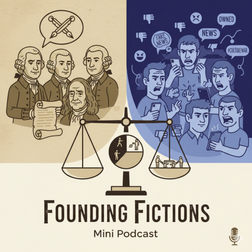
Why does American political debate feel less like a discussion and more like a fight for survival? This deep dive traces modern affective polarization back to the nation's origin, revealing how the historic, existential feud between Alexander Hamilton and Thomas Jefferson established a zero-sum political culture. The episode examines how the Founding Fathers’ fear of factions and the initial absence of a loyal opposition created the blueprint for today’s intense tribalism, and explores a dual strategy—from institutional reforms to shared national goals—to heal the divide.
1 of 2