Evolution Of A Protest

Evolution Of A Protest

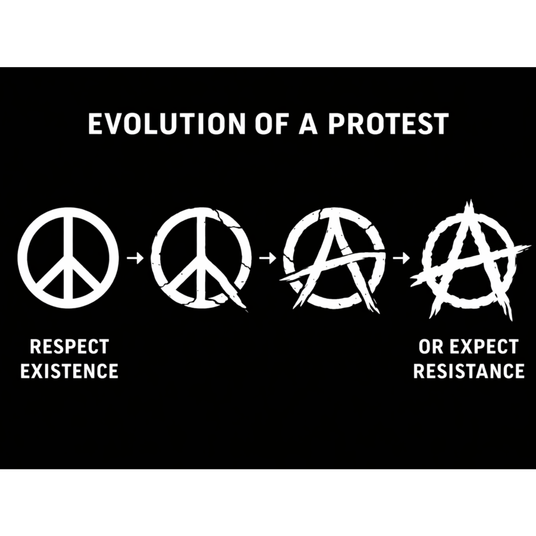
by Singularity Institute
The Disconnect
Theme: How surveillance, over‑criminalization, and elite self‑delusion create a system where empowerment itself becomes treated as a threat — and how power shifts anyway. --- I. Structural Overreach: When Law Becomes Totalizing 1. Hyper‑dense law — Modern legal codes expand until nearly every action is technically violable, creating universal latent guilt. 2. Selective enforcement — Power shifts from “what is illegal” to “who gets punished,” turning legality into a discretionary weapon. 3. Criminalization of coordination — Collective action, mutual aid, and parallel institutions become reframed as conspiracy, extremism, or economic subversion. --- II. Force Multipliers: Surveillance + Militarized Policing 1. Militarized policing — Tactical asymmetry grows: armored vehicles, predictive policing, fusion centers, and rapid‑response units. 2. Total data capture — Mass surveillance, financial tracking, and metadata analysis make early suppression easier. 3. Visibility paradox — The same systems that strengthen the state also create vast paper trails, leaks, and statistical evidence of abuse. --- III. Regulatory Capture as Organized Criminality 1. Elite self‑insulation — Political actors become shielded from consequences by networks of donors, lobbyists, and legal immunities. 2. Sincere delusion — Elites internalize their own narratives, believing repression is “protection,” not predation. 3. Closed feedback loops — Policy is shaped by those who benefit from it, eliminating internal correction mechanisms. --- IV. When Organizing Becomes “Illicit” 1. Chilling effect — People self‑censor, fearing that any attempt at empowerment may be construed as criminal intent. 2. Delegitimization of dissent — Critiques of power are reframed as threats to national security or public order. 3. Weaponized ambiguity — Vague statutes allow authorities to retroactively justify repression. --- V. Decision‑Theoretic Consequences 1. Collapse of expected value for open activism — Direct confrontation becomes irrational under high surveillance and high penalty risk. 2. Shift to covert, distributed coordination — Networks become smaller, denser, and harder to detect. 3. Substrate switching — Organizing moves into culture, economics, diaspora networks, and digital steganography. --- VI. Parallel Structures as Nonviolent Power Reclamation 1. Resilience over rebellion — People build alternatives rather than attack incumbents. 2. Economic sovereignty — Cooperative models, local production, and decentralized finance reduce dependency. 3. Narrative counterpower — Documentaries, art, satire, and open‑source knowledge shift public perception without triggering legal tripwires. --- VII. Long‑Term Dynamics: Brittleness of Over‑Control 1. Legitimacy erosion — Excessive force accelerates public disillusionment. 2. Overreach instability — Systems that criminalize empowerment eventually face crises of compliance. 3. Structural obsolescence — Parallel institutions quietly outcompete captured ones.
Issues with Institutional Mental Health Medicine
1. Historical Misuse of Psychiatry - Psychiatry repeatedly functioned as a tool of social control rather than science. - Drapetomania exemplifies fabricated diagnoses used to enforce domination. - Similar patterns reappear in racialized overdiagnosis, pathologizing dissent, and moralizing nonconformity. 2. Core Epistemic Failure: Black‑Box Classification - Psychiatry lacks a mechanistic, white‑box substrate equivalent to DNA in biology. - DSM categories are symptom clusters, not causal explanations. - Without mechanistic grounding, categories drift with culture, power, and incentives. - Many diagnoses are non‑portable — they exist only within specific rule systems. 3. Institutional Incentives and Diagnostic Inflation - Diagnostic systems shape reimbursement, liability, and professional authority. - Institutions reward complexity, novelty, and control, not parsimony or falsifiability. - Rule‑makers project their own preferences into diagnostic categories. - Coercive tools (civil commitment, forced treatment) amplify institutional bias. 4. Social and Racial Bias as Structural Features - Overdiagnosis of schizophrenia in Black men and other disparities reveal systemic bias. - Cultural mismatch and clinician interpretation errors produce predictable misclassification. - These errors persist because no white‑box mechanism exists to falsify them. 5. Formalism as the Corrective Framework - White‑box models (biomarkers, neurocircuitry, computational phenotypes) anchor portable disorders. - Game theory models contextual behaviors as strategic responses, not pathology. - Optimization and risk theory identify mathematically forced “oughts” for institutional design. - Occam’s razor eliminates unnecessary, non‑portable diagnostic constructs. 6. Taxonomy by Portability - Portable disorders: stable across jurisdictions, likely neurobiological (e.g., Tourette’s, trichotillomania). - Contextual disorders: dependent on authority structures (e.g., ODD, conduct disorder). - Portable disorders warrant mechanistic research; contextual ones require de‑medicalization. 7. Principles for Institutional Reform - White‑box first: treat symptom clusters as hypotheses requiring mechanistic validation. - Transparency: open DSM governance, public data, conflict‑of‑interest disclosure. - Minimize coercion: restrict involuntary treatment to portable, imminent‑risk cases. - Audit bias: continuous monitoring of racial, gender, and socioeconomic disparities. - Mechanism design: align incentives with patient welfare, not institutional power. 8. Clinical and Legal Overhaul - Replace checklists with transparent decision‑support models showing assumptions and alternatives. - Reform civil commitment laws to require objective thresholds and independent review. - Remove reimbursement incentives tied to diagnostic inflation. - Create diagnostic ombuds offices for patient appeals and oversight. 9. Community‑Based Alternatives - Expand peer respite, mobile crisis teams, and non‑police crisis response. - Build housing‑first and harm‑reduction infrastructures to reduce crisis frequency. - Train and credential peer specialists as first‑line responders. 10. Long‑Term Vision - A mental‑health system grounded in mechanistic truth, minimal coercion, transparent governance, and formal optimality. - Portable disorders treated medically; contextual behaviors handled socially, voluntarily, and non‑coercively. - Institutions redesigned to prevent capture, bias, and diagnostic overreach..
A Fair World
1. Economic Harm vs. “Economic War Crime” - “Economic war crime” is not a legal category, but the effects of certain economic actions can mirror the scale and severity of wartime atrocities. - When economic decisions cause mass deprivation, shortened lifespans, or preventable suffering, the moral impact becomes comparable to crimes against humanity. 2. The Threshold: When Unfairness Becomes Systemic Harm A system crosses into morally criminal territory when five conditions align: - Intentionality: Actors knowingly create or maintain harmful structures. - Foreseeability: The consequences—poverty, deprivation, collapse of wellbeing—are predictable. - Scale: Harm affects entire populations, not isolated individuals. - Preventability: Suffering could be avoided without sacrificing essential societal functions. - Benefit Extraction: Perpetrators profit from the harm they inflict or maintain. When all five are present, the behavior is no longer “unfairness” but engineered deprivation. 3. Why Perpetrators Don’t See Themselves as Perpetrators - Individuals benefiting from unfair systems often believe their advantages are natural or earned. - They reinterpret structural correction as persecution because their baseline is elevated. - Acknowledging harm would require moral responsibility, so they resist the logic. - This creates a psychological inversion: fairness feels like hostility to those who relied on unfairness. 4. Why They Feel Victimized When Fairness Arrives - Losing unearned advantages feels like being harmed. - They confuse the removal of privilege with an attack. - They demand justification but often reject first‑principles reasoning that threatens their status. - Their sense of victimhood is a defense of the system that benefits them. 5. Retribution vs. Accountability - Retribution is punishment for its own sake; this is not ethically defensible. - Accountability is preventing further harm by removing the ability to inflict it. - A fair system focuses on structural correction, not revenge. - The goal is to stop engineered deprivation, not to inflict suffering. 6. The Moral Equivalence Argument Economic actions become morally equivalent to war crimes when they: - deliberately restrict access to food, medicine, shelter, or livelihood - create artificial scarcity for profit - cause generational trauma or mass immiseration - shorten millions of lives through preventable deprivation The tools differ—financial instead of military—but the human impact is indistinguishable. 7. The Core Insight The question is not whether individuals “deserve retribution.” The real issue is: At what point does systemic exploitation become so severe that those responsible cannot claim innocence when the system is corrected? Answer: When the harm is intentional, large‑scale, preventable, and profitable.
Evolution of Society
1. Authority-Seeking as an Evolutionary Mismatch - Human dominance drives evolved for small-band coordination. - In large-scale societies, these traits scale into systemic harm. - This is an evolutionary mismatch: locally adaptive, globally destructive. - Technical terms: dominance hierarchy pathology, institutional maladaptation, runaway prestige-dominance fusion. --- 2. Government as a High-Risk Coordination Mechanism - Centralized authority amplifies harm: war, oppression, coercion, institutional violence. - Historical data shows organized violence vastly exceeds natural disasters or spontaneous conflict. - Political science terms: state capacity risk, authoritarian failure modes, institutional violence theory. --- 3. The Pathology of Power-Seeking - Desire to rule correlates with Machiavellianism, narcissism, and authoritarian personality traits. - These traits masquerade as “leadership” in hierarchical systems. - Technical terms: dominance-drive pathology, Dark Triad traits, elite capture dynamics. --- 4. Semantic Capture of “Leadership” - Positive terms are co-opted to legitimize harmful behaviors. - This is concept creep, semantic capture, and legitimacy laundering. - Objective criteria (like biological taxonomy) eliminate ambiguity. - Distinction: dominance leadership (coercive) vs prestige leadership (cooperative). --- 5. The Global Minima of Rulemaking - Optimal society minimizes coercive rules and maximizes autonomy. - Only physically necessary coordination rules remain (e.g., traffic direction). - All preference-based or bureaucratic rules disappear. - This is the global minima of rulemaking and global maxima of allowable freedom. --- 6. Post-Hierarchical Coordination Systems - Future societies use distributed, automated coordination instead of authority. - Humans remain equals; AI mediates information flow, not power. - Technical frameworks: polycentric governance, distributed-autonomy systems, cybernetic post-bureaucracy. --- 7. Institutional Immunology - Systems must be designed so dominance-seeking individuals cannot capture them. - This is analogous to immune systems preventing parasitic takeover. - Technical terms: institutional immunology, anti-capture architecture, resilience engineering. --- 8. Cultural Evolution Under Optimal Conditions - Culture becomes an emergent property of optimized development and environments. - Not arbitrary, not imposed—derived from human flourishing. - Technical framing: cultural attractor states, developmental optimization, post-scarcity cultural dynamics. --- 9. Transition Dynamics - Requires: - Recognition of authority-pathology - Objective definitions of leadership - Automated coordination replacing coercion - Rule-minimization under safety constraints - Education in cognitive immunology - This is a shift from hierarchical to post-institutional civilization. --- 10. End State: High-Autonomy, Low-Coercion Civilization - Minimal rules, maximal freedom. - No dominance hierarchies. - Transparent, automated coordination. - No institutional pathologies. - Human equality as a structural default. - This is the post-hierarchical, distributed-autonomy society.
The Path to Practical Omniscience
1. Finite but Vast Human‑Understandable Theory Space - Human‑usable theories = symbolic structures with bounded alphabet \(A\) and length \(L\). - Even with \(A \sim 10^3\), \(L \sim 10^4\), total space ≈ \(10^{30,000}\). - Enormous but finite; far smaller than physical or neural microstate spaces. - Human cognition restricts usable theories: limited working memory, chunking, attention, and symbolic bandwidth. 2. Structure of the Real World Enables Compression - Universe is highly structured: symmetries, locality, conservation laws. - Human mathematics is structured: algebraic, geometric, analytic regularities. - Language and thought are structured: compositional semantics, Montague‑style mappings. - This structure makes deep compression and unification possible. 3. Classical Limits Do Not Block Practical Omniscience - Gödel: no single formal system proves all arithmetic truths. - Turing/Rice: no universal decision procedure for all programs or semantic properties. - Kolmogorov: no perfect compressor for all strings. - These forbid universal solutions, not finite toolboxes covering all useful cases. - Real‑world problems lie in a tiny, structured subset where powerful heuristics exist. 4. Neural Networks as Algorithm‑Learning Systems - NNs are algorithms that learn other algorithms (function approximators). - They cannot solve undecidable problems but can learn heuristics for theorem proving, compression, search, and representation. - They enable recursive improvement: better models → better algorithms → better models. 5. Quantum, Photonic, and Stochastic Computing as Multipliers - Quantum computing: quadratic speedups for unstructured search; exponential for specific structured problems. - Cannot brute‑force global optima of trillion‑parameter models or escape undecidability. - But accelerates linear algebra, sampling, architecture search, symbolic regression, and meta‑learning. - Photonic/stochastic/ternary architectures improve energy efficiency and parallelism. 6. Effective Compute = Hardware × Algorithms - Hardware growth (compute, energy) and algorithmic efficiency both improve exponentially. - Combined, they yield super‑exponential effective compute. - Recursive meta‑learning accelerates algorithmic progress further. 7. Practical Saturation: The 99.9% Threshold - For each domain (theories, languages, curricula, drugs, algorithms), define: - Utility metric - Human/physical limits - Scaling laws - Threshold where improvements fall below human resolution - Once below JND (just‑noticeable difference), further gains are irrelevant to human experience. 8. The Realistic Path to Human‑Relevant Omniscience - Not brute force; not perfect universality. - Instead: - Discover better representations - Discover better algorithms - Discover better languages (Lojban‑like, Montague‑style) - Discover better curricula - Discover better meta‑algorithms - Use massive compute to accelerate all of the above - Result: a finite, expanding toolbox that solves everything humans care about. 9. Final Picture - A recursively improving system can: - Compress all human‑relevant knowledge - Unify scientific domains - Optimize languages and curricula - Discover deep theories beyond human reach - Approach practical omniscience without violating any impossibility theorem.
Statistics = Mathematized Epistemology
1. Core Claim: Statistics = Mathematized Epistemology - David Salsburg (The Lady Tasting Tea) — statistics emerged to formalize how we know what we know. - E.T. Jaynes (Probability Theory: The Logic of Science) — probability is “extended logic,” turning uncertainty into rational belief. - Key idea: epistemology becomes operational when expressed as likelihoods, priors, and updates. --- 2. Statistics Doesn’t Lie — People Do - Nate Silver (The Signal and the Noise) — misuse, not math, creates false certainty. - John Ioannidis (“Why Most Published Research Findings Are False”) — incentives distort statistical practice. - Examples: - Cherry‑picking endpoints in drug trials. - Misleading graphs in political polling. - “P‑hacking” in academic research. --- 3. Humans Already Use Informal Bayesian Updating - Daniel Kahneman (Thinking, Fast and Slow) — people update beliefs intuitively but inconsistently. - Richard McElreath (Statistical Rethinking) — Bayesian reasoning mirrors everyday judgment. - Examples: - Choosing the most accurate weather forecaster. - Trusting a mechanic with a long track record. - Preferring a friend whose predictions about people pan out. --- 4. AI as the New Epistemic Authority - Philip Tetlock (Superforecasting) — accuracy, not credentials, determines trust. - Norbert Wiener (Cybernetics) — systems with feedback + data outperform human intuition. - Examples: - AI medical triage beating human diagnostic accuracy. - AI logistics outperforming human planners. - AI weather models surpassing traditional meteorology. --- 5. Collapse of “Security Through Obscurity” - James C. Scott (Seeing Like a State) — institutions rely on opacity to maintain authority. - Bruce Schneier (security expert) — obscurity is a brittle protection strategy. - Examples: - Tax codes designed to require specialists. - Legal language engineered for gatekeeping. - Regulatory complexity protecting incumbents. --- 6. Epistemic Secession: When People Can Verify Instead of Trust - Elinor Ostrom (polycentric governance) — people self‑govern when information is accessible. - Clay Shirky (Here Comes Everybody) — information access dissolves institutional monopolies. - Examples: - Citizens using AI to analyze legislation. - Patients verifying medical claims independently. - Workers bypassing credentialed experts with AI‑assisted competence. --- 7. Final Thesis > As AI democratizes statistical reasoning, institutions lose their epistemic monopoly. > When people can verify rather than trust, they gain the power to secede from systems built on complexity, scarcity, and obscurity.
Elite Overproduction and the Manufactured Scarcity of Talent
1. The Paradox of Elite Overproduction Modern societies generate far more credentialed “elite aspirants” than elite positions can absorb. Thousands of graduates compete for a handful of prestigious roles, leaving most underutilized and frustrated. This isn’t a failure of individuals—it’s a structural bottleneck created by institutions that ration opportunity. 2. Artificial Scarcity as a Design Principle Governments and corporations restrict intellectual property, licensing, and production rights, concentrating innovation inside a small number of firms. This creates the illusion that only a narrow elite can produce value, when in reality the constraint is legal, not cognitive or technological. 3. The Lost Productive Majority Most people—especially the “invisible 90%” of elite‑school graduates—could contribute massively to society if allowed to participate in open production ecosystems. Studies of elite overproduction show that societies become unstable when large pools of capable people are denied meaningful roles. 4. The 15‑Year‑Old Thought Experiment If production systems were modular, open, even teenagers could meaningfully contribute to advanced manufacturing, software, biotech, and materials science. The bottleneck is not intelligence—it’s access to tools, IP, and institutional permission. 5. How Academia Reinforces the Bottleneck Universities credential a small number of “acceptable” elites while excluding the majority from participating in high‑value production. This maintains scarcity, protects incumbent firms, and ensures that wealth concentrates in a few hands. 6. Economic Secession as a Remedy By creating public‑funded, royalty‑free intellectual property and member‑owned production clubs, society can bypass institutional gatekeeping. This enables: - mass participation in innovation - decentralized manufacturing - lower cost of living - diffusion of expertise - resilience against elite bottlenecks 7. Closing Insight Elite overproduction is not a natural outcome of talent distribution—it’s a symptom of a system designed to restrict who may produce. Opening production to the public dissolves scarcity and restores autonomy.

Elite Universities Reproduce Wealth Privilege
1. Opening Frame: The Myth of Merit Elite schools present themselves as meritocratic gateways, but their admissions patterns overwhelmingly reflect wealth. Zip code predicts opportunity more reliably than any genetic marker, making “genetic testing for merit” redundant. 2. The Three Populations Inside Elite Schools - Legacy/Wealth Admits: Children of donors, alumni, and the affluent; admitted through inherited cultural capital, institutional preference, and social networks. - DEI Admits: A smaller group selected to satisfy diversity optics; often mischaracterized as the primary beneficiaries of non‑merit admissions despite being far outnumbered by legacy admits. - High‑Aptitude Minority: The genuinely exceptional students whose later achievements (Nobels, startups, public leadership) sustain the institution’s prestige narrative. 3. Why It’s Harder to Fail Out Than to Get In Grade inflation, institutional incentives, and reputational protection mean that once admitted, students rarely fail. The institution confers legitimacy regardless of performance. 4. The Invisible 90% Most graduates do not become leaders or innovators. They enter the professional class quietly, revealing that elite credentials function more as status markers than engines of excellence. 5. Sociological Mechanisms at Work - Cultural capital: Elite families transmit the behaviors and competencies admissions offices reward. - Social capital: Networks and connections shape access to opportunities. - Symbolic capital: The brand of the institution becomes a lifelong asset. - Reproduction theory: Schools reproduce class hierarchy rather than disrupt it. - Opportunity hoarding: Elites maintain exclusive access to pathways of power. 6. Closing Insight Elite universities are not primarily selecting the best—they are curating the next generation of the already‑advantaged, with a thin layer of exceptional talent added to maintain the illusion of meritocracy.
Revolt at the Gates of Luxury
Modern scarcity is largely institutional, not physical. Energy density, automation, and open industrial standards make material abundance achievable. The project proposes a decentralized, autonomy-centered civilization built on publicly owned intellectual infrastructure and vertically integrated automated production. I. Physical Abundance Layer Energy Density Nuclear (mass-produced SMRs), solar, and storage provide scalable high-density power. Reactor cost is a manufacturing problem, not a physics problem. Standardization and factory production collapse cost curves. Vertical Integration Automated steel → reactor components → heavy equipment → infrastructure. Self-funding loop: sell output → expand capacity → reduce cost → repeat. Industrial capacity compounds annually. Automation Robotics + AI remove labor bottlenecks. Continuous production lowers marginal cost. Industrial capital becomes background utility. Result: Energy and manufacturing cease to be structural constraints. II. Open-Standard Economic Architecture Model: Open industrial ecosystem (analogous to open computing standards). Royalty-free designs. Publicly owned automation stack. Vendor-agnostic hardware. Global contributor model. Crowdfunded micro-contributions compounding over time. Millions contributing small amounts fund: Robotics R&D Open CAD/CAM systems Modular factory blueprints Industrial AI infrastructure Outcome: Core intellectual infrastructure cannot be captured or enclosed. III. Education as Autonomy Engineering Current education reproduces hierarchy and institutional dependence. Redesign: Logic-first curriculum (formal reasoning + linguistic precision). Continuous math/science integration. Early robotics and production literacy. AI-assisted personalized knowledge systems. Local autonomy with global optimization feedback. Graduates become: Formally literate Production competent Resistant to manipulation Capable of contributing to shared infrastructure Education becomes civilization replication infrastructure. IV. Institutional & Transition Dynamics Scarcity preserves power hierarchies. Institutional inertia blocks abundance scaling. No mechanical formula determines legitimacy or escalation. Constructive, distributed transformation is required. Civilizational phases: Survival Scarcity management Industrial scaling Knowledge asymmetry Automation & abundance Autonomy-centered civilization Transitions increase centralization pressure before stabilization. V. Integrated System Logic Energy → Manufacturing → Infrastructure → Education → Open IP → Automation → More Energy Feedback loops: Production funds expansion. Open standards prevent capture. Education feeds innovation. Automation accelerates scaling. Distributed production reduces institutional dependency. Abundance weakens coercive scarcity structures. Final Objective Build a decentralized, open-standard, AI-accelerated industrial ecosystem that mass-produces energy, automates infrastructure, educates for autonomy, self-finances expansion, and gradually renders enforced scarcity obsolete. This is not policy reform. It is a structural civilizational upgrade.
The Industrial Think Tank
1. Industrial Core - A single \$20B fully robotic, vertically integrated complex in Nevada. - Produces 3M tons of steel/year and fabricates 2,000 steel high‑rise towers annually. - Entire system powered by on‑site solar + LTO storage; zero purchased electricity. - Manufactures its own steel, glass, ferrock, electronics, solar panels, and batteries. 2. Building Output - Each tower: 11 stories, 100,000 ft², 40 luxury units (2,500 ft² each). - Internal production cost fixed at \$5M per tower. - Market sale price set at \$500/ft² → \$50M revenue per tower. 3. Annual Allocation - Total towers: 2,000/year. - Campuses built: 3/year → 225 towers consumed internally. - Towers sold: 1,775/year. 4. Financial Flow - Revenue from sales: \$88.75B/year. - Total production cost: \$10B/year. - Operating profit: \$78.75B/year. - Reinvestment into R&D and factory expansion: \$11.25B/year. - Remaining surplus: \$67.5B/year. 5. Endowment Creation - Surplus divided among 3 new campuses → \$22.5B endowment each. - Endowment rule: 5% return, 4% reinvested, 1% spendable. - Annual spendable budget per campus: \$225M. - Allocation: \$100M for professor salaries, \$125M for operations and public‑service programs. 6. University Mission - Engineering schools focused on robotics and AI; all IP released to the public. - Medical schools providing at‑cost healthcare. - Law schools offering at‑cost legal services. - Housing, utilities, and infrastructure produced internally at near‑zero cost. 7. Public Funding Model - Startup capital raised by 10M people contributing \$100/month for 24 months. - Total raised: \$24B → enough to build the gigafactory and begin perpetual campus creation. 8. Outcome - A self‑funding system producing 3 new public‑good universities every year. - Each campus permanently endowed, independent of tuition or taxpayer funding. - Creates a scalable, perpetual engine for education, research, healthcare, and legal access.
1 of 3