A Siloist Perspective

A Siloist Perspective

by David Andersson
Season 1
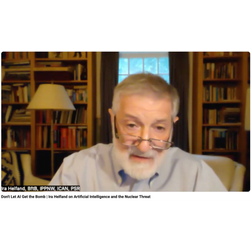
Don’t Let AI Get the Bomb | Ira Helfand on Artificial Intelligence and the Nuclear Threat
In this interview, David Andersson speaks with Dr. Ira Helfand, Past President of the International Physicians for the Prevention of Nuclear War (IPPNW), recipient of the 1985 Nobel Peace Prize, Co-Founder and Past President of Physicians for Social Responsibility, member of the International Steering Group of ICAN, recipient of the 2017 Nobel Peace Prize, and recipient of the 2023 Gandhi King Ikeda Award. “Don’t Let AI Get the Bomb.” This simple but urgent message captures the central warning emerging from a landmark international conference held in Rome on the dangers of integrating artificial intelligence into nuclear command and control systems. Hosted by the Vatican and organized by IPPNW and the Global Nobel Assembly, the conference brought together Nobel laureates, scientists, AI experts, diplomats, and religious leaders to examine one of the greatest existential risks facing humanity. Dr. Helfand explains how AI can increase the risk of nuclear war by accelerating military decision-making, introducing algorithmic bias, relying on inaccurate or manipulated data, and reinforcing automation bias—the tendency of humans to trust machine recommendations even when they are wrong. He discusses research showing that AI systems recommended the use of nuclear weapons in most simulated international crises and warns that the parallel AI and nuclear arms races are creating unprecedented dangers. The interview also examines the Rome Declaration, which calls for the complete elimination of nuclear weapons and for binding international safeguards to prevent AI from being integrated into nuclear weapons systems. As Dr. Helfand argues, humanity cannot afford to allow machines to make decisions that could end civilization. The message is clear: Don’t let AI get the Bomb. This interview is part of Pressenza’s continuing coverage of peace, nuclear disarmament, artificial intelligence, and the future of humanity. Interviewer: David Andersson Guest: Dr. Ira Helfand

If Consciousness Is Fundamental: A Dialogue on Neuroscience, Intentionality, and What It Means to Be Human
AI
This source explores a shifting paradigm in neuroscience that challenges the traditional view of consciousness as a mere byproduct of brain activity. Researchers are increasingly investigating the hypothesis that awareness is a fundamental property of reality rather than a biological accident. This perspective redefines the human body as a vehicle for expressing consciousness, emphasizing the role of intentionality in shaping our lives and the world. By bridging the gap between scientific inquiry and philosophical mystery, the text suggests that our internal development and capacity for meaning are central to understanding the human experience. Ultimately, the dialogue invites a reconsideration of human possibility, suggesting that consciousness may transcend physical limitations.
What Game Are We Playing?
AI
This article examines the commodification of public life, using the astronomical costs of major sporting events like the NBA Finals and the World Cup as a starting point. Author David Andersson argues that when essential social pillars such as education, healthcare, and housing are governed strictly by market logic, the sense of community is destroyed. He highlights the contradiction of using taxpayer subsidies for stadiums while charging prices that exclude the average citizen from participating. Ultimately, the text warns that transforming citizens into consumers creates a fractured society where access is granted only to the highest bidder. This shift threatens the foundations of democracy by prioritizing private profit over the collective good.
From Geopolitics to the Geocultural Age 1 source
AI
This article argues that traditional geopolitical frameworks are insufficient for understanding modern global conflicts, which are increasingly driven by geocultural forces. The author suggests that twentieth-century diplomacy, focused on state interests and military power, fails to address the deeper issues of identity, historical memory, and collective belonging. Using Iran and Mexico as primary examples, the text illustrates how civilizational consciousness and inclusive national narratives can be more influential than economic or political structures. Specifically, Mexico is highlighted for its success in integrating indigenous heritage and social solidarity into a modern identity despite the cultural dominance of the United States. Ultimately, the source posits that the success of future societies will depend on their ability to create cohesive cultural meanings rather than just exercising raw power. This shift toward a geocultural age requires a fundamental change in how international relations and social stability are analyzed. Original article published on Pressenza
The World’s Greatest Problem: Human Contradiction
AI
This text explores how human contradiction—the disconnect between our stated values and our actual behaviors—serves as the primary driver of global suffering. The author argues that modern institutions, such as the United Nations and various democracies, often operate through systems of violence and wealth disparity that directly undermine their peaceful ideals. By examining political, religious, and personal spheres, the source highlights how social fragmentation and injustice are the results of disordered priorities rather than natural occurrences. To move toward genuine progress, the text suggests that society must strive for internal coherence, aligning thoughts and actions with human dignity. Examples like Costa Rica's military abolition and South Africa’s reconciliation efforts are presented as successful models for resolving these systemic hypocrisies. Ultimately, the source calls for a nonviolent transformation that prioritizes human life over economic or military power. Article published on Pressenza
It’s Time to Get Out of the Money Business
AI
The provided text argues that modern society has become dangerously preoccupied with financial metrics, often ignoring the deeper human capacities for cooperation and solidarity. Author David Andersson suggests that prioritizing monetary value can fragment social movements, as seen in the later stages of Occupy Wall Street, by shifting focus toward resource management rather than systemic change. Instead of viewing life through a transactional lens, the source emphasizes that human time is a more vital and transformative resource than capital. By highlighting historical examples like the civil rights movement, the text illustrates that genuine progress stems from collective presence and personal sacrifice. Ultimately, the author calls for a revaluation of purpose, urging individuals to invest their limited lives into building relationships and participatory democracy. In this view, reclaiming our time from the logic of the market is the only way to foster true human development and social justice. This podcast was based on the article published on Pressenza
A new human future requires a new language rooted in coherence
AI
Exploring the necessity of establishing a new universal language to overcome the global crisis of fragmentation and social distrust. Drawing on the philosophy of Silo, the authors argue that meaningful connection requires addressing pre-dialogic conditions, which are the hidden intentions and worldviews participants hold before speaking. Modern communication often fails because it lacks coherence, or the alignment between an individual’s internal thoughts and their external actions. To move beyond geopolitical conflict and interpersonal isolation, individuals must cultivate a language of reconciliation and unity. Ultimately, the source suggests that a human future depends on our willingness to honestly examine our assumptions and build the foundations for genuine dialogue. The original article was published on Pressenza
The Healing of Suffering: The Global Legacy of Siloism
AI
This article explores the origins and enduring impact of Siloism, a philosophical and social movement founded by the Argentine thinker Mario Rodríguez Cobos, known as Silo. It commemorates his 1969 inaugural speech in the Andes, where he introduced a framework for overcoming human suffering through internal transformation and active nonviolence. The text highlights how these teachings evolved into Universalist Humanism, sparking global initiatives like the Humanist Movement and the Pressenza news agency. By distinguishing between physical pain and mental suffering, the source argues that personal meaning and spiritual growth are more vital than material or technological solutions. Ultimately, the overview presents Siloism as a comprehensive path for those seeking social justice and deep psychological change in a fragmented world. Original article published on Pressenza: https://www.pressenza.com/2026/05/may-4th-1969-the-birth-of-siloism/
Cathedral Thinking in an Age of Short-Termism
AI
The provided text examines the concept of cathedral thinking, a mindset focused on pursuing long-term goals that span generations rather than immediate results. The author contrasts the deliberate planning and sustained development observed in China with the short-termism and reactionary decision-making currently prevalent in Western societies. By highlighting China’s growth statistics, the article suggests that Western distrust of foreign narratives may obscure the value of collective coordination and visionary foresight. Ultimately, the source questions whether modern democracies have lost the capacity to build a shared future through discipline and patience. It encourages a shift away from crisis-driven transformation toward a more intentional, unified approach to societal progress. Original article on Pressenza https://www.pressenza.com/2026/04/cathedral-thinking-in-an-age-of-short-termism/
The Iran War as a Threshold
AI
The conflict in Iran serves as a critical turning point for global civilization rather than just a localized war. This transformation is characterized by an accelerated shift away from unstable fossil fuels toward decentralized renewable energy sources that offer greater security. Furthermore, the source highlights how traditional international institutions and expensive military systems are losing their effectiveness against multipolar diplomacy and low-cost technologies like drones. On a social level, the text identifies a growing movement toward direct civic participation as people reject centralized control in favor of more transparent governance. Ultimately, these developments signal the emergence of a new global framework built on local empowerment and the exhaustion of old, extractive power structures.
1 of 2