Comprehensive AP Review: Prep With Detailed Content Review & Tips

Comprehensive AP Review: Prep With Detailed Content Review & Tips

by Edgar Evans
Season 1
AP Macro Unit 6: Open Economy, BOP & Exchange Rates
Dive into AP Macroeconomics Unit 6 with a detailed breakdown of open economy concepts, starting with the Balance of Payments (BOP) and exchange rates. This episode covers the current and financial accounts, trade balances, and how they always sum to zero, plus key AP exam pitfalls and mnemonics to master international trade and finance. Perfect for students prepping for the exam with clear explanations and real-world analogies. Key Topics Covered:Balance of Payments (BOP): Comprehensive record of all transactions with the world Current Account: Trade balance, services, net income, and transfers Financial Account: Foreign direct investment, portfolio investment, and reserve transactions Double-entry bookkeeping: Why current and financial accounts offset each other Exchange rates: Appreciation/depreciation effects on trade and BOP AP pitfalls: Trade deficit vs. current account deficit, and why deficits aren't always bad What You'll Learn:Master the BOP framework to tackle complex multiple-choice and FRQ questions on international economics. Learn mnemonics like "Current = Current Stuff, Financial = Future Claims" and analogies for deficits (e.g., personal overspending covered by borrowing). Understand how currency changes impact exports/imports, setting up forex market mechanics. Why care? Grasping Unit 6 is crucial for 10-15% of the AP exam and explains real-world issues like U.S. trade deficits and global investment flows. AP Macroeconomics, Unit 6, Balance of Payments, Current Account, Financial Account, trade balance, exchange rates, trade deficit, foreign direct investment, portfolio investment, AP exam review, macroeconomics prep, international trade, open economy Subscribe to Comprehensive AP Review: Prep With Detailed Content Review & Tips for full Unit 6 coverage and more!
AP Macro Unit 5: Fiscal/Monetary Policies & Phillips Curve
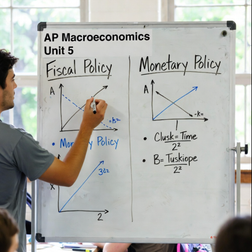
Dive into AP Macroeconomics Unit 5 with a comprehensive review of long-run consequences of stabilization policies. This episode breaks down short-run fiscal and monetary policy actions, their effects on aggregate demand, and introduces the Phillips Curve, equipping you with exam-ready graphs, multipliers, and pitfalls to avoid. Perfect for mastering FRQs and multiple-choice questions on recessionary/inflationary gaps. Key Topics Covered:Fiscal policy: Expansionary (spending up, taxes down) vs. contractionary mechanics and multipliers Monetary policy: Open market operations, money market graphs, interest rates, and AD shifts Short-run effects on real GDP, unemployment, and price level Policy lags, timing differences, and RIPE mnemonic for recessions Phillips Curve introduction and common AP exam pitfalls What You'll Learn:Master the full chain of causation for policy actions—like Fed bond buys leading to lower rates, higher investment, and rightward AD shifts. Calculate spending (1/(1-MPC)) and tax multipliers, draw money market + AD/AS graphs side-by-side, and identify gaps to choose expansionary or contractionary tools. Avoid traps like forgetting price level rises in expansions or confusing multiplier sizes. Whether you're prepping for the AP exam or understanding real-world policy, this episode reveals why short-run boosts can lead to long-run trade-offs—essential knowledge for scoring 5s. AP Macroeconomics Unit 5, fiscal policy, monetary policy, Phillips Curve, aggregate demand, AD/AS model, spending multiplier, tax multiplier, recessionary gap, inflationary gap, open market operations, money market graph, policy lags, AP exam review, FRQ tips Subscribe to Comprehensive AP Review: Prep With Detailed Content Review & Tips for full Unit 5 coverage, practice questions, and more!
AP Macro Unit 4: Financial Sector & Interest Rates
Dive into AP Macroeconomics Unit 4 with this detailed review of the financial sector, starting with financial assets and the crucial distinction between nominal and real interest rates. We'll break down bonds, stocks, money, and the loanable funds market, highlighting AP exam pitfalls like the inverse bond price-interest rate relationship and the Fisher equation. Perfect for students prepping to ace multiple-choice and FRQs on these high-yield topics. Key Topics Covered:Definition and role of financial assets as claims channeling savings to borrowers The big three: money (liquidity vs. return), bonds (face value, coupons, yields), and stocks (equity, dividends, risk-reward) Bond prices and interest rates: inverse relationship ("Rates Rise, Bonds Cry") Loanable funds market: supply/demand driven by real interest rates Nominal vs. real interest rates (Fisher equation: Real = Nominal - Inflation) Common AP pitfalls: interest rate risk, confusing nominal/real rates What You'll Learn:Master the mechanics of financial markets, calculate real yields, graph loanable funds shifts, and apply concepts to Fed policy impacts. Gain exam-ready insights like why rising rates lower bond prices and how inflation erodes purchasing power, with mnemonics and real-world examples to lock in retention. Why listeners should care: Understanding Unit 4 equips you to analyze how interest rates shape economic growth, investment, and your future finances—key for AP success and real-life decisions. AP Macroeconomics Unit 4, financial assets, bonds stocks money, loanable funds market, real interest rates, nominal vs real, Fisher equation, bond prices interest rates, AP Macro review, College Board exam tips Subscribe to Comprehensive AP Review: Prep With Detailed Content Review & Tips for full Unit 4 coverage, practice questions, and more!
AP Macro Unit 3: National Income & Price Determination
Dive into AP Macroeconomics Unit 3 with a detailed breakdown of National Income and Price Determination, starting with Aggregate Demand (AD) and the multiplier effect. This episode unpacks the AD formula, curve, shifters, and common exam pitfalls to build your foundational skills for acing the AP exam. Perfect for students prepping for FRQs and multiple-choice questions on macroeconomic equilibrium. Key Topics Covered:Aggregate Demand (AD): Definition, formula (AD = C + I + G + NX), and components Why the AD curve slopes downward: Wealth effect, interest rate effect, foreign purchases effect Movements along vs. shifts of the AD curve, with CITE mnemonic for shifters Common AP pitfalls: Transfer payments, inflation as movement, not shift Introduction to the multiplier effect and its ripple impact on spending What You'll Learn:Master the AD curve's mechanics, distinguish micro vs. macro demand reasons, identify shifters like consumer expectations and fiscal policy, and grasp how initial spending creates economy-wide ripples via the multiplier—essential tools for analyzing output and price levels on the AP exam. Why listeners should care: These concepts are the core of Unit 3 and appear in 20-30% of AP Macro exam questions, giving you the edge to score a 5. AP Macroeconomics Unit 3, Aggregate Demand, AD curve, spending multiplier, national income, price determination, AP exam prep, macroeconomics review, AD shifters, CITE mnemonic, wealth effect, fiscal policy Subscribe now for full Unit 3 coverage and more AP review tips!
AP Macro Unit 2: Circular Flow, GDP & Business Cycle
Dive into AP Macroeconomics Unit 2 with a detailed breakdown of economic indicators and the business cycle. This episode explores the circular flow model, mastering GDP calculations via the expenditure approach, and key limitations of GDP as a measure of economic health. Perfect for AP exam prep, you'll gain intuitive insights and mnemonics to ace related questions. Key Topics Covered:The circular flow model: households, firms, factor markets, product markets, leakages, and injections Full circular flow with government and foreign sectors (exports, imports, taxes, spending) GDP definition: market value of final goods/services produced domestically Expenditure approach formula: GDP = C + I + G + (X - M) with breakdowns and mnemonics Real vs. nominal GDP, avoiding double-counting and common pitfalls like transfer payments GDP vs. GNP distinctions Limitations of GDP: what it misses in measuring true well-being What You'll Learn:Grasp how money circulates in the economy like blood in a living system, calculate GDP accurately to sidestep AP traps, and understand why real GDP reveals true growth. You'll learn to differentiate investment from financial assets, spot leakages/injections for equilibrium analysis, and critique GDP's shortcomings for nuanced exam responses. Master these concepts to confidently tackle Unit 2 FRQs and multiple-choice questions, building a strong foundation for fiscal policy and business cycles ahead. AP Macroeconomics Unit 2, circular flow model, GDP expenditure approach, real vs nominal GDP, GDP limitations, business cycle, AP Macro exam prep, economic indicators, factors of production, net exports, leakages injections Subscribe to Comprehensive AP Review: Prep With Detailed Content Review & Tips for full Unit coverage, practice tips, and exam strategies!


AP Macro Unit 1: Scarcity & Basic Economic Concepts
Dive into AP Macroeconomics Unit 1 with this foundational episode on basic economic concepts, starting with the core idea of scarcity. Explore why limited resources and unlimited wants drive all economic decisions, from personal choices to national policies. Perfect for AP students building a strong base for exam success. Key Topics Covered:Definition and real-world meaning of scarcity Four factors of production: CELL (Capital, Entrepreneurship, Land, Labor) Opportunity cost and trade-offs due to scarcity Three basic economic questions: What, How, and Who (WHW framework) AP exam pitfalls: scarcity vs. shortage, free goods, capital distinction What You'll Learn:How scarcity forces choices for individuals, businesses, and governments The difference between economic capital and financial capital Why every society must answer the WHW questions Memorable mnemonics like CELL and WHW for quick recall on the AP exam Common traps to avoid, like confusing scarcity with shortage Master these essentials to tackle AP Macroeconomics with confidence and boost your exam score by understanding the root of all economic principles. AP Macroeconomics, Unit 1, scarcity, factors of production, opportunity cost, basic economic questions, AP exam prep, economic concepts, CELL mnemonic, WHW framework, macroeconomics review Subscribe to Comprehensive AP Review: Prep With Detailed Content Review & Tips for full Unit 1 coverage and more!
AP US History Unit 9: 1980-Present (Period 9 Intro)
Dive into AP US History Unit 9 (Period 9: 1980–Present) with a comprehensive contextual overview of America's post-Cold War era. This episode sets the stage by exploring the conservative shift under Reagan, globalization's economic impacts, the tech revolution, a unipolar world order, and rising social tensions. Master the key themes and connections to prior periods to ace your AP exam. Key Topics Covered:Contextualizing Period 9: America after the Cold War The conservative turn: Reagan's coalition, backlash to 1960s-70s upheavals Globalization: Economic integration, job shifts, trade debates Technology and the Information Age: Internet's transformation of society and politics New world order: Soviet collapse, unipolar moment, post-9/11 challenges Social/cultural shifts: Immigration, diversity, identity debates Mnemonic: GETS-D (Globalization, Economic restructuring, Technology, Social diversity, Democratic tensions) Preview: End of the Cold War What You'll Learn:Grasp the big-picture forces driving Period 9, including how conservatism responded to Vietnam/Watergate/stagflation, globalization hollowed out manufacturing, digital tech widened inequality, foreign policy swung from optimism to wars in Afghanistan/Iraq, and demographics fueled cultural conflicts. Learn to connect these to Periods 1-8 for continuity/change-over-time essays and DBQs. Why listeners should care: Understanding Period 9 equips you to analyze today's headlines—from trade wars and tech dominance to polarization and global rivalries—while boosting your AP score with exam-ready insights. AP US History, Period 9, 1980-Present, Reagan conservatism, end of Cold War, globalization, information age, APUSH Unit 9 review, post-Cold War America, AP exam prep Subscribe to Comprehensive AP Review: Prep With Detailed Content Review & Tips for full Unit 9 coverage, practice questions, and more!
AP US History Unit 8: 1945-1980 Cold War & Social Change
Dive into AP US History Unit 8 (Period 8: 1945-1980) with a comprehensive review of America's postwar era, from Cold War tensions to domestic upheavals. This episode sets the stage with contextual frameworks like the economic boom, civil rights struggles, and ideological battles, then previews key Cold War developments. Perfect for acing AP exam questions on contextualization, continuity, and change. Key Topics Covered:Contextualizing Period 8: Post-WWII America at the crossroads Cold War as the central framework: US vs. USSR chess match via proxy wars, arms races, and containment Domestic transformations: Postwar economic boom, suburbs, GI Bill, and unequal prosperity Tensions in the 1950s: Surface golden age vs. exclusion of minorities, women, and the poor Arc of change: Truman to Reagan, including Eisenhower's military-industrial complex CCSR mnemonic: Cold War, Civil Rights, Social Upheaval, Reform vs. Reaction Economic shifts: From boom to 1970s stagflation and eroded confidence What You'll Learn:Master the big-picture timelines, thematic pillars, and AP pitfalls like oversimplifying the postwar period. Gain tools to connect Cold War ideology to civil rights activism, Vietnam escalation, Great Society programs, Nixon's détente, and the roots of Reagan's conservatism. Learn how to contextualize events for DBQ and LEQ success, using anchors like WWII aftermath and economic anxiety. Whether you're prepping for the AP exam or deepening your understanding of 20th-century America, this episode reveals how global superpower status clashed with domestic inequalities, shaping modern US history. AP US History Unit 8, Period 8 1945-1980, Cold War containment, postwar economic boom, civil rights movement, Great Society, Vietnam War, Watergate, stagflation, military-industrial complex, Eisenhower, Kennedy, Johnson, Nixon, Reagan, AP exam review, DBQ tips, LEQ strategies Subscribe to Comprehensive AP Review: Prep With Detailed Content Review & Tips for full Unit 8 coverage, practice questions, and more!
AP US History Unit 7: 1890-1945 Imperialism & Context
Dive into AP US History Period 7 (1890-1945) with this episode, starting with essential contextualization of the Gilded Age's legacy, urbanization, immigration, and America's shift toward global imperialism. Explore the debates surrounding imperialism, including its roots in a closing frontier and economic ambitions, setting the stage for progressive reforms, world wars, and massive societal changes. Perfect for AP exam prep, this covers key themes like reform vs. resistance and U.S. international engagement. Key Topics Covered:Contextualizing Period 7: Gilded Age industrialization, urbanization, immigration waves Closing of the frontier and Frederick Jackson Turner's thesis America's outward turn: Imperialism in Cuba, Philippines, Hawaii Interconnected themes: Reform movements, world involvement, inequality Mnemonic "WIRE" (World Wars, Industrialization/Inequality, Reform, Expansion) Imperialism debates: Economic, military, and cultural motivations What You'll Learn:Master the big-picture forces driving 1890-1945 transformations, from Progressive Era responses to Gilded Age excesses to the debates over empire-building. Gain exam skills in contextualization for LEQs and DBQs, understanding cause-effect links like how urban tensions fueled reforms and nativism influenced policy. Why care? Grasping Period 7's connections unlocks high AP scores by showing graders you see history's interconnected web, not isolated events. AP US History Unit 7, Period 7 1890-1945, APUSH imperialism, Gilded Age context, Progressive Era reforms, Spanish-American War, Frederick Jackson Turner frontier thesis, AP exam contextualization, WIRE mnemonic APUSH, US imperialism debates Subscribe now for full Unit 7 coverage and ace your AP US History exam!
AP US History Unit 6: 1865-1898 Gilded Age Revolution
Dive into AP US History Unit 6 (1865–1898), the Gilded Age's "second American Revolution," where the US transforms from a war-torn nation into an industrial powerhouse. This episode contextualizes the era's massive shifts in industrialization, westward expansion, and immigration, while highlighting social tensions and reform movements. Perfect for AP exam prep with key frameworks like I-WRAP to ace contextualization questions. Key Topics Covered:Contextualizing Period 6: Post-Civil War America and the three big forces—industrialization, westward expansion, immigration Industrial boom: Railroads, steel, electricity, big business, and corporate monopolies Westward expansion: Completion of continental conquest, Dawes Act (1887), closing of the frontier (1890), Frederick Jackson Turner thesis New immigration vs. old: Shift to Southern/Eastern Europeans, Chinese Exclusion Act (1882) Social tensions: Grange, Populist Party, labor strikes (Great Railroad Strike 1877, Haymarket 1886, Pullman 1894) Race relations: End of Reconstruction, Black Codes, sharecropping, Plessy v. Ferguson (1896) I-WRAP mnemonic: Industrialization, Western expansion, Race/immigration, Agrarian discontent, Political corruption/reform What You'll Learn:Master connections between Period 6 and Reconstruction/Progressive Era, craft exam-ready contextualization statements, and analyze how industrial growth fueled US imperialism by 1898. Gain tools to tackle DBQs, LEQs, and SAQs on Gilded Age transformations. Why listen? This unit explains the roots of modern America—inequality, innovation, and identity crises—that shaped the 20th century and appear on every AP US History exam. AP US History, Unit 6, Gilded Age, 1865-1898, westward expansion, industrialization, immigration, Dawes Act, Chinese Exclusion Act, Plessy v Ferguson, Populist Party, labor strikes, Frederick Jackson Turner, AP exam prep, contextualization Subscribe to Comprehensive AP Review: Prep With Detailed Content Review & Tips for full Unit 6 coverage and more!
1 of 2