ChinaVoice

ChinaVoice

by ChinAffairsplus
Season 1
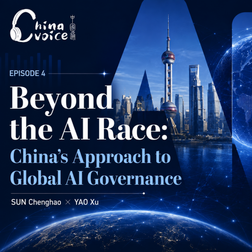
ChinaVoice #4 | Beyond the AI Race: China’s Approach to Global AI Governance
【Episode Description】 Artificial intelligence is advancing at an extraordinary pace globally, and the core debate has shifted from who owns more powerful models and advanced chips to how to carry out effective global AI governance. This year’s World Artificial Intelligence Conference (WAIC) provides a key window to observe this issue, as the conference has gradually transformed from a purely technical and industrial event to a high-level international platform focusing on global AI governance, and made new progress in promoting the establishment of the World AI Cooperation Organization (WAICO). What are the new changes of WAIC 2026? What is the positioning of WAICO, how should we understand the different international reactions to this initiative? How to evaluate the current advantages and bottlenecks of China’s AI development? How will AI competition between China and the United States evolve, and what is the space for practical cooperation between the two sides? What topics should be prioritized for the upcoming China-US governmental AI dialogue? In this episode of ChinaVoice, we invite Yao Xu from Fudan University, who has been deeply involved in related work, to analyze the transformation of WAIC, the development of WAICO, the current situation of China’s AI development, the prospect of China-US AI relations, and China’s contribution to global AI governance. 【Host】 SUN Chenghao, Senior Fellow, Center for International Security and Strategy, Tsinghua University 【Guest】 YAO Xu, Secretary-General of Center for Global AI Innovative Governance, an Associate Professor at the Fudan Development Institute, Fudan University. 【Shownotes】 00:54 Core issue of current AI development: how to establish common rules for global AI governance 01:24 WAIC 2026 focuses on global AI governance, the World AI Cooperation Organization was established 04:12 New changes of WAIC 2026: launched WAICO for broader international participation 05:24 WAIC’s transformation: became a high-level platform for global AI governance in 2024 07:05 Global South countries’ participation in the new AI governance organization 09:53 Global South countries’ demand for assistance in the AI field 11:28 China and global society have the responsibility to help Global South catch up in AI 13:55 AI capability assessment covers models, chips, talents and social absorption capacity 14:44 Chinese companies release cutting-edge AI models rapidly, global AI competition is intense 17:25 China is accelerating to catch up with the U.S. in semiconductors 21:26 Public concern about AI’s social impact, especially the issue of job replacement 22:24 Bill Gates proposes taxing job-replacing AI, China agrees with the proposal 32:28 Core goal of China-US governmental AI dialogue: identify common interests and prevent AI accidents 35:28 Open source AI models break technology monopoly, provide more options for global developers 38:19 China’s vision for AI development focuses on trust, extensive participation and cooperation 【Team】 Executive Producer: SUN Chenghao Producer: LI Yining, WANG Yinuo Content Editor: ZHANG Xueyu, LI Yijie, WANG Yexu Graphics Designer: ZHANG Xueyu
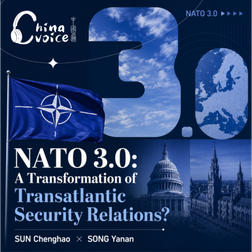
ChinaVoice #3 | NATO 3.0: A Transformation of Transatlantic Security Relations?
【Episode Description】 NATO has experienced huge challenges and profound structural transition. During the Ankara Summit in July, European members promised to significantly increase defense spending, showing that NATO is undergoing an evolution from burden sharing to responsibility transfer. This summit is regarded as a historic turning point in the transition of “NATO 2.0” into “NATO 3.0”, reflecting that the transatlantic relationship enters a new era and the development of NATO may face new challenges. What did the Ankara Summit leave behind? What does “NATO 3.0” means? Can higher defense spending produce strategic autonomy for Europe? Where is the transatlantic alliance heading? Against the background of major power competition and strategic transition of the U.S., a stronger and independent Europe is both a strategic goal and real needs. In this episode of the ChinaVoice, we invite SONG Yanan from SOAS University of London, analyze the outcomes of the summit, the development of “NATO 3.0”, the expectations of the U.S., the future of European defense autonomy, the prospect of future transatlantic relationship, as well as the potential influence on China-Europe relationship. 【Host】 SUN Chenghao, Senior Fellow and Associate Professor, Center for International Security and Strategy, Tsinghua University 【Guest】 SONG Yanan, Associate Professor, Department of Global Politics, SOAS University of London 【Shownotes】 02:31 Definition of the Summit: Strategic Rebalancing 05:01 Assessment of the Outcomes of the Summit 06:23 Whether Europe can deliver the promises is the real question 07:50 Definition of NATO 3.0: redivision of labor within the alliance 09:37 U.S. pressure on Europe reflects structural strategic shift rather than personal political style 12:44 Assessment of European Military Autonomy in the Future 16:03 Assessment of Transatlantic Defense Relationship in the Future 19:19 Prospect of Future Transatlantic Alliance 24:23 Europe will coordinate rather than completely align with the U.S. on China issues 25:08 The transatlantic alliance will be more balanced, more European and fundamentally transatlantic 【Team】 Executive Producer: SUN Chenghao Producer: WANG Yinuo, LI Yining Content Editor: LI Yijie, WANG Yexu, ZHANG Xueyu Graphics Designer: ZHANG Xueyu
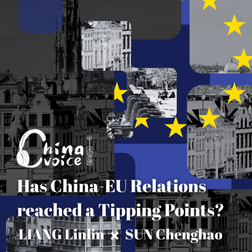
ChinaVoice #2 | China-Europe Relations: A Tipping Point?
【Episode Description】 Over the past year, European discourse on China has increasingly prioritized concepts such as economic security, de-risking, and industrial resilience, reflecting a significant shift in bilateral dynamics. Since the European Union officially defined China as a partner, competitor and systemic rival in 2019, the relationship has navigated a complex and often turbulent path. What are the structural sources driving current tensions, and how do issues like trade imbalances, investment hesitations, and the Ukraine crisis complicate the landscape? Furthermore, to what extent is Europe’s cautious approach rooted in an over-securitization of economic issues, driven by internal anxieties over sluggish growth and declining industrial competitiveness? As the EU's 27 member states navigate internal divisions to formulate a cohesive policy, maintaining pragmatic engagement remains crucial. In this episode of the ChinaVoice, we deeply engaged in China-Europe relations dissect the realities of European policymaking, the operational environment for Chinese enterprises in Europe, the mechanisms needed to prevent frictions from escalating into strategic confrontation, and the enduring necessity for bilateral cooperation in global governance, green transition and artificial intelligence. 【Host】 SUN Chenghao, Senior Fellow, Center for International Security and Strategy, Tsinghua University 【Guest】 LIANG Linlin, Director of Communication and Research of China Chamber of Commerce to the EU 【Shownotes】 02:24 Is Europe Echoing Washington's China Debate? 05:46 The EU's "Partner, Competitor, Systemic Rival" Framework 10:54 Three Major Sources of Bilateral Tension 13:42 Unpacking Europe's "Irrational Anxiety" and Economic Security 19:24 Internal Debates within the EU on Trade and Tech 24:53 Managing Friction: Dialogues and Mechanisms 30:14 Global Governance: Finding Room for China-EU Cooperation 【Team】 Executive Producer: SUN Chenghao Producer: LI Yining, WANG Yinuo Content Editor: ZHANG Xueyu, LI Yijie, WANG Yexu Graphics Designer: ZHANG Xueyu
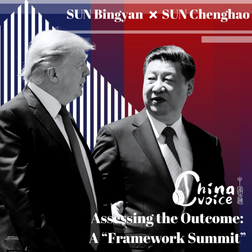
ChinaVoice #1 | Strategic Stability and the Future of China-U.S. Relations
Episode Description Over the past ten years, the narrative of strategic competition has dominated the development of Sino-U.S. relationship. But at the same time, both China and the U.S. need and are needed to cooperate to solve the geopolitical conflicts and promote global governance. During U.S. President Donald Trump’s visit to China after 9 years, a new concept proposed by China, a constructive China-U.S. relationship of strategic stability, was accepted by the U.S. and laid the foundation for the development of future bilateral relationship. What are the goals and evaluation for China and the U.S. regarding this Summit? Can this new strategic positioning improve Sino-U.S. relationship? As Sino-U.S. relationship has become one of the most important bilateral relationships in the world, keep high-level and institutional communication may itself inject momentum into global peace and development. In the first episode of the ChinaVoice, scholars with extensive Sino-U.S. study experience analyze the outcomes of the summit, the expectations of both countries, the significance of the new strategic positioning, balance between strategic competition and cooperation on global governance, as well as the prospects for bilateral relationship. 【Host】 ·SUN Chenghao, Senior Fellow, Center for International Security and Strategy, Tsinghua University 【Guest】 ·SUN Bingyan, Assistant Professor, Department of International Politics, University of International Relations 【Shownotes】 03:17 Definition of the Summit: Stabilization vs. Temporary Easing 08:26 China’s expectations from the Summit 10:50 The Summit has met China’s target 14:50 The signals released by new strategic positioning 21:29 U.S.’ expectations from the Summit 22:43 Trump takes the Summit seriously and treats China differently 26:06 The G2 Concept and China’s Reluctance 30:12 China and U. S. positions on Iran issues 31:37 Potential challenges for future China-U.S. relationship 【Team】 Executive Producer: SUN Chenghao Producer: WANG Yinuo, LI Yining Content Editor: ZHANG Xueyu, LI Yijie, WANG Yexu Graphics Designer: ZHANG Xueyu