Burning Questions: Conversations About Our Living World with Leslie Davenport

Burning Questions: Conversations About Our Living World with Leslie Davenport

by Leslie Davenport
Season 1
How does deep listening create systemic change? with LaUra Schmidt
I invite you to listen to this insightful, interview with LaUra Schmidt, the founder of the Good Grief Network and the brain behind the “10-Steps to Resilience & Empowerment in a Chaotic Climate” program and the FLOW Facilitation Training. She is a lifelong student, curator, and practitioner of personal and collective resilience strategies. She is the lead author in How to Live in a Chaotic Climate. Her work so skillfully centers on supporting heartfelt conversations as the foundation of peer support—really listening to one another, practicing sitting with discomfort so we can move forward together through the unknowns. Her work is essential in these rapidly changing times. Learn more about her and the Good Grief Network here: www.goodgriefnetwork.org https://goodgriefnetwork.org/book/ https://kinema.com/films/good-grief-t...
How do we shift our culture toward collective climate action? with Lise Van Susteren
Dr. Lise Van Susteren was thinking about climate change as a mental health issue over twenty years ago, and has been forging paths for this field in clinical practice, litigation efforts, and public advocacy ever since. Lise is remarkably clear-eyed about the work. We're fortunate to have her perspectives honed from years of experience. Dr. Van Susteren is a general and forensic psychiatrist based in Washington, D.C., and co-founder of the Climate Psychiatry Alliance and the Climate Psychology Alliance of North America. She's served as an expert witness on the psychological harm of climate inaction in Juliana v. United States and Held v. Montana, and co-authored Emotional Inflammation: Discover Your Triggers and Reclaim Your Equilibrium During Anxious Times. Find out more about her work with these organization: https://climatejunction.org/ https://www.climatepsychiatry.org/ https://www.climatepsychology.us/ #Climate #Psychology #ClimateAnxiety #MentalHealth #BurningQuestions
How do I find my Climate Magic? With Sarah Jaquette Ray

You may be used to hearing Sarah Jaquette Ray as the one asking questions on her own podcast, Climate Magic. But this time we get to turn the microphone the other direction and learn about her climate journey. One of the most frequently asked questions I hear from community members is how they can effectively contribute and really make a difference. On this episode of Burning Questions, Sarah helps us reframe the questions from "what should I be doing about climate change" to "what am I actually good at, and how does that serve this moment." Sarah Jaquette Ray, author of A Field Guide to Climate Anxiety and professor of environmental studies at Cal Poly Humboldt, shares how she personally navigated that shift, and arrived at her own "climate magic."" She describes climate magic as the specific, sometimes unglamorous contribution that only you are positioned to make, and that becomes powerful precisely because it's embedded in something larger than you. We talked about why individualism is such a trap in climate work — the pressure to personally solve an unsolvable problem, the guilt that follows when we can't — and why the answer isn't doing more alone but understanding our efforts as amplified by social and political context. But our actions, connected to community and movement, means something else entirely. Ways to connect with Sarah: Website: https://sarahjaquetteray.com/ Climate Magic: https://www.khsu.org/show/climate-magic LinkedIn: / sarahjaquetteray Subscribe to this channel to hear all the episodes and join our growing community. Because we're always better together.
Jennifer Uchendu: When the People Rise Together, Can Anything Stop Us?
I'm excited to share my conversation with Jennifer Uchendu Kalu: When the People Rise Together, Can Anything Stop Us? What does it look like when people refuse to wait for permission to act on climate? In this episode, I sits down with Jennifer Uchendu — Nigerian climate advocate, eco-anxiety researcher at Utrecht University, founder of SustyVibes, and one of BBC's 100 Most Influential Women of 2023 — to explore what it really means to reclaim our power in the face of the climate crisis. Together we dig into the ripple effects of everyday influence: how parents shape the next generation's relationship to the Earth, why keeping the conversation going matters even when it's hard, and what collective courage looks like when it rises from the ground up. Jennifer's work reminds us that people power is here! Learn more about Jennifer: Website: jenniferuchendu.com/ LinkedIn: linkedin.com/in/dzennypha/ Wikipedia: en.wikipedia.org/wiki/Jennifer_Uchendu Subscribe to this channel and become part of the growing community!
The Psychospiritual Roots of the Climate Crisis
What are the psychological and spiritual roots of the climate crisis, and what might healing actually look like? In this episode, Leslie Davenport speaks with Adrián Villaseñor Galarza, PhD, and integral/transpersonal ecopsychologist, international facilitator, ritualist, author, and contemplative practitioner passionate about human transformation in service to the living Earth. Adrián is Associate Professor in the Department of East-West Psychology at CIIS, founder of the Bioalchemy Institute, and founder of the Work That Reconnects Latin America. His work weaves together Eastern and Western liberation teachings, systemic-transpersonal developments, Earth wisdom, and ecopsychology into an elemental framework for self-discovery, healing, and regenerative action. Together, Leslie and Adrián explore the inner dimensions of our ecological moment — how disconnection from the living world runs deeper than behavior or belief, and what it takes to move from breakdown toward regenerative action by exploring the psychospiritual roots. 🌿 Learn more about Adrián's work: living-flames.com | bioalkimia.org | eltrabajoquereconecta.org
The Emergence of a New Culture
Isabel Cavelier Adarve is a writer, speaker, language and poetry wanderer, lawyer, former diplomat, advocate for planetary transition & creator of eco-social initiatives for cultural transformation. She co-founded mundo común in 2023 as an initiative dedicated to seeding and nurturing a culture of care, rooted in interdependence, in response to the contemporary planetary challenges. In this episode, she shares with us some of the foundations of mundo común, a speculative practice of the future in the present, and a collective design lab for a new relationality between the human and the more than human worlds. Isabel’s current work combines the co-creation of immersive somatic-narrative interspecies activations, biomimetic design of gathering spaces, and the amplification of re-worlding stories. The challenges posed by the climate crisis call us to review the ways in which we respond to the urgency. It is necessary but insufficient to address the visible symptoms of the current socio-environmental degradation that has deprived humanity of a sense of the open, loving and plural yet-to-come. The root causes of this crisis are related to our sense of identity and spiritual belonging. Check out their resources: mundo común’s website mundo común’s youtube channel mundo común on Instagram
The Polycrisis Is the Opening: Multisolving Our Way Forward
What if the most powerful response to compounding crises isn't doing more, but doing things that work on multiple levels at once? Dr. Elizabeth Sawin, founder of the Multisolving Institute and co-founder of Climate Interactive, has spent her career mapping the places where climate action, health equity, and community wellbeing converge. She calls this "multisolving," and it changes not just what we do, but how we understand leverage, hope, and what's actually possible right now. In this conversation, we explore how the living web of relationships we inhabit — ecological, social, political — becomes the very ground of transformation. Beth offers a framework that meets people across many entry points, inviting action on every scale, each choice a seed planted for a future of cohesion and justice. This is climate work that doesn't ask you to bracket your humanity to show up. It asks you to bring all of it. Learn more about Beth and her work through the Multisolving Institute.
The Importance of Cross-Generational Alliances
Dr. Jade Sasser shares her personal journey with climate change and how being evacuated during a wildfire powerfully deepened the direction of her work. She reminds us that resilience isn’t a single tool we reach for in crisis, but a wide, living landscape we tend over time. For her, that landscape stretches from teaching and advocacy to the simple grounding rituals of gardening and Pilates. And yet, at the center of it all is her devotion to students and to building intergenerational alliances, honoring the distinct gifts each generation carries while inviting us to share the responsibility for action together. Listening to her feels a bit like sitting with someone who is both steady and searching, someone who doesn’t pretend the road is easy but still believes deeply in walking it with others. I hope you enjoy hearing her as much as I did. She also has two wonderful books and a podcast on the climate-driven reproductive anxiety and politics that places race and social justice at the center. See more about her work at her website.
An Invitation to Transformative Leadership
In this episode, Dr. Renée Lertzman brings a rare blend of wisdom, depth, and grounded practicality to the conversation about climate change and human behavior. A pioneer in the psychology of climate emotions, she helps us move beyond overwhelm and polarization toward curiosity, compassion, and meaningful engagement. What I so appreciate in her work is the way she names what’s often unspoken—our defenses, ambivalence, and fears—without judgment, and then offers pathways forward that feel both humane and doable. In this conversation, Renée reminds us that responding to the climate crisis isn’t just about information or solutions; it’s about relationship, leadership, and learning how to stay present with what’s hard while still acting with care and courage. Dr. Renée Lertzman is a pioneer, who for 30 years has been bridging psychology with climate change, sustainability and existential threats. An academic-turned practitioner, she designs frameworks and methods that guide people to take action and create impact on climate and sustainability issues. Over the past two decades, Renée has worked with global leaders, startups, governments, and mission-driven companies—including Google, IKEA, the California Academy of Sciences —helping them navigate the emotional complexities of climate engagement. She is developing a new academy that equips changemakers with psychologically grounded resources for collective transformation. She is also working on a forthcoming book to be published by Viking in 2027. Website TED Talk Podcast, Accidental Gods
Bringing Our Wise Mind to Climate Conversations
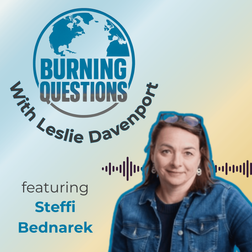
In this episode of Burning Questions, Steffi Bednarek offers the kind of grounded, soul-level guidance we ache for in a time of climate upheaval. She reminds us that navigating this moment isn’t just about strategies or solutions — it’s about honesty with ourselves, staying present with what’s hard, and cultivating the wisdom needed to move forward with clarity and courage. Her insights feel like deep water: steady, reflective, and quietly transformative. Steffi Bednarek is the founder and director of the Centre for Climate Psychology and editor of the book “Climate, Psychology and Change”, which reckons with the ways our innocent seeming familiar perceptions impact our myriad crises. Steffi is an accredited psychotherapist with over 25 years of clinical experience, which underpin her work in climate psychology and systems thinking. She has worked for local and national governments, the corporate sector, global financial institutions, the sustainability sector and large NGOs. Her work has been featured in the Huffington Post, the BBC, the Financial Times and numerous journals and publications.
1 of 2