Bible in a Year with Fr Paul

Bible in a Year with Fr Paul

by Fr Paul Guirgis
Season 2
Day 365 - Revelation 20-22
What, then, brothers, ought we to do? Should we grow slack in doing good and give up love? May the Lord never permit this to happen at any rate to us! Rather, should we be energetic in doing “every good deed” [Tit 3:1.] with earnestness and eagerness.… The good laborer accepts the bread he has earned with his head held high; the lazy and negligent workman cannot look his employer in the face. We must, then, be eager to do good; for everything comes from him. For he warns us, “See, the Lord is coming. He is bringing his reward with him, to pay each one according to his work.” He bids us, therefore, to believe on him with all our heart and not to be slack or negligent in “every good deed.” He should be the basis of our boasting and assurance. We should be subject to his will. We should note how the whole throng of his angels stand ready to serve his will. For the Scripture says, “Ten thousand times ten thousand stood by him, and thousands of thousands ministered to him and cried out: Holy, holy, holy is the Lord of Hosts: all creation is full of his glory.” [Isa 6:3.] We too, then, should gather together for worship in concord and mutual trust and earnestly beseech him as it were with one mouth, that we may share in his great and glorious promises. For he says, “Eye has not seen and ear has not heard and human heart has not conceived what he has prepared for those who patiently wait for him.”—St Clement of Rome
Day 364 - Revelation 17-19
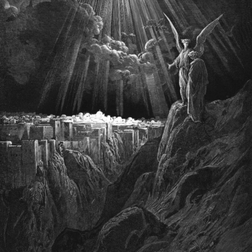
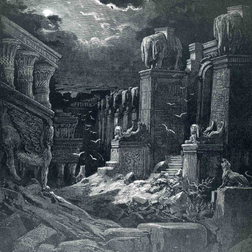
Later, when the seer is commanded to behold the wife of the Lamb, he sees the holy city coming down from heaven, and he says concerning her, “The kings of the earth carried their glory into her.” [Rev 21:24.] For in the world there are two cities, one that arises from the abyss and the other that comes down from heaven. And so now he compares the same ungodliness, which he had described in the form of a harlot made naked and burned up, with the ruins of a deserted city—The Venerable Bede
Day 363 - Revelation 13-16
Since then in this world some persons come to the light, and by faith unite themselves to the light and by faith unite themselves with God, but others shun the light and separate themselves from God, the Word of God comes preparing a fit habitation for both. For those indeed who are in the light, that they may derive enjoyment from it and from the good things contained in it; but for those in darkness, that they may partake in its calamities.… For this reason the apostle says, “Because they did not receive the love of God, that they might be saved, therefore God shall also send them the operation of error, that they may believe a lie, that they all may be judged who have not believed the truth, but consented to unrighteousness.” [2Th 2:10-12.] For when [antichrist] arrives, and of his own accord concentrates in his own person the apostasy, and accomplishes whatever he shall do according to his own will and choice, sitting also in the temple of God, his dupes will adore him as the Christ. Therefore he shall deservedly “be cast into the lake of fire,” [Rev 19:20.] [and this will happen according to divine appointment], God by his prescience, foreseeing all this at the proper time sending such a man, “that they may believe a lie, that they all may be judged who did not believe the truth, but consented to unrighteousness.”—St Irenaeus of Lyon
Day 362 - Revelation 10-12
He indicates that when he ate the book sweetness would be mixed with bitterness. That is to say, that when he is released from exile, he was to preach the gospel to the nations. This would be a sweet task as regards love, but it would be a bitter work on account of the persecutions that he would endure—The Venerable Bede
Day 361 - Revelation 6-9
With a loud voice [the martyrs] sing of salvation from God, since they recall with great thanksgiving that they have triumphed, not by their own virtue but by his help, in the struggle with the tribulations assailing them—The Venerable Bede
Day 360 - Revelation 1-5
Although it was after us that he was made man for us and became our brother by likeness of body, still he is called and is the firstborn of us. Since all people were lost through the transgression of Adam, Christ’s flesh was saved first of all and was liberated, because it was the Word’s body. Henceforth also we, having become joined together with his body, are saved through it. For in his body the Lord becomes our guide to the kingdom of heaven and to his own Father, saying,“I am the way” [Jhn 14:6.] and “the door,” and “through me all must enter.” [Jhn 10:9.] Wherefore he is also said to be “firstborn from the dead,” not because he died before us, since we died first, but because he suffered death for us and abolished it, and therefore, as man, was the first to rise, raising his own body for our sakes. Therefore, since he has risen, we too shall rise from the dead from him and through him—St Athanasius of Alexandria
Day 359 - 1 John 1-5, 2 & 3 John
This book is very sweet to every healthy Christian heart that savors the bread of God, and it should constantly be in the mind of God’s holy church. But I choose it more particularly because what it specially commends to us is love. The person who possesses the thing which he hears about in this epistle must rejoice when he hears it. His reading will be like oil to a flame.… For others, the epistle should be like flame set to firewood; if it was not already burning, the touch of the word may kindle it—St Augustine
Day 358 - Hebrews 9-13
If they are not seen, how can you be convinced that they exist? Well, where do these things that you see come from, if not from one whom you cannot see? Yes, of course you see something in order to believe something, and from what you can see to believe what you cannot see. Please do not be ungrateful to the one who made you able to see; this is why you are able to believe what you are not yet able to see. God gave you eyes in your head, reason in your heart. Arouse the reason in your heart, get the inner inhabitant behind your inner eyes on his feet, let him take to his windows, let him inspect God’s creation—St Augustine
Day 357 - Hebrews 5-8
Now, how long shall we saw away along the same line on this question [i.e., what is permitted], when we have a long-standing practice which by anticipation has all but settled the question? Even though no scriptural passage prescribes it, it is strengthened by a custom that certainly arose from tradition. How can anything become normal practice if it has not first been handed down to us? But, you tell me, “You must always have a written source if you are going to plead the force of tradition.” Let us look into the matter, then, of whether or not a tradition without a written source should be accepted. The answer will certainly be no if we cannot adduce examples of other observations which are without written source in Scripture and rest solely on the basis of tradition and yet have come to have the force of custom. To begin, for instance, with baptism: When we are about to enter the water, and, as a matter of fact, even a short while before, we declare in the presence of the congregation before the bishop that we renounce the devil, his pomps and his angels. After that, we are immersed in the water three times, making a somewhat fuller pledge than the Lord has prescribed in the gospel. [See Mat 28:19.] After this, having stepped forth from the font, we are given a taste of a mixture of milk and honey [Cf. 1Co 3:2; 1Pe 2:2.] and from that day, for a whole week, we forego our daily bath. We also receive the sacrament of the Eucharist that the Lord entrusted to all at the hour for supper, at our early morning meetings, and then from the hand of none but the bishops. Further, we make offerings for the dead on their anniversary to celebrate their birthday of eternal life. We consider fasting or kneeling during service on Sundays to be unlawful, and we enjoy the same privilege from Easter until Pentecost. We also are upset if any of our bread or wine falls to the earth at the Lord’s Supper. Lastly, we make the sign of the cross on our foreheads at every turn, at our going in or coming out of the house, while dressing, while putting on our shoes, when we are taking a bath, before and after meals, when we light the lamps, when we go to bed or sit down, and in all the ordinary actions of daily life—Tertullian
Day 356 - Hebrews 1-4
You see, those old sacrifices of the people of God also represented in a variety of ways this single one that was to come. Christ himself, I mean, was both a sheep, because of his innocence and simplicity of soul, and a goat because of “the likeness of sinful flesh.” [Rom 8:3.] And whatever else was foretold “in many and various ways” in the sacrifices of the old covenant refers to this single one which has been revealed in the new covenant—St Augustine
1 of 37