Life, Liberty, and Smallpox: How Medicine Helped Win the Revolutionary War
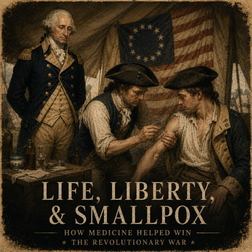
The British weren’t the deadliest enemy facing George Washington’s army. Disease was. And one controversial medical decision may have helped save the American Revolution. In this special Independence Day episode of Beyond Ether Dome, Dr. Robert Lane and Dr. Bart Patenaude explore the Revolutionary War through the eyes of its soldiers, surgeons, and patients. More American servicemen died from disease and imprisonment than on the battlefield. Dysentery swept through unsanitary camps. Typhus followed lice, hunger, and overcrowding. Smallpox devastated military units, discouraged enlistment, and helped cripple the American campaign in Canada. We examine what medicine could—and could not—do for the ordinary soldier. We follow a country doctor who happened upon James Monroe on the road to Trenton and then saved the future president’s life after a musket ball severed an artery. We look at the bloodletting of George Washington during his final illness and reconstruct, step by step, the brutal reality of a Revolutionary-era battlefield amputation: the tourniquet, the knife, the saw, the tenaculum, and the race to control hemorrhage without anesthesia or modern resuscitation. Finally, we turn to smallpox. Long before vaccination, physicians deliberately infected healthy people through a dangerous procedure called inoculation. George Washington initially prohibited the practice in the Continental Army. Then the evidence changed—and Washington changed his mind. His decision led to one of the largest organized medical interventions of the eighteenth century. Soldiers were inoculated in stages, quarantined, and returned to service with immunity to a disease that had threatened the survival of the army itself. The American Revolution was won with muskets, artillery, endurance, and French assistance. But medicine had a role too. In this episode: Why disease killed more American soldiers than combat The horrors of British prison ships and military prisons Dysentery, typhus, malaria, and smallpox in the Continental Army Starvation, exposure, and disease at Valley Forge What Revolutionary War doctors actually did for sick soldiers How Dr. John Riker saved the wounded James Monroe George Washington’s final illness and massive bloodletting Which battlefield wounds were survivable in the eighteenth century A step-by-step reconstruction of a battlefield amputation without anesthesia The difference between smallpox inoculation and vaccination Why inoculated patients could spread smallpox Why Washington initially banned inoculation How the Canadian campaign changed his thinking How the Continental Army carried out inoculation without incapacitating the entire force Why Washington’s willingness to change his mind mattered to the war Beyond Ether Dome is a podcast about the history of modern medicine and healthcare: the discoveries, disasters, personalities, institutions, and ideas that made medicine what it is today.