AI Futures: Beyond Human Labor

AI Futures: Beyond Human Labor

by Jaffar Humayoon
Season 1
The Machines Worked Too Well
AI
Is the world ready for an explosion in productivity? Inspired by the insights of Jaffar Humayoon, we examine the concept of "Excess Global Productivity." This episode breaks down why traditional economic models might fail in an AI-driven future and explores the transition from "human-in-the-loop" to "AI-at-the-helm." We're discussing the end of the productivity gap and the start of a new global paradigm. Read the original article here: AI Futures | Episode 1 of 30: The Machines Worked Too Well Join us as we discuss the first installment of the AI Futures series and what it means for the next decade of work and wealth.
The Cognitive Tier Framework
AI
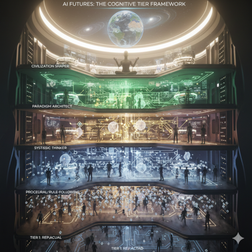
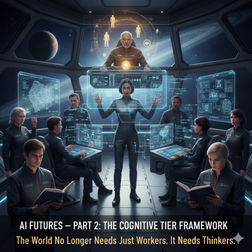
What happens when intelligence becomes a commodity that scales like software? In this second episode of the AI Futures series, we move beyond the vague idea of "automation" to explore the Cognitive Tier Framework. Based on the analysis by Jaffar Humayoon, we break down how AI is systematically moving through the layers of human capability—from basic task execution to complex reasoning and strategic intuition. We discuss: The Five Tiers of Intelligence: How we are transitioning from "Tool-based AI" to "Agentic Autonomy." The Tokenization of Thought: Why human expertise is being priced against the cost of a token, and what that means for the professional class. The "Reasoning Gap": Why the last bastions of human value—nuance and high-stakes judgment—are being encroached upon faster than anticipated. This isn't just about jobs being replaced; it's about the fundamental restructuring of how value is created and captured in an AI-native economy. We examine the framework that explains why some industries are dissolving while others are being rebuilt from the "silicon up." Original Script & Analysis: AI Futures | Episode 2 of 30: The Cognitive Tier Framework
Is Thought Factory possible?

AI
Building on the foundation of the Cognitive Tier Framework, we examine the transition from individual intellectual effort to "Industrialized Cognition." We dive into the logic of a world where "thinking" is no longer a bespoke human craft, but a high-volume output of massive compute power. Key topics include: The Industrialization of Logic: Moving from AI as an assistant to AI as a self-contained production floor for complex thought. The Death of the "Draft": How the elimination of the human iterative process changes the speed—and value—of intellectual property. The Efficiency of Insight: What happens to the global market when high-level strategy and innovation become cheap, instant, and infinite? The Quality vs. Scale Paradox: Can a "factory" produce original thought, or are we entering an era of perfectly optimized derivative intelligence? We challenge the traditional belief that "creative" or "strategic" roles are safe from automation by looking at the economic mechanics that make the Thought Factory not just possible, but inevitable. Original Script & Analysis: AI Futures | Episode 3 of 30 : Is Thought Factory possible?
The Schools That Taught Irrelavant

AI
What happens when the global education system continues to manufacture "human processors" for an economy that no longer requires them? In this episode of the AI Futures series, we examine the widening chasm between academic curricula and the new reality of the AI-driven market. Based on the analysis by Jaffar Humayoon, we discuss the "Education Lag"—the phenomenon where the skills currently being certified by universities are the very ones being commoditized by AI in real-time. We explore: The Processor Factory: Why our current school systems are designed to create efficient, repeatable cognitive labor—a role AI now performs for near-zero cost. The Skills-Value Decoupling: Why a degree no longer serves as a reliable proxy for economic value in a world of "Tokenized Intelligence." The Legacy of Rote Knowledge: How institutional inertia prevents schools from pivoting away from teaching "what to think" toward "how to navigate" a post-labor world. The Credential Crisis: As AI collapses the value of entry-level professional work, what becomes of the millions of students currently training for roles that are disappearing before graduation? We hold a mirror to our educational institutions and ask: Are we preparing the next generation for a future that exists, or are we simply teaching them how to be obsolete? Original Script & Analysis: AI Futures | Episode 4 of 30 : The Schools That Taught Irrelavant
The Demographic Misalignment
AI
What happens when a shrinking, aging global workforce finally meets its replacement—but the economic timing is disastrous? In this episode of the AI Futures series, we explore the "Demographic Misalignment," a critical intersection where human population trends collide with the exponential growth of AI. Based on the analysis by Jaffar Humayoon, we dive into the paradox of the "missing workers" and the "excess intelligence" that defines our current era. We discuss: The Silver Tsunami meets Silicon: How aging societies originally looked to AI as a solution for labor shortages, only to find that the technology doesn't just fill gaps—it erases the roles entirely. The Tax Base Erosion: The looming crisis for social safety nets when the "tax-paying worker" is replaced by a "non-tax-paying token". The Global North vs. South Divide: Why demographic trends in different regions mean AI will impact a youthful, growing Africa very differently than a shrinking, aging Europe or East Asia. The Consumption Trap: If the working-age population disappears or loses its income to automation, who is left to buy the goods and services the "Thought Factories" are producing? We move beyond simple "jobs" talk to look at the macro-level stability of nations. Are we using AI to save our aging societies, or are we inadvertently accelerating their economic irrelevance? Original Script & Analysis: AI Futures | Episode 5 of 30 : The Demographic Misalignment
History Doesn’t Loop Back

AI
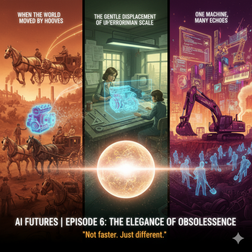
One of the most dangerous comforts we cling to is the belief that because society survived the Industrial Revolution, it will naturally survive the AI Revolution. In this episode of the AI Futures series, we dismantle the "historical loop" fallacy and explore why our current trajectory is a break from history, not a repeat of it. Based on the analysis by Jaffar Humayoon, we examine the fundamental differences between mechanical muscle and digital mind. We discuss: The Replacement vs. Enhancement Myth: Why the shift from horses to cars is a poor metaphor for the shift from human cognition to AI. The Speed of Adaptation: How the centuries-long timeline of previous industrial shifts has compressed into a few short years, leaving no room for generational retraining. The "General Purpose" Trap: Unlike the steam engine or electricity, which were tools that required human operators, AI is a tool that operates itself, decoupling productivity from human presence. The End of New Frontiers: Why the classic economic argument that "new jobs will be created" fails when AI is the very entity that will fill those new roles more efficiently than any human. We challenge the optimism of the "history repeats itself" crowd by looking at the unique, non-linear nature of AI. This isn't a loop; it's a leap into an entirely different operating system for humanity. Original Script & Analysis: AI Futures | Episode 6 of 30 : History Doesn’t Loop Back
The Productivity Illusion
AI
We are taught that higher productivity is the ultimate sign of economic health. But what happens when that productivity is no longer tied to human prosperity? In this episode of the AI Futures series, we pull back the curtain on The Productivity Illusion. Based on the analysis by Jaffar Humayoon, we explore the dangerous decoupling of corporate output from societal well-being. We discuss: The Ghost in the Machine: How GDP and corporate earnings can skyrocket even as the "human" economy—wages, purchasing power, and job stability—hollows out. Efficiency vs. Value: Why doing things "faster and cheaper" with AI creates a surplus that the average worker can no longer afford to consume. The Measurement Trap: Why traditional economic metrics are failing to capture the reality of a world where "value" is generated by tokens rather than time. The Hollow Growth Paradox: An examination of how a nation can appear wealthier on paper while its citizens feel increasingly economically excluded. We challenge the assumption that "more" is always "better" and ask: If the system is producing at record levels but doesn't need you to participate, is it still an economy—or just an engine running in an empty room? Original Analysis: AI Futures | Episode 7 of 30 : The Productivity Illusion
MAANG’s Human to Token

AI
What happens when the world’s most powerful tech companies realize their greatest asset isn't their people, but their compute? In this episode of the AI Futures series, we analyze the radical transformation of Big Tech—shifting from the "Human-Centric" era to the "Token-Centric" era. Based on the analysis by Jaffar Humayoon, we explore how the titans of industry (MAANG) are quietly re-architecting their entire business models to prioritize AI-native operations over human talent. We discuss: The Unit of Value Shift: Why companies are moving away from measuring success by "revenue per employee" to "revenue per token". The Invisible Downsizing: How the move toward AI-native organizations leads to a structural "hollowing out" of departments that once required thousands of workers. The "Human as a Bottleneck": Why the speed of AI development is making human decision-making and manual labor appear as a drag on corporate efficiency. The Talent Arbitrage: A look at how Big Tech is trading massive payrolls for massive energy and compute budgets, fundamentally changing the nature of a "tech job". We look past the press releases to the cold logic of the corporate balance sheet. Is the era of the high-status tech worker coming to an end in favor of the optimized algorithm? Original Script & Analysis: AI Futures | Episode 8 of 30 : MAANG’s Human to Token
The Corporate Balance sheet

AI
For decades, the corporate balance sheet has been a map of human talent and physical assets. But as AI integrates into the core of the enterprise, the map is being redrawn. In this episode of the AI Futures series, we explore the radical evolution of The Corporate Balance Sheet. Based on the analysis by Jaffar Humayoon, we examine how the shift from "Human-in-the-loop" to "AI-at-the-helm" fundamentally changes how companies value themselves and their future. We discuss: The Transition from OpEx to CapEx: Why human payroll (Operating Expense) is being traded for massive investments in permanent AI infrastructure and compute power (Capital Expenditure). The Liquidation of Legacy Talent: Why the "assets" on a balance sheet are shifting from specialized human teams to proprietary models and datasets. The Efficiency Trap: How companies are optimizing for a world where marginal costs drop to near zero, but the cost of entry—owning the "intelligence"—skyrockets. The Valuation Gap: Why traditional accounting methods are failing to reflect the true health of a company that is producing record output with a fraction of the traditional workforce. We dive into the cold logic of the ledger to see the future of the firm. Is the modern corporation becoming a "Black Box" of automated value, and if so, where does the human stakeholder fit in the final tally? Original Script & Analysis: AI Futures | Episode 9 of 30 : The Corporate Balance sheet
The Loyalty Illusion in the Efficiency War
AI
"This isn't betrayal. It's just math." In Episode 2 of our AI Futures series, we pull back the curtain on the "Loyalty Illusion." For decades, the corporate world ran on a silent agreement: work hard, stay loyal, and you’ll have a place. But as AI transitions from a tool to a teammate—and eventually to the helm—that story is collapsing. In this episode, we discuss: The Refactoring: Why corporations aren't "evil" for replacing labor, they're simply following market mechanics. The Tokenized Org: A look at the $220M shift from human departments to autonomous AI tokens. The Efficiency War: Why choosing empathy over efficiency has become a form of corporate "suicide" in the new economy. We aren't witnessing a moral failure; we’re witnessing a systemic reset. Welcome to the AI economy, where value isn’t hired—it’s deployed. 🔗 Read the original article: AI Futures | The Loyalty Illusion in the Efficiency War
1 of 5