Zenith Massif

Zenith Massif

di YJL

Copenhagen: The Country That Built What It Needed

Something most people don't know about the human eye: the retina is installed backwards. The photoreceptors — the cells that actually detect light — face the back of the eye rather than the front. Light entering the eye has to pass through several layers of neurons and capillaries before reaching them, traveling in the wrong direction through the mechanism it's meant to activate. Scientific American has described the arrangement as equivalent to putting a microphone in backwards and using the wired end to capture sound. The octopus and the squid solved this 400 million years ago; their photoreceptors face the light directly. Vertebrate eyes — ours — did not solve it. An engineer who submitted this design would be sent back to revise it.
The good glasses: A Statement You Wear on Your Face

Something most people don't know about the human eye: the retina is installed backwards. The photoreceptors — the cells that actually detect light — face the back of the eye rather than the front. Light entering the eye has to pass through several layers of neurons and capillaries before reaching them, traveling in the wrong direction through the mechanism it's meant to activate. Scientific American has described the arrangement as equivalent to putting a microphone in backwards and using the wired end to capture sound. The octopus and the squid solved this 400 million years ago; their photoreceptors face the light directly. Vertebrate eyes — ours — did not solve it. An engineer who submitted this design would be sent back to revise it.
GEHRY & ZAHA: TITANS OF CURVES

Last December, Frank Gehry died at home in Santa Monica, ninety-six. When I saw the news, I sat with it for a moment, then opened my laptop and looked for a long time at one photograph — Gehry standing in front of the Guggenheim Bilbao in 1997, just finished, the building behind him like a docked spacecraft, the titanium flashing silver in the sun. He looked like a man who had just completed something very difficult and discovered it was entirely worth it. I was his student first, and later worked in his office. He said something I've kept ever since: always do it for humanity. This one is about two people. Frank Gehry and Zaha Hadid. The two most alike figures of the same era. A Canadian Jew who grew up in Los Angeles and found the soul of architecture in a crumpled piece of cardboard, and an Iraqi woman who grew up in Baghdad and drew, with a brush, spaces no one believed could be built. Their careers crossed in the same decades, in a mutual respect that never once tipped into imitation.

DTLA: The Toy Nobody Wanted

I lived in DTLA for a while. Groceries, class, sleep, and the smell that met me every morning when I walked out the door — coffee and urine, mixed. That stretch changed how I think about cities, because DTLA is a strange place. It holds the densest homeless population in the country and some of the most expensive contemporary art in the world, at the same time. There's a concert hall by Gehry, and two minutes away, a full block of tents. Outside a blue-chip gallery, a truck selling three-dollar tacos. A little further, a Le Labo, where a bottle of perfume runs three hundred. In most cities you have to go looking for that kind of contrast. In DTLA it was on my walk to school.

EP16 Tribeca: where I wept and lived

New York, seen from the air, produces a specific physical response before you've even landed. Something tightens in the chest. Manhattan sits down there like a narrow stone arrowhead — pinched between the Hudson and the East River, pointed south. The further south you go, the denser it gets, the heavier it gets. More steel, more history, more weight per square foot. Keep descending. You'll see the Statue of Liberty standing offshore, the way she always has. You'll catch a long reflection — two square pools, like eyes looking straight up at the sky. Then a white glass tower, catching light the way towers in this city have always caught light, like they're competing with the sun. And next to it, that strange white skeletal creature emerging from the ground. That's where we're going.

EP15 Sushi: A global export worldwide

There's a restaurant in Tokyo called Saito. You can't call to make a reservation. You can't book online. You get in because an existing guest introduces you, and the chef decides whether he wants you there. People wait years. The room is small — ten seats at the bar. Chef Takashi Saito goes to Toyosu Market every morning and selects the fish himself. He doesn't use refrigeration. Every piece arrives in front of you at the exact moment he's decided it should be eaten. One person. One meal. Four hundred dollars, starting.

Disney: the empire of happiness

Start with a number: $91 billion. That's what the Walt Disney Company brought in during fiscal year 2024. One company running nearly every piece of business that has anything to do with happiness — films, television, theme parks, cruise ships, streaming, ESPN, and a private island in the Bahamas. Its parks host over a hundred million visitors a year. Its streaming platform has 230 million subscribers. Its cruise fleet is expanding to 13 ships by 2031. All of it traces back to a young man who had just gone bankrupt, riding a train, sketching a mouse.

Tokyo: The canvas for sparkles.

Tokyo is a city that lives inside a Rashomon. Walk into it and you will see a different city from the person standing next to you. History and the future coexist without apparent friction. The supernatural and the rational share the same postcode. Silence and noise are separated by a single door. No version is false. None is complete.

BENTELY X AUSTIN MARTIN

TL;DR In 1930 an Englishman raced his Bentley against France's fastest train, beat it by the width of the Channel, and sat down to wait. Bentley has booked six straight profitable years at a 14% margin; Aston Martin lost £324 million last year — two completely different ways to stay alive. What you pay millions for isn't a car. It's a hundred years of lineage.

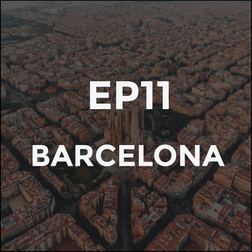
BARCELONA: A Toast to the Windmills

Cervantes wrote an old man on a bony horse, a rusted lance in his hand, who saw the windmills standing in a field and charged. His squire shouted after him — they're windmills, they're windmills — and the old man looked back and said something about doing battle with the great windmill of life. Everyone agreed he was mad. Every time I read it, I feel something closer to envy: the willingness to charge at a thing simply because it has weight in your chest, with no thought of whether it pays. Past a certain age, after you've seen enough, that turns out to be the rarest thing a person can hold onto. I took the old man with me to Spain — a few days in Barcelona, then a flight, on a whim, to Mallorca.
1 di 2