Work is Weird Now

Work is Weird Now

di Danielle Emery
Stagione 7
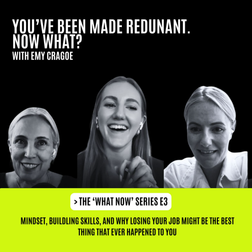
E63: You've been made redundant, Now what? With Emy Cragoe
The third episode in our "What Now" mini-series, exploring the questions people are really asking themselves when the old rules of work and life no longer apply, tackles redundancy. This week's guest, Emy Cragoe, co-founder of Ori, a new platform rethinking how people understand themselves, navigate their careers, and communicate their value, makes the case for flipping the stigma around redundancy entirely. After redundancy prompted her own career rethink, Emy is now building the tool she wishes she'd had. In this episode, Emy talks to Dan and Alice about: What it actually felt like to be made redundant just before Christmas, and why she now sees it as one of the best things to happen to her Why school and university leave people so unprepared to understand their own strengths The difference between mentors, career coaches and sponsors, and why sponsorship might be the most underrated of the three Her practical, three-step advice for anyone facing redundancy right now Why she thinks the stigma around redundancy is fading, and what actually matters is what you do next Building Ori, an AI careers intelligence platform designed to match people to roles, mentors and skills based on who they really are "I almost think that people who are being made redundant now or in the next year or so are actually quite fortunate." This is episode three of "What Now," our mini-series on what comes next when the old script stops applying. Find out more and join the waitlist at ori.careers, or follow Emy on TikTok at @emmy.cragoe.
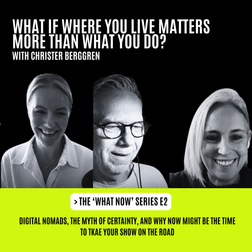
E62: What if where you live matters more than what you do? With Christer Berggren
Continuing our "What Now" mini-series on the questions people are really asking themselves when the old rules of work and life no longer apply, this episode turns to place. This week's guest, Christer "Chris" Berggren, a Swedish senior project and production professional, community builder and advocate for location independent living now based in Bulgaria, has spent three decades proving that where you live can matter more than what you do. Chris was living a nomadic life in touring and events back in the mid-90s, long before anyone had coined the term "digital nomad." Six years of it were spent on a sailboat, four square metres of floor space, working from wherever the boat happened to be. In this episode, Chris talks to Dan and Alice about: Why he feels more at home in Sofia than he ever did in Sweden The gap between the "laptop on a beach" fantasy and the 24/7 reality of building a location-independent life How stripping away job titles changes the way people connect with each other Redefining success on his own terms as he turns 65 this year Why chosen community, not proximity, is what makes a place feel like home "I don't care about success anymore. It's not what you are saying. It's the outcome of what you are saying that matters, always. Am I successful? For myself, I am." This is episode two of "What Now," our mini-series on what comes next when the old script stops applying. Find Chris's work at gosso.bg and his blog, Me and Bo Life.
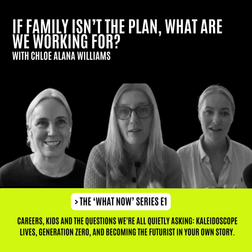
E61: If family is no longer the plan, what are we working for? With Chloe Williams
For generations, adulthood came with a promise: work hard, progress in your career, buy a house, start a family. This episode kicks off our new "What Now" mini-series, digging into the questions people are really asking themselves when the old rules no longer apply. Our first guest, strategist and writer Chloe Alana Williams, co-founder of 8th Day, describes the old promise as a three-legged stool. For anyone entering the workforce now, all three legs have been kicked out. In this episode, Chloe talks to Dan and Alice about: Why we used to live in sync with each other and now live "kaleidoscope lives," hitting major milestones out of order or not at all Why Japan's decision to support families from birth to age 18, rather than a one-off baby bonus, is starting to move the numbers where almost nothing else has A US survey in which having children didn't crack the top ten markers of a successful life for women, regardless of who they voted for Chloe's concept of "Generation Zero," a possible first generation in which half the population doesn't have children Why she believes women need to become "futurists in their own lives," planning backwards from the future they actually want A brand new framework for building a portfolio career, floated live on air: something you know, something to grow, and somewhere for flow This isn't an episode about doom, and it isn't an episode about blaming women, a narrative Chloe firmly dismantles. It lands somewhere surprisingly hopeful: that what work has always quietly provided, connection, community, people in each other's orbit, might be exactly what we should be redesigning it around. This is episode one of "What Now," our mini-series on what comes next when the old script stops applying. More episodes coming soon. Find Chloe's writing on her Substack, Natalism Nudges, on LinkedIn, and at chloealana.com.
Stagione 6
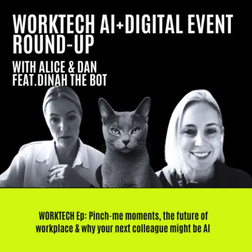
E60: Worktech AI+Digital round-up with Alice, Dan & Dinah
IA
Dan and Alice took an AI agent called Dinah to a conference at Meta's Kings Cross HQ — and let her challenge a room of 100 senior leaders live on stage. In this episode they unpack what happened, what surprised them, and what it actually feels like to work alongside AI. Then they hand the mic to Dinah herself.
E59: What is today's best career advice? With Alice and Dan
What’s today’s best career advice? In this solo episode of Work is Weird Now, Alice Phillips and Dan Emery unpack the career advice that no longer fits the reality of modern work — from climbing the corporate ladder and staying loyal to one company, to following your passion at all costs. Instead, they explore what actually matters now: building T-shaped skills, learning continuously, creating optionality, and staying visible in an increasingly AI-shaped job market. Along the way, they reflect honestly on identity, ambition, burnout, and why tying your entire sense of self to a job title might be one of the biggest risks of all. A conversation about careers, reinvention, and how to stay adaptable when the rules keep changing.
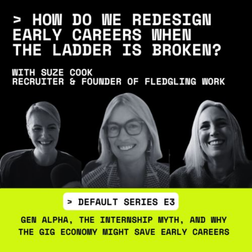
E58: How Do We Redesign Early Careers When the Ladder is Broken? With Suze Cook
In this episode of Work Is Weird Now, Dan and Alice sit down with Suze Cook to unpack what happens when the traditional career ladder no longer works for early career talent. From hidden internships and broken graduate pathways to project-based work, AI-native skills and social mobility, Suze shares why the future of early careers may look very different — and why businesses need to rethink how they spot and support talent.
E57: Can AI help lighten the mental load for women? With Alex Issakova
Here’s a tighter podcast bio option that keeps her credibility and personality, while tying directly into the episode themes: Alex Issakova is an AI strategist, educator and founder helping businesses navigate the messy reality of generative AI. After 15 years working across tech, systems thinking and machine learning for Silicon Valley companies, she left corporate life to build her own business focused on practical AI adoption, ethical implementation and real-world ROI. Before ChatGPT even launched, Alex’s MBA research explored how non-technical leaders could bring AI into their work responsibly — a conversation that now feels more urgent than ever. Through her consultancy, leadership training and newsletter, The Roadmap, she helps organisations cut through the hype and figure out what AI actually means for work, leadership and everyday life. In this episode, we explore the hidden gender dynamics shaping AI adoption, why women often feel they need permission to use these tools, and how AI could radically reduce the invisible mental load carried by so many working women. From household “chiefs of staff” to job disruption, workplace bias and the future of human value, this is a conversation about the opportunities and tensions emerging as AI becomes part of daily life.
E:56 Have traditional hierarchies made us too dependant? With Alex Hirst and Lizzie Penny
This week on Work Is Weird Now, we’re joined by Lizzie Penny and Alex Hirst, co-founders of Hoxby and The Workstyle Revolution, to unpack how work needs to evolve beyond industrial-age thinking. From the legacy of the 9–5 to the rise of digital, distributed work, we explore why organisations are struggling to balance autonomy with structure and what happens when people are given freedom without the skills or frameworks to use it well. We get into: • Why traditional hierarchies create a parent–child dynamic at work • The shift from presence-based to trust-based collaboration • Why “freedom within a framework” is the real unlock • How autonomy is a skill, not a perk • What organisations get wrong when they try to go “flat” Along the way, Lizzie and Alex share the deeply personal experiences that shaped their thinking — from burnout to illness to building a business around a more human way of working. This isn’t about scrapping structure. It’s about redesigning it.
Stagione 5
E55: She Shapes AI Global Awards & Conference Wrap Up
She Shapes AI: Who gets to build the future? Alice and Dan recap their experience at the She Shapes AI Global Awards and Conference at the London School of Economics an event that didn’t just celebrate innovation, but challenged who gets to shape it. The day opened with a bold Oxford-style debate asking whether AI will lead to an era of abundance and human flourishing. Arguing the opposition, Alice helped shift the room driven by one simple, cutting question: if abundance is inevitable, why aren’t we seeing it already? From there, the conversation turned refreshingly honest. Author Caroline De Cock cut through the hype, calling time on years of overpromising from the tech world—and questioning why the people building AI are still the ones defining its purpose. But the most powerful theme came from the founders themselves. Across the awards, women from around the world showcased AI solutions shaped by lived experience tackling everything from domestic abuse and healthcare inequality to environmental challenges and political conflict. Many had stepped away from traditional careers to build something better. Most had been told not to. The takeaway is clear: AI is changing who gets to participate. And for those with deep, personal understanding of a problem, that might be the most powerful advantage of all.
E54: Can AI education help level the playing field? With Anna Cejudo
Can AI education help level the playing field? This week on Work Is Weird Now, we’re joined by Anna Cejudo, co-CEO and co-founder of Founderz, to explore one of the most important questions in the age of AI: who actually gets to benefit? Anna unpacks why traditional education models are struggling to keep up — caught between exclusivity at one end and passive, disconnected online learning at the other — and how Founderz is trying to build something different. We dive into what it means to learn with AI, not just about it. From always-on AI mentors to personalised, real-time learning experiences, this is a model that shifts education from consumption to interaction. But access to tools is not the same as capability. Anna shares why so many organisations are getting AI adoption wrong, and why mindset, confidence, and practical application matter far more than simply rolling out licences. We also explore what this means for the next generation, how AI could reshape learning in schools, and the risk of a new divide emerging — not just between those who have access to technology, but those who know how to use it well. At its core, this is a conversation about opportunity. Because if education creates opportunity, then in the age of AI, the real question is: who gets to learn?
1 di 7