The Enabling Space: Voices of Civil Society Resistance

The Enabling Space: Voices of Civil Society Resistance

di EU SEE
Stagione 2

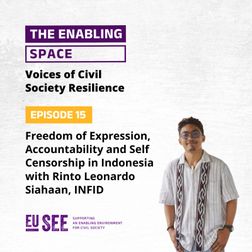
Freedom of Expression, Accountability and Self Censorship in Indonesia
In this episode, EU SEE and our wonderful host Clarisse are joined by Rinto Leonardo Siahaan from the International NGO Forum on Indonesian Development, or INFID, a leading civil society organisation working on human rights, democracy and development in Indonesia. In recent months, Indonesia has experienced a wave of attacks against civil society and human rights defenders, including the infamous acid attack on activist Andrie Yunus. The perpetrators recently saw their sentences reduced in a military court. It's fair to say the battle for civic space and fundamental rights is a hot one in Indonesia, from the attacks to the criminalisation of activists, we also explore how the country's healthy civil society organisations are responding to an apparent deterioration in Indonesian civic space.

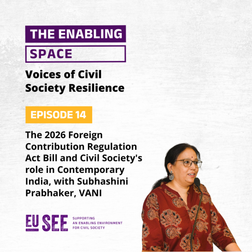
The 2026 Foreign Contribution Regulation Act Bill and Civil Society's role in Contemporary India, with Subhashini Prabhaker, VANI
In this episode, we're joined by Subhashini Prabhakar from the Voluntary Action Network India, or VANI, to discuss the amendments to India's Foreign Contribution Regulation Act, which will have far reaching implications for civil society actors in India, impacting how those actors are governed, and how they are funded. We discuss what the changes mean for civil society, including large and small actors in India, and how local and international organisations and stakeholders can respond, with Subhashini Prabhaker from the Voluntary Action Network India, or VANI. Learn more about the EU SEE's work in India here: India – Eu SEE Or read the India Country Focus Report – Eu SEE

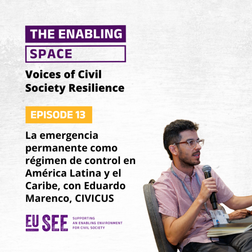
La Emergencia Permanente como Régimen de Control en América Latina y el Caribe, con Eduardo Marenco, CIVICUS
En este segundo episodio en español del podcast de la EU SEE retomamos la conversación iniciada en nuestro primer episodio sobre Ecuador para ampliar la mirada hacia las dinámicas regionales en América Latina y el Caribe. En los últimos años, diversos gobiernos de la región han recurrido a leyes de emergencia y estados de excepción que, bajo el argumento de garantizar la seguridad pública, han sido utilizados para suspender garantías fundamentales y restringir el espacio de actuación de la sociedad civil. Países como El Salvador, Ecuador, Guatemala y Trinidad y Tobago evidencian cómo estas medidas, inicialmente presentadas como temporales, tienden a consolidarse como mecanismos permanentes de control político. En este episodio conversamos con Eduardo Marenco, politólogo y abogado de CIVICUS, sobre las tendencias regionales en torno al uso de estos marcos normativos, la construcción de narrativas como la del “terrorismo” para justificar violaciones de derechos humanos, y el impacto específico que estas medidas tienen sobre el derecho a la protesta pacífica y la organización de la sociedad civil. También reflexionamos sobre la importancia de fortalecer la resistencia colectiva frente al avance del autoritarismo y defender la democracia en la región.

Ecuador: El uso selectivo de las leyes para restringir la sociedad civil
En este primer episodio en español del podcast de la EU SEE contamos con la participación de nuestros socios de la red en Ecuador. En el último año aproximadamente, el Gobierno de Ecuador ha aprobado o intentado aprobar diversas leyes que, en general, han sido utilizadas para restringir el espacio de actuación de las organizaciones de la sociedad civil. Por ejemplo, la Ley Orgánica de Transparencia Social fue empleada para congelar las cuentas bancarias de una conocida organización de la sociedad civil, la Fundación Pachamama. En este episodio analizamos las tendencias que se observan en Ecuador en relación con la introducción de este tipo de normativas y su aplicación selectiva, así como la forma en que están siendo utilizadas para restringir el entorno propicio para la sociedad civil. Este es el primero de dos episodios; el segundo abordará las dinámicas regionales.

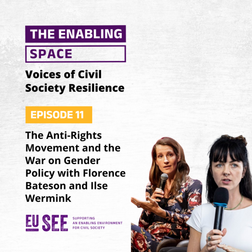
The Anti-Rights Movement and the War on Gender Policy with Florence Bateson and Ilse Wermink
In this special episode for gender justice month, we talk to Ilse Wermink, MenEngage Europe Director and Florence Bateson, Gender, Peace and Security Expert, to discuss the $1bn globally coordinated war on gender policy, the growing anti-rights movement and its impact in international fora, and the challenges of working on gender policy in hostile, often dangerous, contexts. This is a confronting episode that captures the interlinkages between the war on gender policy and attempts to choke democracy and shrink the enabling environment for civil society. It's a must hear for anyone, especially men, working in this space.

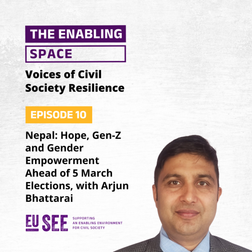
Nepal: Hope, Gen-Z and Gender Empowerment Ahead of 5 March Elections
Today’s guest is Arjun Bhattarai, President of the NGO Federation of Nepal and a member of the global Forus network, EU SEE network member. Nepal's most important election in years is right around the corner. In this timely episode, we talk about the youth-led mobilisation in Nepal, shifts in the enabling environment and — especially in this Gender Justice Month — the intersection between youth activism, gender equality and democratic participation.

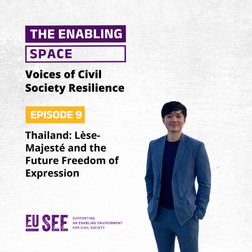
Thailand: Lèse-Majesté and the Future of Freedom of Expression
Thailand is rapidly approaching new elections and a constitutional referendum on 8 February, following the recent dissolution of the Parliament by Prime Minister Anutin Charnvirakul on December 11th, the consequences of which include the lapse of the Amnesty Bill, among other things. In this episode we talk to our network member in Thialand to discuss this, Lèse-Majesté, and other developments that impact the enabling environment for civil society. You can learn more about the changing environment for civil society in Thailand by reading the EU SEE's recently published country focus report on the country.

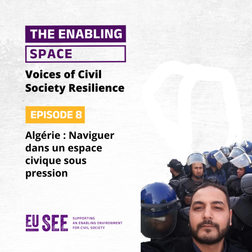
Algérie : Naviguer dans un espace civique sous pression
Dans cet épisode d’Enabling Space, Voices of Civil Society Resilience, nous parlons avec Zakaria Benlahrech, avocat et directeur de la Fondation pour la promotion des droits en Algérie. Il nous parle des défis auxquels la société civile algérienne est confrontée, entre répression croissante, lois restrictives et contrôle des financements étrangers. Découvrez comment les OSC continuent de résister, de défendre les droits et d’innover malgré les obstacles, et quelles priorités devraient guider la communauté internationale pour soutenir leur travail.

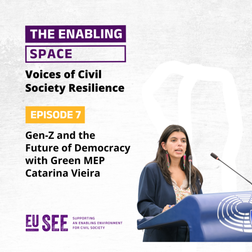
Gen Z and the Future of Democracy with Green MEP Catarina Vieira
In this episode we sit down with Dutch/Portuguese Green MEP Catarina Vieira, one of the youngest MEPs in the European Parliament. We talk about the rise of Gen-Z and the movement's impact on global democracy. We also discuss the advantages, and disadvantages, in the rise of digital technologies within civic space. These tools are a boon for civil society and protest movement's ability to organise, but they are also quickly being used by Governments and other actors to oppress civil society and create a disabling environment for civic space online. This is felt nowhere more strongly than in Myanmar, which has seen a severe militarisation of the internet in recent years amid a violent and dangerous crackdown against civil society. We also touch upon how policymakers and be brought closer to those on the ground fighting for a better enabling environment for civil space through ground-up organisations like the EU SEE.

From the Streets to the Screens: Strategies for Defending the Digital Enabling Environment

Conversations about civic space, referred to as the "enabling environment" in the EU SEE Project, often unfold along two parallel tracks: one addressing traditional aspects such as freedom of assembly, access to funding, and association rights, and another focused on the digital realm. These discussions are sometimes treated separately, with the digital dimension viewed as secondary or less integrated. In this episode, we explore how the digital sphere is now a critical space for civic engagement and participation, while also becoming an area of growing concern due to increasing restrictions, surveillance, and risks faced by civil society actors around the world. See the full EU SEE insight report here:
1 di 2