The United States of Amnesia

The United States of Amnesia

di Marshall Newman, Blake Henke, and Mike Mendenhall
Stagione 5
The U.S. and Iran: What Went Wrong? - The Third Way
Intelligence professional and Substack author Sharon Bibee joins us to begin our new series on the complicated history of U.S.-Iran relations. We travel back to Qajar Persia, where Iran was caught between the competing ambitions of the British and Russian Empires. Along the way, we meet two Americans who played surprising roles in Iran's Constitutional Revolution: missionary and teacher Howard Baskerville, remembered as Iran's "American Lafayette," and lawyer William Shuster, whose efforts to reform Iran's finances brought him into conflict with the foreign powers dominating the country. We also examine the devastating famine of 1918-1919 and the forces that shaped Iran's relationship with the West. Rimsky-Korsakov., "Scheherazade, Symphonic Suite, Op. 35, The Young Prince And Princess," the San Francisco Symphony Orchestra conducted by Pierre Monteux, violin solo by Naoum Blinder, from Wikimedia Commons (https://commons.wikimedia.org/wiki/File:Rimsky-Korsakov._Scheherazade,_Symphonic_Suite,_Op._35_-_03_The_Young_Prince_And_Princess.ogg), used under the Creative Commons CC0 1.0 Universal Public Domain Dedication license.
Stagione 4
403: Internal Improvements - Enter Lincoln
For obvious reasons, Abraham Lincoln's presidency is best remembered for his emancipation of America's slaves, determination to preserve the Union in the face of Southern secession, and leadership in the American Civil War. But an often-overlooked aspect of his administration was its promotion of the United States Government as an active, positive actor in such matters as infrastructure improvement and economic affairs. In this conclusion to the series, Marshall leads our discussion of how the first four years of Lincoln’s presidency in the 1860s were among the most consequential in U.S. history for civic infrastructure and economic reform, rivaling the achievements of Franklin Roosevelt’s New Deal of the 1930s and Lyndon Johnson’s Great Society of the 1960s.
402: Internal Improvements - By The Eternal!
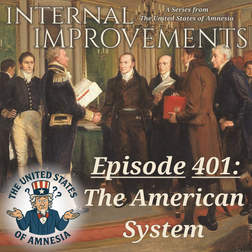
President Andrew Jackson took office in 1829. beginning a 30-year period in which his Democratic Party blocked the efforts of the 'elitist" Whig Party to give the U.S. federal government a greater role in developing the country's infrastructure and stabilizing its financial system. Although the existence of slavery in the South did not divide the two political parties at the time, its possible expansion into the western territories did, leading to increasing sectional hostility between North and South. The fear in Southern states that any increase in federal power might lead to the abolition of slavery limited the federal role in domestic affairs, blocking the development of a national transportation system and beginning a cycle of financial panics and economic depressions that would repeat roughly every 20 years. It would take a civil war to tip the balance in favor of government activism.
401: Internal Improvements - The American System
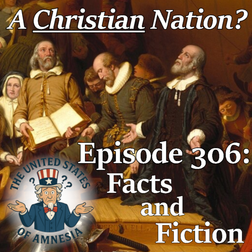
In the 1820s, Henry Clay envisioned a bold new role for the federal government: building America’s infrastructure, strengthening its economy, and shaping the nation’s future. He called it the 'American System.' But was the Constitution willing to let Washington build? In this premier episode of our new series, Marshall traces the battle over “Internal Improvements” from Clay and John Quincy Adams to Andrew Jackson and the rise of populist democracy. What began as a fight over roads, canals, and federal power soon became entangled with the deepest conflict in American politics: slavery. For the next three decades, Southern opposition would help derail the vision of a more economically activist federal government. This episode begins a series exploring what Americans wanted their government to build, what they believed it had the power to build, and why those questions still haunt American politics.
306: A Christian Nation? - Facts and Fiction
The debate over whether America was founded as a Christian nation has endured for more than two centuries, but what does the historical record actually say? In the final installment of this series, Blake, Marshall, and Mike revisit the evidence, challenge some of the most persistent myths surrounding the American Founding, and examine what the Founders believed about Christianity, government, and religious freedom. Drawing together the evidence from across the series, they separate fact from fiction and ask what the Founding generation actually intended when it came to religion, government, and the identity of the United States. Is America a Christian nation? The answer is more complicated and more fascinating than either side of the debate often admits.
305: A Christian Nation? - The Awakenings
History remembers the Founding Fathers. It often forgets the revivalists. Between the Revolution and the modern era, a series of religious awakenings swept across America, changing not only how people worshiped, but how they understood the nation itself. In this conversation, Blake guides Marshall and Mike through the Great Awakenings, tracing the origins of evangelicalism, fundamentalism, and ideas that many now assume have always been part of American Christianity. If today's religious landscape wasn't inherited from the Founders, when was it created? And what happens when centuries of theology, politics, and national identity become tangled together? Sometimes the most influential chapters in American history are the ones we rarely think to read.
304: A Christian Nation? - The Founders, Part 2
What were the personal religious beliefs of Thomas Paine, Patrick Henry, George Mason, James Madison, and Alexander Hamilton, and what role did they see for religion in the United States? Why did Mason and Madison disagree on the "toleration" of religious beliefs? These questions (and others) arise as Blake leads the second part of our discussion of what selected Founding Fathers held as their religious beliefs, what they thought about the role of religion in personal morality and civic society, how they sought to achieve civic tranquility through religious freedom, and how that played in role in forging the disunited colonies into the United States.
303: A Christian Nation? - The Founders, Part 1
What were the personal religious beliefs of Benjamin Franklin, George Washington, Thomas Jefferson, Samuel Adams, and John Adams, and what role did they see for religion in the United States? Blake leads a discussion of what selected Founding Fathers held as their religious beliefs, what they thought about the role of religion in personal morality and civic society, how they sought to achieve civic tranquility through religious freedom, and how that played in role in forging the disunited colonies into the United States.
302: A Christian Nation? - The Colonies
Is the United States of America truly a Christian Nation? Was it founded to be so? History has the answer! Blake, Marshall, and Mike break down the origins of each of the 13 original American colonies. We ask and answer the big questions: why they were founded, who contributed to the development, and, most importantly for this series, the religious affiliations (and lack thereof) carried by settlers and pilgrims, and the weight of the different churches in the New World.
301: A Christian Nation? - The Founding Intent
Was America founded as a Christian nation? Some say yes, some say no, and the real answer is more complex than you might think. Blake takes the reins as the leader of this series, discussing the role (or in some cases, perhaps, the lack thereof) of Christianity in the establishment of the colonies, the founding of the nation, and the early evolution of the United States. In this premiere episode, Blake, Marshall, and Mike start with the First Amendment to the United States Constitution, and from there go on to discuss what the Founding Fathers, who wished to avoid the religious strife that had plagued Europe, seemed to have intended for religion in American public life. Did the Founders "design" America as a Christian country? If the United States had an official church, which denominations would qualify as "Christian"? How would the official church function within civic life in matters of law, public policy, voting, and taxation? Would non-Christians be suppressed? The discussion also covers deism and its influence on the Founders, whose beliefs ranged from borderline atheism through deism and "Christian rationalism" to devout Christianity.
1 di 3