Unleashed 101

Unleashed 101

di Myia Hanson and Jeremy Hanson
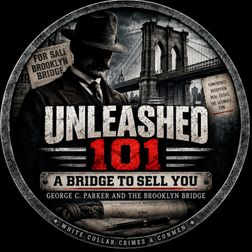
"A Bridge to Sell You" George C. Parker and the Brooklyn Bridge
There is a scene that repeats in New York police accounts around the turn of the last century. A patrolman finds a man on the Brooklyn Bridge walkway with lumber and tools, building a toll booth. The man is polite. He has papers, and the papers are beautiful: engraved letterhead, a corporate seal, a deed of conveyance. He has paid for this, sometimes with everything he brought from the old country, and when he is told the City of New York owns the bridge, he argues. The name on that deed, more often than any other, was George C. Parker. This is where the phrase comes from. If you believe that, I have a bridge to sell you. The premise was not absurd. The Brooklyn Bridge was built by the New York Bridge Company, a private corporation chartered in 1867, and it charged a toll on every crossing until 1911. In the countries Parker's victims came from, toll roads and licensed concessions were ordinary commerce. He did not invent a possibility. He located one already sitting in the mark's head and put a price on it. In this episode: the Roeblings and what the bridge meant to a city that could see it from every arriving ship. Fifteen million people through the port between 1890 and 1915, many carrying the proceeds of a sold farm and looking for a business to buy. The rented offices with a nameplate on the door, and why a professional address is the only thing most instincts actually check. The forged deeds, the walking tour of the structure, and the payment plan taken out of future toll revenue. Grant's Tomb, sold by a man claiming to be Ulysses S. Grant's grandson. The Statue of Liberty, the Metropolitan Museum, Madison Square Garden. Why almost none of his victims went to the police. The sheriff's hat and coat he is said to have walked out of a courthouse wearing. And the 1928 conviction under New York's Baumes Law that turned a lifetime of small frauds into a life sentence at Sing Sing. Then the second half, which is the reason this episode exists. Most of what everyone knows about George C. Parker is poorly sourced. The claim that he sold the bridge twice a week for thirty years has no traceable origin. A man named William McCloundy was convicted for selling the Brooklyn Bridge in 1901, which is a firmer record than anything attached to Parker, and the Gondorf brothers worked the same ground in the same years. The con was a category, not a signature, and it collapsed into one name because repetition was the only credential the story ever needed. That is the same failure this show keeps documenting, running in the retelling instead of the crime. Unleashed 101 is a Fuzzy Life Entertainment production.
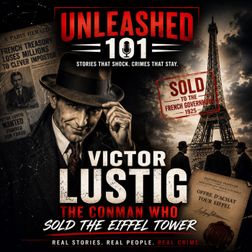
The Man Who Sold the Eiffel Tower: Victor Lustig
In the spring of 1925, six of the most successful scrap metal dealers in France received the same letter on Ministry of Posts and Telegraphs stationery, requesting their presence at a confidential meeting at the Hotel de Crillon. They were told the government had decided to dismantle the Eiffel Tower and sell seven thousand tons of iron for scrap, that the political sensitivity required a private sale, and that sealed bids would be submitted personally to the Deputy Director General.There was no decision, no tender, and no deputy director. There was Victor Lustig, a Bohemian con man with forty-seven documented aliases, five languages, roughly forty-five American arrests, and almost no convictions.One of the six paid. He never reported it. Four weeks later Lustig came back to Paris and sold the tower again.This episode traces how a story that was already circulating became a crime. The Eiffel Tower had been built as a temporary structure for the 1889 World's Fair, its permit had run out in 1909, the maintenance was expensive, and Parisians were arguing about whether it was worth keeping. Lustig contributed no facts. He contributed a seal, a date, and a suite at the Crillon.In this episode: the mahogany money box he sold for as much as thirty thousand dollars, and the Texas sheriff who tracked him to Chicago and left with counterfeit cash. Why a sealed bid stops six competitors from comparing notes. Andre Poisson, the outsider who wanted a seat at the table more than he wanted the iron. The moment Lustig asked his own victim for a bribe, and why that request destroyed every doubt Poisson had. The fifty thousand dollars he took from Al Capone and gave back untouched, and what he actually bought with it. The counterfeiting operation with Tom Shaw and William Watts that reached an estimated hundred thousand dollars a month. Nine bedsheets and a window on West Street in Manhattan. Alcatraz, prisoner number 300, and a death certificate in Springfield, Missouri, that lists his occupation as apprentice salesman.The mechanism at the center is not forgery. It is silence. Lustig did not build a scheme that avoided detection. He built one that made reporting it unbearable for the only man who could.Unleashed 101 is a Fuzzy Life Entertainment production.
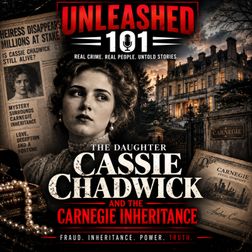
The Daughter: Cassie Chadwick and the Carnegie Inheritance
In December of 1902 a Cleveland lawyer waited in a carriage outside Andrew Carnegie's mansion on Fifth Avenue while a woman went inside. She came out half an hour later holding papers, dropped one, and let him pick it up. It was a promissory note for hundreds of thousands of dollars, signed with Carnegie's name. She asked him to forget he had seen it, and then told him why. She was Carnegie's illegitimate daughter, provided for privately, and nobody could know. The lawyer gave his word and broke it within a week, which is exactly what she had brought him to New York to do. She had never met Andrew Carnegie. She had written the note herself. Over the next two years Ohio banks lent her millions of dollars against it, and not one lender ever wrote to Carnegie to ask. This episode follows Elizabeth Bigley from a railway worker's house in Eastwood, Ontario, through a forgery arrest at twenty-two, an eleven-day marriage that ended when the creditors arrived, a fortune-telling practice in Toledo under the name Madame Lydia DeVere, and a nine and a half year sentence in the Ohio Penitentiary, to a mansion on Cleveland's Millionaires' Row as the wife of a respected physician. In this episode: why she never had to make a claim to a single banker. The sealed envelope she left with a Cleveland bank officer who wrote her a receipt for five million dollars in securities without ever opening it, and how that turned an unverifiable story into verifiable collateral. Why the secrecy was not protection but a delivery system. Why no banker in Ohio was willing to write the one letter that would have ended it, and what that says about verification steps that are socially prohibited rather than merely inconvenient. Herbert Newton, the Boston lender with no reputation to protect, and the lawsuit that broke it open in November 1904. The collapse of Citizens' National Bank of Oberlin and the farmers and widows who lost deposits they never knew had been lent. Andrew Carnegie sitting in a Cleveland courtroom to look at the forgeries. And a death in the Ohio Penitentiary on October 10, 1907, her fiftieth birthday. Unleashed 101 is a Fuzzy Life Entertainment production. Cassie Chadwick, Elizabeth Bigley, Madame Lydia DeVere, Carnegie inheritance con, Andrew Carnegie illegitimate daughter, Unleashed 101, Jeremy Hanson, Cleveland history, Euclid Avenue Millionaires Row, Citizens National Bank Oberlin, Charles Beckwith, Herbert Newton Boston banker, Iri Reynolds, Wade Park Banking Company, James Dillon lawyer, Leroy Chadwick, Ohio Penitentiary, Hotel Breslin arrest, forgery, promissory note fraud, bank fraud history, Gilded Age fraud, female con artist, greatest cons in history, historic scams, white collar crime podcast, true crime finance podcast, American Greed style podcast, con artist history, 1900s America, affinity fraud, why banks lend against rumor, secrecy and fraud, verification failure, narrative nonfiction podcast, storytelling podcast, Fuzzy Life Entertainment, Fuzzy Life Studios
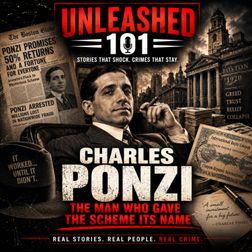
The Man Who Sold Tomorrow: Charles Ponzi and the Summer of 1920
In July 1920, the Boston Police Department assigned officers to School Street because the crowd trying to give Charles Ponzi their money had grown large enough to stop traffic. Seventeen years earlier, Ponzi had arrived in Boston with $2.50. Six months after founding the Securities Exchange Company, he had become one of Massachusetts’ most famous men—and his investors’ money was about to disappear. Who was Charles Ponzi, and how did the Ponzi scheme work? This episode of Unleashed 101 traces the mechanism behind one of history’s most famous financial frauds. Ponzi promised investors 50% returns in 45 days or 100% in 90 days, when American banks were paying roughly 4–5% annually. His story began with something real: International Reply Coupons, whose fixed exchange rates had become badly distorted after World War I. A coupon bought cheaply in Europe could theoretically be redeemed in the United States for several times its cost. The problem was scale. Redemption produced postage stamps rather than cash. Converting stamps to money destroyed the margin, and postal authorities sold coupons only a few at a time. Covering Ponzi’s obligations would have required roughly 160 million coupons. Investigators found about $2 worth. The episode follows Ponzi from Lugo, Italy, to Boston, Montreal, and Atlanta, including the Banco Zarossi lesson where he watched old depositors paid with new deposits, his forgery conviction in Montreal, his imprisonment, and his eventual rise in Boston’s North End. We examine the Securities Exchange Company, the eighteen original investors, the agent network, the 1920 Boston investment frenzy, and why calling Ponzi’s victims “greedy” gets the story backwards. Many were Italian immigrants who trusted a man who spoke their language and knew their communities—a classic example of affinity fraud. Then comes the arithmetic. Clarence Barron exposed the numbers behind the scheme. Ponzi temporarily stopped a bank run by personally paying investors who demanded their money, returning roughly $2 million over three days. His own publicist, William McMasters, examined the books and declared him insolvent. The Boston Post published Ponzi’s Montreal forgery record and mugshot. Hanover Trust was closed, and Ponzi surrendered to federal authorities. What happened next was the long way down: criminal convictions, another land scheme in Florida, arrest in New Orleans, deportation to Italy, and finally death in a charity ward in Rio de Janeiro in January 1949 with roughly $75. How much money did Charles Ponzi take? Estimates range from $9 million to $15 million in 1920 dollars, involving approximately 40,000 investors. Six banks failed, and investors ultimately recovered about 30 cents on the dollar. The larger lesson is the reason Unleashed 101 tells these stories. Every generation gets new technology, new markets, and new names—but the machinery of deception remains remarkably familiar: a kernel of truth stretched beyond what it can carry, an early payment that clears, and a storyteller who makes something complicated sound simple. Unleashed 101 is a narrative investigative podcast about the greatest deceptions in history, the people who built them, and the ordinary lives left in the wreckage. Episode: The Man Who Sold Tomorrow: Charles Ponzi and the Summer of 1920 Host and Writer: Jeremy Hanson Produced by Fuzzy Life Studios Distributed by Fuzzy Life Entertainment Season 1, Episode 3 Genre: True Crime, Business, History, Documentary
The Ocean in Bayonne: The Great Salad Oil Scandal
Oil floats on water. That is the entire secret. A ninth grader could tell you. And Anthony "Tino" De Angelis built one of the largest frauds in American history on it. Fill a sixty-foot storage tank with seawater. Float a thin layer of vegetable oil on top. An inspector drops a measuring line, pulls it up coated in oil, and certifies a full tank. He isn't lying. He saw oil. From a leased tank farm in Bayonne, New Jersey, De Angelis borrowed against inventory that did not exist, using warehouse receipts issued by a subsidiary of American Express. Fifty-one financial institutions lent against that paper, including Bank of America and Chase Manhattan. At the peak, his receipts accounted for more soybean oil than the U.S. Department of Agriculture said existed in the entire country. Nobody ran that check. In this episode: The federal school lunch meat scandal De Angelis walked away from a decade earlier, with no conviction The forty-one tanks: twenty-three unavailable, seven unusable, one that did not exist, ten that were real Three methods for showing an inspector four hundred million pounds of oil when you have twenty Field warehousing explained, and why the American Express name was the whole game The self-reinforcing loop: fake inventory to receipts to loans to futures to higher prices to bigger receipts November 15, 1963: the Senate kills the Russian wheat deal and soybean oil falls twenty-six percent in two days The twenty thousand Ira Haupt customers who had never heard of Tino De Angelis and could not reach their own money Why American Express chose to pay when it may not have had to, and why Warren Buffett was watching The lesson: audited does not mean honest, and certified does not mean true Next episode: An immigrant with two dollars and fifty cents, fifty percent in forty-five days, and a crowd in the street in Boston. Charles Ponzi. Unleashed 101 is a Fuzzy Life Entertainment production. Some stories are too incredible to stay forgotten.In this episode of Unleashed 101, we uncover the true story behind [Episode Title]. Through immersive storytelling and meticulous research, we explore what happened, why it happened, and the lasting impact it left behind.Whether it's a forgotten historical event, a shocking fraud, an unsolved mystery, corporate deception, an extraordinary act of courage, or one of history's greatest betrayals, Unleashed 101 brings remarkable true stories back into the light.If you enjoyed this episode, please:Follow or subscribe to Unleashed 101 Leave a rating and review Share this episode with someone who loves incredible true stories Every share helps us uncover more stories that deserve to be remembered.Follow Unleashed 101 for new episodes featuring forgotten history, legendary scams, remarkable crimes, extraordinary survival stories, and mysteries that continue to fascinate the world. Hosted by Simplecast, an AdsWizz company. See pcm.adswizz.com for information about our collection and use of personal data for advertising.
Everything Changes Today: The New Unleashed 101
Everything about this show changes today. In 1963, a man in New Jersey convinced the American banking system he owned more salad oil than existed in the entire country. The tanks were full of seawater. In 1925, a con man sold the Eiffel Tower for scrap metal, then came back months later and sold it again. In 1902, a woman walked into a Cleveland bank claiming to be Andrew Carnegie's secret daughter, with no proof at all, and walked out with the money. All of it documented. All of it true. Unleashed 101 is relaunching as a narrative investigation into the greatest deceptions in history. One complete story per episode, from origin to collapse. Host Jeremy Hanson explains why he walked away from a headline-driven format, what the new show is, and what is coming this season. In this episode: Why news-driven podcasting has a shelf life, and what replaces it The one question every episode will answer, and why it is not "what happened" Why this is explicitly not a political show The five-part pattern behind nearly every major fraud in history, and the one warning sign that never fails What twenty-five years in business teaches you about spotting manipulation instead of opportunity Why this show will never reduce a fraud to a dollar figure Coming this season: The Great Salad Oil Scandal. Charles Ponzi. Victor Lustig and the sale of the Eiffel Tower. Cassie Chadwick and the Carnegie inheritance con. Ivar Kreuger, the Match King. Next episode: Tanks of seawater, a dipstick that lied, and one of the largest commodity frauds in American history. The Great Salad Oil Scandal. If this sounds like your kind of show, follow Unleashed 101 wherever you listen, and share this episode with someone who would enjoy it. Unleashed 101 is a Fuzzy Life Entertainment production. Some stories are too incredible to stay forgotten.In this episode of Unleashed 101, we uncover the true story behind [Episode Title]. Through immersive storytelling and meticulous research, we explore what happened, why it happened, and the lasting impact it left behind.Whether it's a forgotten historical event, a shocking fraud, an unsolved mystery, corporate deception, an extraordinary act of courage, or one of history's greatest betrayals, Unleashed 101 brings remarkable true stories back into the light.If you enjoyed this episode, please:Follow or subscribe to Unleashed 101 Leave a rating and review Share this episode with someone who loves incredible true stories Every share helps us uncover more stories that deserve to be remembered.Follow Unleashed 101 for new episodes featuring forgotten history, legendary scams, remarkable crimes, extraordinary survival stories, and mysteries that continue to fascinate the world. Hosted by Simplecast, an AdsWizz company. See pcm.adswizz.com for information about our collection and use of personal data for advertising.
"Running From the Wreckage: The Spy, the Congressman, and the Trillion-Dollar Exodus"
Eric Swalwell is thirty-four days from California voters beginning to cast ballots in the gubernatorial primary. He is leading in the polls. And he is threatening to sue the FBI.The subject of that lawsuit threat: investigative files compiled by federal law enforcement regarding his relationship with Christine "Fang Fang" Fang — a suspected Chinese intelligence operative who fundraised for Swalwell's 2014 campaign, placed an intern in his congressional office, and maintained a personal relationship with him before departing the United States in 2015 after the FBI alerted Swalwell to the suspected influence campaign.FBI Director Kash Patel is reportedly considering releasing those records. Swalwell's attorneys sent a cease-and-desist letter warning of "significant legal liability." His allies in Congress called it "plain weaponization." His campaign framed it as election interference.What no one is explaining is why a man with nothing to hide would spend his own money trying to make sure the files stay hidden.In this episode of Unleashed 101, Jeremy Hanson walks through the full Swalwell-Fang Fang timeline — what is known, what has never been answered, what it means that a man with this history sat on the House Intelligence Committee for years and is now running for governor of one of the most powerful states in the nation.And then Jeremy connects it to the other story happening in parallel: the mass exodus of American capital from the cities and states that keep electing people like Swalwell.Apollo Global Management is scouting second headquarters locations in Texas and South Florida. Goldman Sachs is building a $500 million campus in Dallas. Citadel left Chicago for Miami. Palantir relocated to Denver. Charles Schwab left San Francisco for Texas. AllianceBernstein moved from New York to Nashville. Between 2020 and early 2023, more than 370 investment companies relocated, bringing $2.7 trillion in assets with them.These are not impulsive decisions. They are rational responses to governance failure. To tax environments that punish productivity. To regulatory regimes that treat business as a problem to be managed. To urban dysfunction that makes cities uncompetitive and unlivable.And the states doing the attracting — Texas, Florida, Tennessee, North Carolina — are not offering elaborate ideological frameworks. They are governing competently and letting the results speak.The connection between Swalwell and Apollo is not coincidental. It is structural. The political class has exempted itself from accountability. The financial class has responded with the only tool available to it: departure.Jeremy Hanson closes with a direct challenge to the people watching this happen and wondering what they are supposed to do about it.Unleashed 101 does not tell you what to think. It asks the questions the official channels are designed to prevent you from asking.Subscribe wherever you get your podcasts. Share this episode with someone who is ready to stop pretending the system is working.Jeremy Hanson | Unleashed 101 | Contact: unleashedjeremyhansonshow@gmail.comEric Swalwell Chinese spy Fang Fang files FBI Kash Patel Swalwell Christine Fang spy California Apollo Global Management Texas corporate headquarters migration Florida blue state capital flight Democrat accountability machine Swalwell governor California FBI files political candidate financial firms leaving New York investment firms moving to Texas Tucker Carlson style commentary China espionage Congress Swalwell FBI cease and desist blue state exodus businesses Apollo second headquarters Dallas freedom states business migration Swalwell mortgage fraud referral Unleashed 101 Jeremy Hanson why is Eric Swalwell threatening to sue the FBI over Fang Fang files what did Fang Fang do in Eric S
The Body Knows: Peptides, Suppressed Medicine, and the Industry That Profits From Your Ignorance
What if the most effective healing tools available to you have been sitting in the published medical literature for thirty years — and the system you trust with your health has been quietly, systematically, and deliberately keeping them out of reach?In this episode of Unleashed 101, host Jeremy Hanson examines the growing body of research behind therapeutic peptides — specifically BPC-157, TB-500, and KPV — and confronts the institutional machinery responsible for their suppression in American healthcare. This is not fringe science. This is peer-reviewed research published across multiple countries, documenting measurable outcomes in tissue repair, inflammation reduction, gut healing, neurological protection, and cellular regeneration. The evidence base is real. The suppression is equally real.What Jeremy covers in this episode:The pharmaceutical industry's fundamental business model — why a patient who recovers is a lost customer, and why chronic disease management is the most profitable product the healthcare system has ever built.The FDA's structural conflict of interest — how the Prescription Drug User Fee Act created an agency that is substantially funded by the companies it regulates, and what that funding relationship produces in practice for treatments that have no industry sponsor.The approval pathway as a financial filter — why the absence of FDA approval for peptide compounds reflects the absence of pharmaceutical industry economics, not the absence of clinical evidence.BPC-157 in depth — derived from human gastric protein, studied in over a hundred peer-reviewed publications, demonstrating accelerated healing of tendons and ligaments, neuroprotective properties, gastrointestinal repair outcomes, and anti-depressant effects with a safety profile that puts most approved alternatives to shame.TB-500 and musculoskeletal recovery — the documented outcomes in muscle fiber repair, tendon regeneration, and inflammatory response reduction that have driven widespread adoption in athletic communities and produced real-world results that mirror the controlled research.KPV and anti-inflammatory applications — why a three-amino-acid peptide that outperforms approved biologics for certain inflammatory bowel conditions in animal studies has generated no pharmaceutical development interest, and exactly what that tells you about the system's priorities.The suppression playbook — how dismissal, demonization, and regulatory capture operate in sequence to eliminate access to compounds that threaten pharmaceutical revenue, with specific reference to the FDA's escalating enforcement actions against compounding pharmacies supplying peptide therapy to legitimate medical practices.Delivery method advances — how developments in oral bioavailability and intranasal administration are narrowing the access barriers that the regulatory environment depends on to contain peptide use, and why the enforcement response has followed the accessibility research.The physicians and patients at the margin — the gastroenterologists, neurologists, and orthopedic practitioners incorporating these compounds into practice under institutional pressure, and the patients who found measurable functional recovery after years of dependence on approved treatment pathways that produced symptom management but not resolution.The liberty argument — in plain terms, why the government's authority to prevent you from accessing compounds your own body already produces, with a documented safety record and decades of supporting research, should concern anyone who takes the concept of individual autonomy seriously.This episode is not asking you to reject medicine. It is asking you to reject the framing that positions an industry-funded regulatory apparatus as a neutral guardian of public health. The evidence does not support that framing. The outcomes do not support it. The incentive structure does not support it.Unleashed 101 exists to ask the questions that the official channel
"The Return to the Bible: Why Young Men Are Searching for Meaning Again"
Something is happening in America that almost no one in the mainstream press is willing to talk about. Young men — the generation that was supposed to permanently abandon religion — are returning to the Bible in numbers that are reshaping what we know about faith, culture, and the future of the country.According to data from the Barna Group, 54% of Gen Z men and 57% of Millennial men now report reading the Bible on a weekly basis. A decade ago, those numbers barely reached the mid-thirties. That is a twenty-point swing in a single generation — and the media is silent.On this episode of Unleashed 101, Jeremy Hanson breaks down exactly why this is happening, what it reveals about the catastrophic failure of secular progressive alternatives, and why this quiet cultural shift may be the most important story in America right now.Jeremy covers the hard data on the male crisis — collapsing college enrollment, declining workforce participation, skyrocketing loneliness, and the epidemic of purposelessness that the progressive institutional project created and then refused to acknowledge. He prosecutes the secular replacement frameworks — therapy culture, political identity, social media, government dependency — and explains why every single one of them failed to deliver what they promised.Then he makes the affirmative case: what the Bible actually provides that nothing else does, the public health research proving that faith community is measurably good for human beings, and why the return to traditional values among young men is not a regression — it is a civilizational correction.This is the story the gatekeepers don't want told. We're telling it.Topics covered:Barna Group data on Gen Z and Millennial Bible reading rates The collapse of male college enrollment, workforce participation, and social connection Why secular culture's replacement frameworks all failed What the Bible provides that modern culture refuses to Harvard and JAMA research on faith, community, and public health outcomes Alexis de Tocqueville and the civic foundation of American life What the return to faith means for the future of the country 54% of Gen Z men now read the Bible weekly. The media won't cover it. Jeremy Hanson breaks down why young men are returning to faith — and what it means for America.young men and religion Gen Z faith Bible reading statistics return to Christianity male loneliness epidemic traditional values America faith and masculinity religious revival America men and the Bible American Christianity Millennial faith conservative podcast meaning and purpose men masculinity crisis male identity why are young men returning to the Bible Gen Z men reading Bible statistics 2024 Barna Group Gen Z faith data why young men are leaving secular culture male loneliness epidemic statistics what the Bible says about masculinity faith community and mental health research why young men are rejecting progressive culture conservative podcast on faith and masculinity return to traditional values young men secular alternatives to religion that failed Harvard study religious attendance civic engagement JAMA study religion and suicide prevention why male college enrollment is declining Alexis de Tocqueville religion American democracy faith and family outcomes research why young men are losing purpose men without community crisis Gen Z rejecting secular culture what does the Bible say about being a man Why are young men returning to the Bible? A: Young men are returning to the Bible in response to a crisis of meaning, identity, and community produced by decades of institutional
"The Long War: Why the Iran Conflict Won't End Quickly"
On February 28th of this year, the United States and Israel launched nearly nine hundred coordinated strikes on Iran in twelve hours. Missile systems. Air defense installations. Political leadership. The Iranian Supreme Leader was killed. And within hours, the retaliation began — drone swarms, missile attacks on oil infrastructure, strikes on American bases across the region.Washington called it decisive. The foreign policy establishment called it necessary. The cable news analysts called it a turning point.What none of them are telling you clearly is this:This may be the beginning of a very long war.In this episode of Unleashed 101, Jeremy Hanson goes through every factor driving that conclusion — methodically, clearly, and without the reassuring vagueness you're getting from official sources.First: history. This conflict didn't start on February 28th. It started in 1979, with the Islamic Revolution, the hostage crisis, and four decades of proxy warfare, sanctions, cyber operations, and regional power struggle that the foreign policy class managed but never solved. The strikes didn't start a new war. They escalated one that's been running since before most of the people watching the coverage were born.Second: geography. Iran is not Iraq. It is a country of ninety million people, surrounded by mountain ranges that military historians describe as a natural fortress, with a military specifically built and dispersed to survive a decapitation campaign. The terrain that made Iraq fall in three weeks makes Iran a fundamentally different strategic problem.Third: the proxy network. Iran doesn't fight directly. It fights through Hezbollah in Lebanon, Shia militias in Iraq, armed groups across Syria and Yemen — a distributed regional network that doesn't require Iranian command to operate and can't be dismantled by striking Tehran.Fourth: the Strait of Hormuz. Twenty percent of the world's oil supply passes through a waterway twenty-one miles wide at its narrowest point, with Iran on one side of it. Iran doesn't have to close the Strait to disrupt the global economy. It only has to make it feel dangerous. And that cost flows directly to your gas pump.Fifth: cyber warfare. Most of this conflict is invisible — running on servers, through infrastructure systems, in financial networks. Iranian-linked groups have the capability to conduct sustained operations against American targets without a single headline.Sixth: the global powers. Russia. China. Turkey. None of them want regional collapse. But several of them see American overextension as opportunity. History calls this dynamic a proxy struggle. The Cold War version lasted forty-five years.And at the center of all of it: the question nobody in Washington will answer publicly.What is the actual objective?Is it stopping the nuclear program? Weakening conventional military capability? Regime change? Because those are three completely different wars, each with a completely different timeline and a completely different price tag. And the American people — who are paying for this, whose kids may fight in it, who will absorb the economic consequences for years — have not been given a straight answer.Jeremy Hanson holds no government, no party, and no foreign policy establishment to a lower standard than complete honesty with the people who foot the bill.This episode is that standard applied to the most significant military action of the current era.Unleashed 101 — the questions your government doesn't want asked.Iran war 2025 Iran conflict explained US Iran war Iran war how long Strait of Hormuz Iran proxy war US strikes Iran Iran war podcast Iran military strategy Middle East war 2025 Iran nuclear program Iran war update Jeremy Hanson podcast Unleashed 101 Iran retaliation Iran US conflict Iran war analysis Persian Gulf conflict Ira
1 di 29