2 Commas: The $multi-million exit show with Josh Comrie

2 Commas: The $multi-million exit show with Josh Comrie

di Josh Comrie
Stagione 5
The non-performing salespeople weren't the problem. I was. | Rich Conway | 2 Commas by Josh Comrie
Rich Conway spent hundreds of thousands of dollars proving he was hiring the wrong salespeople. He was wrong about that too. He was bringing in good people, then setting them up to fail with no systems, no metrics, and no structure to succeed. When he finally hired a sales manager who put that scaffolding in place, the same calibre of people started producing straight away. It's one of the more honest leadership admissions you'll hear from a founder. Rich is an introvert with imposter syndrome who built Pure SEO into the number one search agency in New Zealand, arriving here in the depths of the GFC with no friends and no family. He refused to guarantee Google rankings when every competitor did, nearly went under, then watched the market swing his way. We get into: Why his best salespeople on paper kept failing and what he owned about it The systems that turned the same people into producers The emotional call to let go of his best mate, who he'd hired as GM Two exit processes that fell over and why he's glad they did How he rebuilt the whole business around AI search Sometimes the hire isn't the problem. The setup around them is. 📩 Subscribe to the 2 Commas Journal → ⁠https://www.joshcomrie.com/subscribe⁠ 📖 Order the 2 Commas book → ⁠https://www.joshcomrie.com/2-commas-book-order⁠ 👤 Follow Josh on LinkedIn → ⁠https://www.linkedin.com/in/joshcomrie/⁠ 🔗 Connect with Rich Conway → ⁠https://www.linkedin.com/in/pureseo/
Taking on and beating the giants | 2 Commas by Josh Comrie
The Comma Club is now open for founding members — a private community for NZ founders building toward a multimillion-dollar exit: https://www.joshcomrie.com/club Shane Young flew to Sydney six times to get a single purchase order out of Woolworths. On launch day, he walked into the flagship supermarket to find his product had separated in transit and was leaking yellow puddles across the shelf. Four years of work, and he thought it was over in an instant. It wasn't. This is a special episode of 2 Commas built around one question: what does it take for a small New Zealand business to take on far bigger competitors and win? Three founders answer it from three angles. Shane covers product, and how getting locked out by contract manufacturers forced him to build his own factory and made the business unbeatable. James McGlinn covers strategy, and how Event Finder survived the NZ Government launching a taxpayer-funded competitor by fighting back with a guerrilla Twitter campaign that put the responsible minister on the spot live on Breakfast TV. Cornelius Boertjens covers market, and how raising his prices, building a deliberately annoying presence in Australia, and engineering deal tension between two acquirers turned a niche agency into a Havas exit. We get into: Why Shane's Brisbane disaster became the thing that made his business defensible How James won against a competitor with millions in government funding behind it Why pricing up got Cornelius more demand, not less The modesty penalty that quietly costs NZ founders across the Tasman The annoying itch strategy that makes a giant come to you If you're building something small in a market full of big players, this episode is three different maps for the same territory.
50 Ferraris, 4 exits and a fight for his life | Grant Baker | 2 Commas with Josh Comrie
The Comma Club is now open for founding members — a private community for NZ founders building toward a multimillion-dollar exit: ⁠https://www.joshcomrie.com/club⁠ Grant Baker was sitting in his office on credit watch with BNZ when his phone rang. Eric Watson was calling from Palm Springs to say he'd sold Blue Star for a hundred million dollars. The deal had been done on a golf course in the dark. Grant thought he was joking. He wasn't. Ninety million came in shares. Six months later, when the lockup expired, those shares had doubled. Blue Star had grown from $2M to $1B in sales through 56 acquisitions and almost no working capital. That was exit one. Then came Empower, an electricity retailer Grant built to 150,000 customers and 10% of all NZ electricity sales before selling to Contact Energy. Then 42 Below, which Jeff Ross was making 500 cases a year of in his garage when Grant got involved, sold to Bacardi for $165M USD on $20M revenue. Then Turners, bought for $70M when Grant's own company was worth $20M, now approaching a billion dollar market cap. Along the way: a bowel cancer diagnosis the morning of his first Bacardi meeting, 50 Ferraris, and a decade backing Liam Lawson from a $4,000 airfare to Formula One. We get into: What 56 acquisitions taught him about what kills a roll-up strategy Why Bacardi paid a technology multiple for a spirits business and what that tells you about brand How to build a business that a specific buyer will have to acquire The cancer diagnosis, the 50/50 odds, and what his father's death three weeks later changed Why he disagrees with "follow your passion" and what he'd tell any young NZ founder If you're building something and wondering what four decades of exits, setbacks, and survival actually looks like from the inside, this one's worth your time.
He’s invested $billions and not taken a single share of equity | Tim Wixon | 2 Commas with Josh Comrie
Tim Wixon has put debt funding into more than 1,700 New Zealand tech companies. He has never taken a single share of equity in any of them. As Head of Technology and Innovation at BNZ, Tim spent 11 years building a lending model most traditional bankers said was impossible. Debt against recurring revenue, interest only while you scale, no personal guarantees, and no dilution. His first deal set the tone: five million dollars to a zero-profit software company buying another zero-profit company, secured only against the software. His colleagues laughed when he said he wanted to fund tech. One deal led to another, and it grew into a portfolio of over 1,700 companies. A former lawyer and FMA regulator, Tim brings an outsider's clarity to how founders should actually think about capital. This is the clearest explanation of non-equity funding you'll hear from anyone in New Zealand. We get into: How BNZ funds companies with no profit, no tangible assets, and no personal guarantees Why interest-only debt while you grow can protect your cap table better than a raise The lead indicators Tim looks for that most founders never track What the SaaS apocalypse did to founder attitudes toward debt in NZ The one question that turns a bank's no into a roadmap Debt or dilution is a choice most founders make without understanding one side of it.
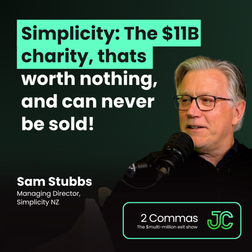
Simplicity: The $11B charity, that's worth nothing, and can never be sold! | Sam Stubbs | 2 Commas with Josh Comrie
KiwiSaver fees in New Zealand will hit a billion dollars this year. Sam Stubbs has been the loudest voice in the country saying that's a scandal and building something to prove it doesn't have to be that way. Sam is the founder and CEO of Simplicity, an $11 billion KiwiSaver fund owned by a charity. It makes almost no profit. It is worth essentially nothing. It can never be sold. That's the point. When you ask people to trust you with their retirement savings, being unbuyable turns out to be an extraordinarily powerful thing. Before Simplicity, Sam was at Goldman Sachs listing Chinese companies on the New York Stock Exchange, flying on the Rolling Stones jet, and having lunch at the Ritz in the same room where Princess Diana dined the week she died. He made all the money he needed by 50, felt nothing from it, planted trees on an island for three years, then came back to take on the finance industry from the inside. Simplicity now gets between $5 and $16 million in member contributions every single day. It gives $10,000 to charity daily, builds 1.3 houses a day, saves its members $100,000 a day in fees, and gets 10% of new signups directly from AI engines with zero advertising spend. We get into: Why the finance industry is a priesthood and how they've kept it that way for decades The deliberate bank lobbying that set NZ open banking back 10 years Why KiwiSaver heading toward $1 trillion by 2070 is the most significant economic event in NZ history that founders aren't paying attention to How KiwiSaver funds could become the exit buyer of choice for NZ baby boomer business owners What Sam would say to any exited founder wondering what to do next If you're building something and wondering what it looks like to take on a billion dollar industry with almost no marketing budget and a model nobody thought would work, this one's worth your time.
Why I left millions on the table | Carl Thompson | 2 Commas with Josh Comrie
Carl Thompson flew to Singapore with $3,000, shared a pullout bed with his co-founder in a room so small he could touch the wall sitting up, and cold-called New York at 2am because that's when the market was awake. That was the start of TradeGecko. He left the company two and a half years in, halfway through his vesting schedule, because he needed to come home for his relationships and his health. He split his role into five people on the way out. A few years later, Cam checked his spam folder and found an email from Intuit saying they wanted to buy the business. The acquisition closed at $100 million US. Carl has ADHD, has been cycling in and out of burnout for 20 years, and now runs SortMe, a money management platform built around the uncomfortable fact that 60% of NZ households can't cover a $1,500 bill without borrowing. His clients aren't struggling. They earn $150K to $500K a year and spend every dollar of it. We get into: Why he walked away from millions in unvested equity and whether he regrets it The dopamine science behind ADHD and why he thinks it's a competitive advantage for founders How a spam folder email became a $100M acquisition What lifestyle creep actually looks like at high income levels What he did with the exit money the day it landed If you're building something and wondering what it looks like to choose the life over the money and keep building anyway, this one's worth your time.
Why I closed a business that fed 2,500 kids a day | Lisa King with Josh Comrie
Lisa King had a goal from the very first day of Eat My Lunch: the business would be a success the day it became unnecessary. She built it in 2015 to solve a problem she couldn't stop thinking about, kids going hungry at school in a country of abundance. By week 12 she was making 2,000 lunches a day out of her own kitchen. At peak, nearly 5,000, with police officers, politicians, and grannies in their sixties all buttering bread before sunrise. Then the government launched its own school lunch program, and Lisa did something most founders never do. She closed the business on purpose. Before that happened, a media story accused her of personally profiting off hungry kids, at a time when she was being paid less than she'd ever earned. She had to show a reporter her payslip to prove it. We talk through what that period actually felt like, what New Zealand's tall poppy syndrome did to her willingness to talk to press afterward, and the identity crisis of letting go of a business that had defined her for five years. We get into: How Eat My Lunch scaled from 50 to nearly 5,000 lunches a day The media smear and what it actually cost her personally Why she built the business to make itself redundant from day one What closing your first business does to your sense of who you are If you're building something with real purpose behind it, or wondering what it takes to walk away from your own success on your own terms, this one's worth your time.
Would you sell 80% of your business to 5X its value? | Murray Schnuriger and Toby King with Josh Comrie
Most founders won't give up 80% of their business. The ones who did walked away with more than if they'd kept 100%. Murray Schnuriger made the jump from 20 years advising founders on exits to actually owning the risk at 5V Capital, a mid-market PE fund across Australia and New Zealand. Toby King has spent his career at Cameron Partners, one of NZ's most established M&A firms, allied with Rothschild and Company. Together they've sat on both sides of more NZ business exits than almost anyone alive. The Education Perfect story is the one that sticks. Two brothers built an edtech platform into 50% of NZ secondary schools, hit their ceiling, and sold 80% to 5V. One went backpacking for a year. 5V brought in a new CEO, put sales teams on the ground in Australia, and tripled the business in three years. Exit to KKR. The 20% the brothers held at the end was worth more than their original 100%. That's the structure most NZ founders never think to ask about. Murray and Toby pull no punches on what founders consistently get wrong, pricing on EBITDA when buyers price on free cash flow, waiting one more year for growth when the multiple compression wipes out the gain, and showing up to a sale process without a narrative that holds up under serious due diligence. We get into: Why selling 80% can leave you wealthier than holding everything The EBITDA trap that costs NZ founders millions at the table Why "one more year of growth" is often the most expensive decision you'll make How PE investors actually think about your exit before they've even finished investing in you What your business narrative needs to nail to earn a premium valuation The succession wave hitting NZ baby boomer founders and why PE is filling the gap If you're building something and wondering what it actually looks like to sell part of your business, back yourself for one more run, and walk away with more than you started with, this one's worth your time.
I gave away half of my business on a handshake. Here's why. | Mark Zeman with Josh Comrie
What if the most successful version of your company is the smallest one? This week I sit down with Mark Zeman, co-founder of SpeedCurve, who quietly built one of the most unusual software businesses I've come across. No VC. No sales team. No marketing function. A team that never grew beyond seven people, paid two to three times market salary, and shared the monthly profit with everyone. SpeedCurve had customers like Airbnb, the New York Times and the Guardian. They found him, not the other way around. And after 13 years, he exited to Embrace, not at the peak. We get into: - Why Mark turned down customers, capital and "grow at all costs" - How a UX designer in New Zealand ended up shaping global web performance standards - The handshake co-founder deal with Steve Souders and why it worked - Monthly profit share instead of equity and a someday-maybe exit - The moment the market shifted and SpeedCurve became the wrong shape - Selling a declining SaaS business and why Embrace still wanted it - What working inside a VC-backed company has confirmed and challenged If you've ever wondered whether there's another way to build a SaaS business and exit on your own terms, there is. Mark just lived it.
67% of founding teams fail. Here's why | Logan Yonavjak | 2 Commas
What if the biggest risk in your company isn't your product, it's whether your people are actually ready to lead? This week, I sit down with Logan Yonavjak, founder of the Readiness Engine, to explore how AI can now measure leadership capacity at scale. We get into coachability, the grit myth, the early warning signs a founding team is in trouble, and my own method for testing resilience and values in the room. Essential listening for founders, investors and operators.
1 di 9