
Note sull'episodio
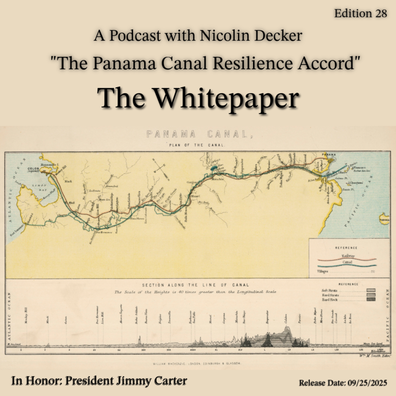
In this Special Edition of The Whitepaper, Nicolin Decker unveils the Panama Canal Resilience Accord (PCRA)—the first hydrodiplomatic treaty architecture that converts neutrality from a fragile promise into an enforceable, self-financing covenant. Where climate-driven droughts, sediment inflows, and systemic scarcity once pushed the Canal into the escalation band, PCRA fuses law, science, finance, and diplomacy to deliver stability that is auditable, reproducible, and intergenerational.
Why now: The Canal carries ~6% of global maritime trade. Neutrality “in form” is no longer enough—operability under stress is the standard for neutrality in substance. PCRA meets that standard by codifying minimum hydrological thresholds, fiduciary finance, multilateral oversight, and binding arbitration to keep the Canal open, lawful, and resilient.
The Result? Water → Throughput → GDP (Leader Metrics): +3–5 ft effective Lake Gatun head (Integrated System) → ~1,800–3,600 extra dry-season transits (~10–20/day) and earlier draft restoration. Direct cash effects (dry season): $1.7–3.9B (tolls + shipper cost avoidance + volatility reduction). Global stabilization dividend: $9–11B/yr in avoided GDP losses; freight/insurance volatility reduction $1–3B/yr. PNR/AI risk shift: >90 (baseline) → ~40 (post-PCRA+M.A.D.E.) — from escalation outlier to stability band.
Key Takeaways: 🔷 Neutrality becomes law you can measure: hydrology thresholds, audit trails, arbitration. 🔷 Returns multiply: $2.25B/yr allocated protects $9–11B/yr in global GDP. 🔷 U.S. leads by convening, not control: parity for China, assurance for allies, legitimacy for Latin America. 🔷 Exportable blueprint: Suez, Malacca, and Arctic routes can adopt the same architecture—chokepoints become resilience anchors. 🔷 Intergenerational covenant: obligations endure across cycles; the Canal remains a resilience commons for generations.
📄 Access the Full Accord: The Panama Canal Resilience Accord (PCRA): Intergenerational Treaty Continuity, Hydrodiplomacy, and Global Trade Stability in the 21st Century [Click Here]
This is The Whitepaper. And this is how peace becomes the operating system of global trade.
In Honor of President Jimmy Carter 39th President of the United States (1977–1981)