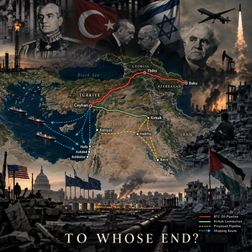
To What End?

To What End?

di Professor John McKawim
Stagione 1
WORLD CUP 2026: FRAUD & FANS | A Karim Nasser Editorial
IA
What happens to the love of football when the game no longer loves you back, respects your loyalty, or trusts your eyes? Karim Nasser, an Egyptian-American maritime shipping and geopolitical risk analyst, lifelong football supporter, and longtime friend and colleague of Professor John McKawim, takes the microphone for this solo To What End? editorial on the 2026 FIFA World Cup. record ticket sales presented as proof of success, supporters processed as consumers, national mythology marketed as authenticity, and political power concealed behind the language of the beautiful game. From FIFA and Lionel Messi to Argentina, ticket pricing, fan culture, commercialization, and the machinery surrounding the tournament, Fraud & Fans asks whether a sold-out World Cup can still betray the people who gave football its meaning. The question is not simply whether the stadiums are full. It is who gets inside, who profits, what disappears behind the spectacle, and to what end. VIDEO VERSION (YouTube) https://youtu.be/tQCcDOHitlE PRODUCTION DISCLOSURE The AI designation applies only to the synthetic voice. The script, research, editing, and editorial direction are original human work. Karim Nasser is a composite editorial character created for narration, analysis, and commentary.
American Exceptionalism and the Art of Expecting Less
IA
America tells itself it is exceptional. But maybe the most exceptional thing about modern America is how little ordinary Americans have been taught to expect in return. This episode is tagged for AI voice use because the narration is performed through a synthetic voice. The research, writing, editing, and episode direction are creator-led. In this episode of To What End?, Professor John McKawim examines the contradiction at the center of American life: extraordinary wealth, technology, and productivity alongside rising anxiety, housing insecurity, exhaustion, and a collapsing faith in the social contract. This is not simply a complaint about prices. It is about structure: who owns the housing, who captures public goods, who benefits from exhaustion, and why people are told to solve collective problems through private anxiety. The episode asks what happens when a society becomes wealthy enough to do better, but too morally disordered to choose better. And beneath it all is the question: Who benefits from making people live this way? Every present has a past. Every sequel has a prologue. To what end?
Qatar Me Twice
IA
Qatar Me Twice asks what happens when Qatar’s bargain becomes a regional template. From Doha to Rabat, Riyadh, Cairo, and Abu Dhabi, this episode traces the dangerous logic of Arab client states courting empire, hosting bases, buying weapons, normalizing alliances, and mistaking access for safety. Qatar survived the bargain once. But if others ask for the same deal, knowing the cost, shame on who? Production note: Professor John McKawim is a composite narrator and analyst, performed through a synthetic text-to-speech voice. The show is tagged for AI transparency, but the research, writing, editing, and direction are creator-led.
Qatar Me Once
IA
In Part One of this two-part series, Qatar Me Once, Shame on You traces the 1995 palace coup that remade Qatar and set the stage for its modern role in the Gulf. From father and son, coup and counter-coup, Al Jazeera and Al Udeid, gas wealth and U.S. power, this episode asks how a small state learned to survive by becoming useful to everyone and trusted fully by no one. Production note: Professor John McKawim is a composite narrator and analyst, performed through a synthetic text-to-speech voice. The show is tagged for AI transparency, but the research, writing, editing, and direction are creator-led.