The Wire Talks

The Wire Talks

di The Wire
Stagione 1
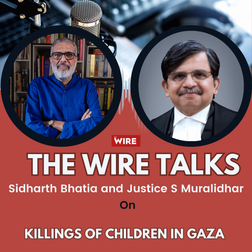
India Must Ask Itself, Do We Want to Take a Stand on Atrocities Against Palestinian Children or Not?
The new report by the UN appointed Commission of Inquiry on the Occupied Palestinian Territory has revealed shocking details about Israeli attacks on Gaza and specifically the torture and killings of Palestinian children. Several instances of children being shot, tortured and sexually abused have been recorded in the report. “This includes a girl who was stripped. So, you know, this public shaming, we call it public nudity. If you subject children to this kind of, it's actually a very deep psychological trauma,” Justice Srinivasan Muralidhar, who was the chairman of the Commission said in a podcast discussion with Sidharth Bhatia. “In our report, We say that mental harm has become intergenerational, producing a distinctive occupied psyche in which the freedom to play, imagine, hope and develop an identity has been eroded,” he said. “No Palestinian child has been able to have a formal education in the last three years. Where a child should be sitting in a classroom, the child is running around looking for firewood. Gaza city had the highest literacy rate even as recently as 2021 and yet you target a place like that, you destroy all its schools. The message is so clear.” The Israeli government has issued an 18 page rebuttal of the report. “Israel says Hamas is using children as shields and that is something that we have missed. A 10-day-old baby breastfeeding on his mother is not involved in any hostility,” he said. Justice Muralidhar stated that Israel was sent all the Commission’s reports and asked to comment, but never got a response. “We have absolutely nothing to gain by falsely accusing either the state of Israel or its soldiers.” Speaking about India, he said, “We can't afford to keep silent. We have been in the forefront of many of the international human rights movements. The values of human dignity, human liberty, which also forms the fundamental constitutional values in our Indian constitution. So, we're not acting contrary to anything at all. When we stand up for the rights of the Palestinian people, particularly Palestinian children." India has not backtracked from its official stance that it stands with the Palestinian people. And it stands with the two state solution. People should also realize, your viewers should realize that the origin, one origin of all of this is 1947, a UN resolution, which talks of the creation of two states, the State of Israel and the State of Palestine. India should seriously introspect and ask itself, with this level of evidence having come forth on the atrocities against Palestinian children, does India want to take a stand at all or not? This is a moment of reckoning.”
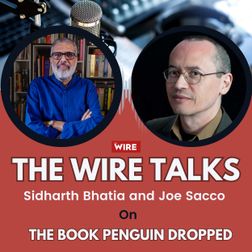
"I think Penguin India Is Looking For Excuses To Drop My Book" - Joe Sacco
Joe Sacco is An internationally known cartoonist journalist famous for his books on Palestine and Gaza. His first book on India — The Once and Future Riot — was published last year, about the Muzaffarnagar riots of 2013 between Jats and Muslims that ended in the death of 60 people and the displacement of 60000, mainly Muslims. The book was set to be sold from August onwards, but last week, the distributors Penguin Random House India stepped back from it. He got a five page list of queries from Penguin UK asking for clarifications and changes. “The main thing for me was changes that seemed like editorial changes they were asking for, which were removing quotes, removing quotes about public figures, removing quotes from a public figure I talked to, even to the extent of move this caption down the page. And I mean, there were like four or five things that were called requirements that I simply wasn't going to do,” Sacco said in a podcast conversation with Sidharth Bhatia.
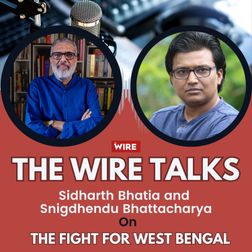
“The Election Commission Is The Key Player In This Election"
Crucial elections will take place in West Bengal in two phases on April 23 and 29. Mamata Bannerjee’s Trinamool Congress has to fight anti-incumbency, because it has been in power since 2011, and the main challenger the Bharatiya Janata Party sees its best opportunity to win the state. This time, the Special Intensive Revision ordered by the Election Commission has also complicated matters since over 90 lakh voters have been struck off the rolls and between 30 and 34 lakh have appealed their removal. The Trinamool Congress and other opposition parties have said that the Election Commission is playing a partisan role and helping the BJP. “The Election commission is the key player in this election. It is election commission that has issued an ultimatum to the Trinamool Congress. It is the election commission that is taking the administration in their control,” said Snigdhendu Bhattacharya. In this election, it looks like Gyanesh Kumar has emerged as the face that wants the change to happen in Bengal. So that means Trinamool Congress, which is the main party in West Bengal and the other smaller opposition parties are fighting not the BJP so much as Gyanesh Kumar,” he said, in a podcast discussion with Sidharth Bhatia.
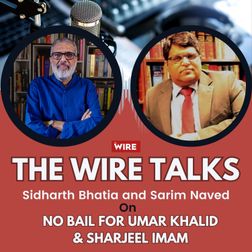
A Political Element Cannot be Ruled Out in the Lack of Bail to Umar Khalid and Sharjeel Imam | Sarim Naved
Umar Khalid and Sharjeel Imam have been in prison for the last five years. Their bail has been denied repeatedly. Last week their five colleagues, also arrested in the Delhi riot case of 2020, were granted bail. Why haven’t they? Lawyer Sarim Naved, who fights both civil and criminal cases, analyses this in a podcast discussion with Sidharth Bhatia. While bail not jail is a general principle, “the courts have a lot of discretion in this matter”, he said. But he says, “the way the current government behaves, yes, a political element cannot be ruled out.” Also, he says, times change and “our understanding of civil liberty shifts from time to time.” He points to cases from the 1990s when “somebody said Khalistan Zindabad and the Supreme Court said this does not amount to terrorism.” But, he says that the cases of Khalid and Imam cannot be discussed by themselves without considering the larger systemic issues of police investigations and the judiciary. “Even in UAPA, there are people who are waiting for a longer period for their trials to start.”
What Makes Mumbai’s Food History Different From Other Cities
Mumbai’s cuisine has been shaped by its migrants, not just from other parts of India but also from different countries. “Irani food, for example, is not available in such abundance in other cities,” says Pronoti Datta, in this podcast conversation with Sidharth Bhatia. Datta’s new book In the Beginning There was Bombay Duck, a Food History of Mumbai, details the various cuisines brought by the city’s communities when they moved here. They brought their food traditions, met other food traditions and it all got transformed in the city. “I suppose my one thought, one idea that runs through the book, or I hope it runs through the book, is the idea of what it means to be native. And the idea of you know, being native is a very strong political idea in the state” she says. She explains that the dining out culture did not start in the then Bombay till quite late. Most eating places catered to the working classes of their particular communities—Maharashtrians, south Indians, Gujaratis, Muslims. Only the westernised restaurants, which became popular in the 1930s, were patronised by the elite. It was only the Irani restaurants that were open to all communities and classes, she points out.
The Poetry Has Gone From Our Lives, but Hate Cannot Last Forever | Saeed Akhtar Mirza
Thirty years ago, Saeed Akhtar Mirza made his final feature film, Naseem, about an aging Urdu poet, played by Kaifi Azmi, and set in the days preceding the demolition of the Babri Masjid. The film opened with a title card which said, “That one act of demolition wrote the epitaph of an age that has passed, perhaps never to return!” “The Babri Masjid epitomised the final collapse, you know, of an idea of India, of a sovereign, secular, democratic republic, equal for all, equality and justice. You saw it collapse in front of your eyes,” he said. “I was in despair but I was also angry when I made the film,” Mirza said in a podcast conversation with Sidharth Bhatia. He has not made any feature film since, though he still makes documentaries and has written two books. Mirza spoke about how the “Hindu-Muslim binary was stupid” and said that those who promoted it hadn’t read any history. Their idea of history is “fundamentally flawed”, he said. He said over 10 million young persons finished school every year and they too had aspiration. “They see glamorous weddings on television, they see cars, fashion and they want all that. And why not?” Without adequate jobs, “where will all that energy be channelled”, he asked. He also spoke about the growing trend of Hindutva-oriented films and said that the filmmakers “know exactly what they are doing and in a strange way I believe they think they are doing no wrong because this is the time for retribution”. But in the end, he said, “Hate cannot last forever, it has to have an expiry date.”
India Badly Needs a Zohran Mamdani to Take On the Right Wing | Saira Shah Halim
India’s left parties are no longer as influential as they used to be. In her new book, Comrades and Comebacks: The Battle of the Left to Win the Indian Mind, Saira Shah Halim, CPI(M) candidate in the 2024 elections, analyses the reasons for this and suggests the way forward. “There have been strategic decisions that went wrong, but morally the Left has never made a mistake,” she said in a podcast conversation with Sidharth Bhatia. Halim talks of the need to bring in the youth and look at contemporary issues – “Let’s look at gig workers, at student networks, at climate change movements, at women,” she said. She felt that the BJP could not be taken on by showing "soft-Hindutva”. She believes Mamdani had shown radical ideas — “I mean, this guy is unfazed, he is taking on Donald Trump, he is taking on these right wing oligarchs, he is taking on these big capitalists, and he is winning because, you know, people are liking these new ideas, which are a far cry from the traditional morals of what the old communists stood for,” though she clarifies that the old guard was right in its own way.
Religion is a No-Go Area in Stand Up Comedy, Now Even the Law Says So | Punit Pania
Comedians and satirists have borne the brunt of the state and of people who are offended by something or the other, but even so, the stand up comedy scene is quite active with many faces. One such is Punit Pania, who left his corporate job 10 years ago and is now a very successful stand up comic. His topics range from poor roads and civic architecture, know-all bhakt uncles, and NRIs, but he also talks about social issues. “In my first open mic, I had two minutes and talked about domestic violence because I felt it had to be talked about,” he said to Sidharth Bhatia in a podcast conversation. He noticed that a man from the audience left, “dragging a woman behind.” Pania says he is not a political activist, but his comedy cannot help being political. “Why there are potholes on the road and why there is no beef on your plate, both things are politically driven. And those are just the most blatant examples. If you really drill down, almost every aspect of your life has a political background to it.” Even so, he slips in references to political leaders. “When you completely inundate the country with your image and your persona and then people can't even mention your name. Even slightly critically. How is that fair? So, when you take all the credit you will get all the blame also.” He also explains why the laws have made religion out of bounds but there are still “innovative ways to say what you want to say.”
Senior Citizens Are the Most Vulnerable to Online Scams Such as Digital Arrests and Sextortion | Ruby Dhingra
Why have digital scams become so commonplace? And why are senior citizens falling prey to scamsters? “We can say that a vast number of people who fall for cyber scams are senior citizens,” says Ruby Dhingra, a former journalist who co-founded Saksham Senior which works to digitally empowers senior citizens. “There are a number of reasons for this, ranging from neurological factors and the fact that seniors have money in the bank, property etc.,” Dhingra said in a podcast conversation with Sidharth Bhatia. She gives some examples of the kind of scams that are being perpetrated—from sextortion to investment opportunities to ‘digital arrest’ which has become very common. “A banker in Delhi lost Rs 23 crore to a digital arrest scam.” “The digital arrest is the scariest,” she said. The victim is isolated from everyone and threatened with arrest if they step out of the house. “There have been cases where the victim is under digital arrest for a month.” She said most scam organisations work out of South East Asia and the government brought back many hundreds of Indians last year who had been kept there forcefully.
More Young Indians Are Opting for Therapy as Mental Health Stigma Is Fading | Maherra Desai
It is no longer unusual to hear of someone, especially from a younger generation, who is undergoing therapy from a mental health professional, which is a big change from some years ago. The Covid lockdown increased “stress, depression and anxiety for many” says Maherra Desai, clinical psychologist in Mumbai’s Jaslok Hospital on World Mental Health Day. “Social media too has increased a sense of isolation,” she says during a podcast discussion with Sidharth Bhatia. Desai explains there are many reasons why people seek out therapists — they may be in distress or feel they need help — “They recognise the need for mental health.” She says not only do younger Indians seek out therapists for themselves, but also persuade their elders to do so too. “A de-stigmatisation has happened.” And queries come from all kinds of places. “I get messages from remote parts of the country from people who have found my number.” Many consult online too. “Online consultation too has taken off—earlier I was skeptical, but I now see it can be effective.” India has a need but also a severe shortage of qualified counsellors. “The World Health Organisation recommends 3 psychiatrists per one lakh population, but India has only 0.75 per lakh.”
1 di 6