The Security Nexus Deep Dive

The Security Nexus Deep Dive

di The Security Nexus
Stagione 2

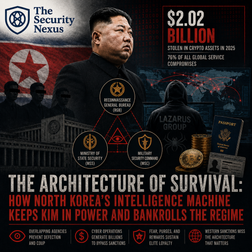
The Watcher State: North Korea's Intelligence Architecture as a Survival Machine
Kim Jong-un's overlapping intelligence agencies are not redundant bureaucracies — they are a deliberately engineered system for preventing coups, disciplining elites, and bankrolling a sanctions-strangled regime. https://www.thesecuritynexus.net/

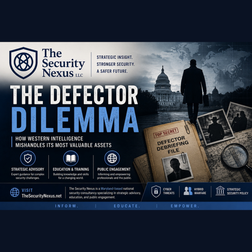
The Defector Dilemma: How Western Intelligence Mishandles Its Most Valuable Sources

Between paranoid skepticism and reckless credulity, Western agencies have repeatedly failed to extract full value from defectors—and the structural causes remain unreformed. https://www.thesecuritynexus.net

China’s Southern Flank: How Beijing Built a Multi-Domain Intelligence Architecture in Latin America

From SIGINT stations in Cuba to a PLA-operated antenna in Patagonia, China’s intelligence footprint in the Western Hemisphere is more operationally mature than U.S. policy acknowledges. https://www.thesecuritynexus.net

The Purge Paradox: When Authoritarian Leaders Gut Their Own Intelligence Services
Purging intelligence services consolidates political control, but it systematically degrades the operational capacity autocrats need to survive. Turkey, Saudi Arabia, and Russia illustrate the pattern. https://www.thesecuritynexus.net

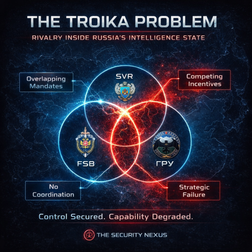
The Troika Problem: How Rivalry Between Russia’s Intelligence Services Is Shaping the War and Threatening Western Security
Russia’s intelligence system is built around competition, not coordination. That structure protects Putin but distorts analysis, degrades integration, and produces cascading failures. In Ukraine, those weaknesses manifested in poor strategic warning, disjointed operations, and a forced shift to tactical intelligence. Western services have recognized these dynamics but have not systematically exploited them. The Troika problem remains both a liability for Russia and an underused opportunity for its adversaries. https://www.thesecuritynexus.net

Commercial Spyware Is a NATO Counterintelligence Problem
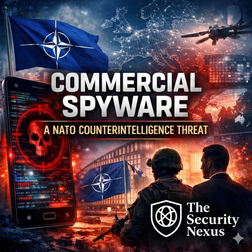
Commercial spyware has evolved into a privatized intelligence capability that allows governments to acquire advanced mobile exploitation tools without developing them internally. Platforms such as Pegasus and Predator can covertly access communications, contacts, location data, and encrypted messaging, turning smartphones into powerful intelligence collection devices. While public debate often focuses on civil liberties, the more significant issue is strategic: these tools enable adversaries to conduct intelligence operations against NATO officials, diplomats, and defense personnel through commercial intermediaries. Because the spyware market complicates attribution and bypasses traditional export controls, NATO’s current responses—primarily device-level cybersecurity measures—are insufficient. Treating commercial spyware as a collective counterintelligence threat, rather than isolated national incidents, is necessary to protect alliance decision-making networks. https://www.thesecuritynexus.net

Governing Proxies Without Command Authority
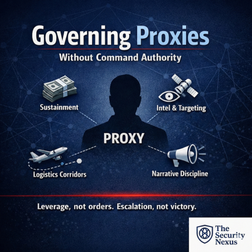
States don’t need command authority to govern proxies—but they do need leverage. The real mechanisms are sustainment, intelligence/targeting support, sanctuary and logistics corridors, and narrative discipline. Those tools can keep proxy violence “below threshold,” but they also produce predictable failures: agency slack, autonomization, deniability collapse, and blowback. https://www.thesecuritynexus.net

Counterintelligence for the Cloud: Treat Your Hyperscaler Like Contested Terrain
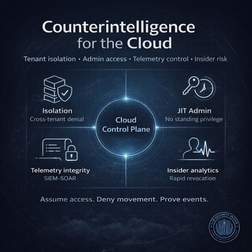
Cloud counterintelligence treats hyperscale and GovCloud environments as contested terrain. The decisive fights happen at tenant boundaries, privileged access, telemetry integrity, and insider-risk enforcement. Build for constrained privilege (JIT), durable visibility (tamper-resistant telemetry), and compartmented blast radius—then continuously verify. https://www.thesecuritynexus.net

Militarized Policing and the Civil Liberties Trap
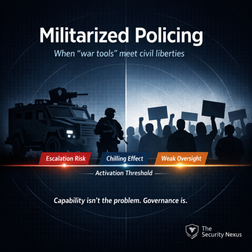
The strategic mistake is treating militarized policing as a “gear” issue. It is a governance problem: coercive capacity plus weak constraints yield predictable degradation of civil liberties. The evidence base provides little confidence that militarization systematically reduces crime or improves officer safety, while it does indicate reputational harm and potential escalation risks. A democratic state can maintain a high-end response capability, but it must make militarized deployment rare, auditable, and politically costly when misused. https://www.thesecuritynexus.net

Open Source Naval Order of Battle

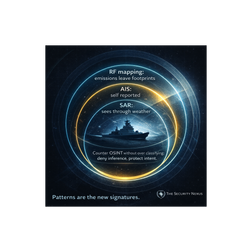
Commercial maritime sensing has made it easier to build naval order-of-battle estimates from open sources. AIS provides identity and patterns but is vulnerable to spoofing and manipulation. SAR detects ships regardless of cooperation, and fusion approaches exploit mismatches between AIS and imagery to identify anomalies and “dark ships.” Commercial RF mapping can add another layer of behavioral evidence when AIS goes silent. States should counter OSINT by reducing adversary inference through emission discipline, selective disclosure, AIS governance, and better internal sharing, rather than defaulting to overclassification. https://www.thesecuritynexus.net
2 di 5