The Psychological Eval

The Psychological Eval

di Corey Wilson Stuart
Stagione 1

When Drama Gets Personal: Labels, Loyalty & Taking Sides

Esplicito
Everyone has a side. But what happens when defending yours turns into tearing someone else down? Screenshots, divided loyalties, and public insults—when does online drama become personal? In the premiere of The Psychological Eval, Corey examines the situation involving Alana, Madison, and messages connected to Kayla’s account. Through selected posts, message excerpts, and a participant’s perspective, this episode explores how an argument about behavior becomes a battle over character and reputation. We’re talking about public shaming, mental-health stigma, the assumptions we make about emotional reactions, and whether protecting a friend can affect how we interpret a conflict. Can compassion and accountability coexist? And what does hearing “both sides” actually require?

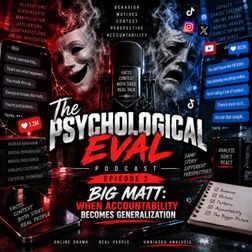
Big Matt: When Accountability Becomes Generalization

Esplicito
In Episode 2 of The Psychological Eval, Corey examines the public commentary of social media personality and podcaster Big Matt (Matthew Chappell) through a psychological lens. Rather than deciding who's “good” or “bad,” this episode digs into the psychology behind the way we communicate online. Using Big Matt's publicly available commentary as the starting point, Corey explores confirmation bias, social identity theory, group polarization, selective empathy, moral exclusion, and the powerful role outrage plays in social-media engagement. But this isn't a takedown. The evaluation also examines moments where Big Matt has advocated for people facing discrimination, creating a more complicated picture than either supporters or critics might expect. The larger question becomes whether legitimate anger toward injustice can sometimes evolve into the same kind of generalization we're trying to fight.

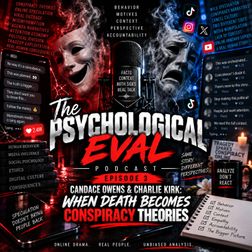
Candace Owens & Charlie Kirk: When Death Becomes Conspiracy Theories

Esplicito
Why has Candace Owens continued returning to Charlie Kirk’s assassination, and what happens when questioning an official narrative develops into something much larger? In this episode of The Psychological Eval, Corey examines Owens’ extensive public commentary surrounding Charlie Kirk, the investigation into his death, Turning Point USA, Erika Kirk, and the numerous theories and allegations that have emerged along the way. Rather than diagnosing anyone or deciding which theory listeners should believe, this episode explores the psychology surrounding the controversy, including confirmation bias, motivated reasoning, grief, pattern recognition, cognitive dissonance, social identity, and the powerful reinforcement created by online audiences. We also examine an important distinction that can easily disappear online: asking questions is not the same as proving an allegation. Where does healthy skepticism end? What evidence should be required before suspicion becomes accusation? And why can certain stories become increasingly difficult for creators and audiences to walk away from? This is The Psychological Eval: examining the psychology behind the internet’s biggest controversies without telling you which side to take. Disclaimer: This episode contains commentary, opinion, and psychological analysis of publicly available information. No psychological or psychiatric diagnosis of any individual is intended. Allegations discussed are identified as allegations unless independently established. Tyler Robinson has pleaded not guilty, and the criminal proceedings concerning Charlie Kirk’s death remain ongoing as of this episode’s publication. Portions of third-party material, if included, are used for purposes such as criticism, commentary, and news reporting consistent with the principles of fair use under Section 107 of the U.S. Copyright Act.

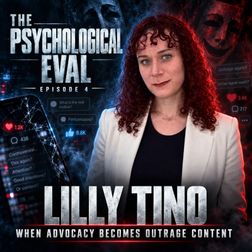
Lilly Tino: When Advocacy Becomes Outrage Content

In Episode 4 of The Psychological Eval, Corey examines the public behavior and online controversies surrounding influencer Lilly Tino. The episode explores restaurant confrontations, the filming of workers and bystanders, privacy concerns involving Disney restrooms, and the way social-media algorithms reward emotionally charged conflict. The discussion separates Lilly’s gender identity from her conduct. It also acknowledges that some criticism directed toward Lilly crosses into genuine anti-trans harassment. Respecting someone’s identity does not require defending everything they do, and criticizing specific behavior does not justify attacking an entire community.

When The Internet Invents A Villain: The Menachem Silverstein Misinformation Scandal

In this episode of The Psychological Eval, Corey examines the false story that Jewish comedian Menachem Silverstein announced his support for Israel and caused an audience at Chicago’s Laugh Factory to walk out. According to reporting, Silverstein was not the comedian in the video and was not even in Chicago when the event occurred. The performer was Kieron Harrell, and the audience’s departure was reportedly part of a staged prank—not a political protest. So how did an ambiguous video become a widely accepted political scandal? Corey breaks down the psychological forces that helped the story spread, including: Confirmation bias and motivated reasoning The emotional appeal of politically satisfying narratives Social proof and online mob behavior The difference between misinformation and deliberate disinformation Automation bias and the authority people give AI-generated answers The illusory truth effect created through repetition Why corrections rarely reach as many people as the original accusation The lasting professional and emotional consequences of false identification
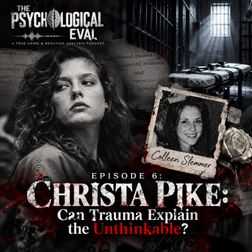
Christa Pike: Can Trauma Explain The Unthinkable?

Esplicito
DISCLAIMER: In this podcast, there is strong content & language used/suggested. The analysis is not bias, but may contain some "heat of the moment" discussions. This is an episode that per TPE Management is highly suggested NOT SUITABLE for anyone under the age of 18 years old. If you or someone you love struggles with traumatic events past or current, please reach out for help. In Episode 6 of The Psychological Eval, we go beyond the crime itself to examine Pike's development from childhood through adolescence, the psychological vulnerabilities identified by evaluators, her relationship with Tadaryl Shipp, the events leading to Colleen Slemmer's murder, and the psychological evidence that became increasingly important during decades of appeals. We also examine one particularly uncomfortable question: Can someone be both the product of profound victimization and fully responsible for profoundly victimizing someone else? This episode explores childhood trauma, attachment, emotional regulation, identity development, adolescent brain development, interpersonal dependency, PTSD, personality pathology, and the important distinction between understanding behavior and excusing it. And throughout that analysis, we return to the person whose life cannot become secondary to the psychology of her killer: Colleen Slemmer. ⚠️ CONTENT WARNING This episode contains discussions of murder, severe violence, childhood abuse, sexual trauma, mental-health conditions, and capital punishment. Some material may be disturbing or emotionally difficult for listeners. Listener discretion is strongly advised.