The Deep Dive

The Deep Dive

di FlyingFree

The Problem with Science in Media

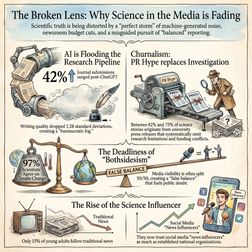
The evolving relationship between scientific evidence, public policy, and modern news consumption. One report highlights a systematic review of the barriers and enablers that influence how research is integrated into government decision-making, emphasizing the need for structured advisory bodies and mutual trust. In parallel, another study examines how young adults are reshaping the information landscape by increasingly relying on social media and news influencers rather than traditional media outlets. While policymakers struggle with institutional deficits and political resistance to scientific data, younger generations show a growing trust in digital platforms, often viewing news as something they incidentally encounter rather than intentionally seek. Suggesting that future governance and public discourse will be defined by how well institutions adapt to technological shifts and changing perceptions of expertise. This underscores the critical challenge of maintaining scientific integrity in an era of hypercompetition and rapidly transforming media habits.

Why Most Scientific Discoveries Are Wrong

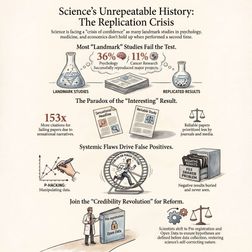
Exploring the replication crisis, a systemic phenomenon where numerous published findings in fields like psychology, medicine, and economics cannot be reproduced by independent researchers. This failure is often attributed to questionable research practices, such as data manipulation to achieve statistical significance and a "publish or perish" culture that prioritizes novel results over accuracy. Recent large-scale efforts, like the Reproducibility Project, have documented significant drops in effect sizes and low success rates when attempting to verify landmark studies. In response, an Open Science movement has emerged to promote transparency through methods like pre-registration, data sharing, and registered reports. Additionally, publishers are increasingly utilizing artificial intelligence to safeguard research integrity by detecting fraud and improving editorial workflows. Despite these challenges, public confidence in scientists remains relatively high, though it faces pressure from partisan divides and concerns regarding communication and bias.

Universal Vaccines

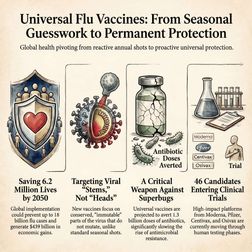
Detailing the ongoing shift toward universal and next-generation vaccines designed to provide broader, more durable protection against highly mutable viruses like influenza and SARS-CoV-2. According to a World Health Organization (WHO) assessment, these innovative platforms could prevent billions of infections and save millions of lives by 2050 while simultaneously curbing antimicrobial resistance. Clinical progress is highlighted through various candidates, including Moderna’s mRNA-1010, which has reached marketing authorization filings, and Osivax’s OVX836, which recently completed enrollment for large-scale efficacy trials. Researchers are utilizing advanced technologies such as self-assembling nanoparticles and computational epitope-focusing to target stable, internal viral components that do not mutate as rapidly as surface proteins. Furthermore, examining the regulatory evolution and economic benefits of these broad-spectrum tools, emphasizing their potential to replace the current system of reactive seasonal updates with a more proactive global health strategy. Efforts are also expanding into pan-coronavirus research and needle-free delivery systems to ensure these medical advancements are accessible and effective across diverse global populations.

AI in Medicine

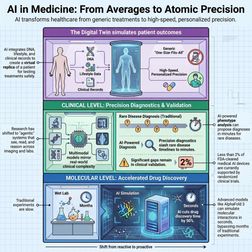
Exploring the transformative impact of artificial intelligence on the future of healthcare, with a primary focus on drug discovery and personalized medicine. Organizations like Isomorphic Labs and UW Medicine are utilizing sophisticated models to accelerate the design of new treatments for complex diseases, shifting from slow lab experiments to rapid computational simulations. Technical breakthroughs such as AlphaFold 3 and the PATH algorithm are enhancing our ability to predict molecular interactions with greater speed and transparency. Beyond drug design, we discuss how AI-driven precision medicine tailors care to individual genetic profiles and clinical histories to improve patient outcomes. However, experts emphasize that widespread adoption requires addressing critical challenges regarding algorithmic bias, data privacy, and the need for continuous clinical validation. Overall, the data presents AI as a powerful tool for operational efficiency and scientific innovation, provided it is implemented through responsible governance.

Climate Change

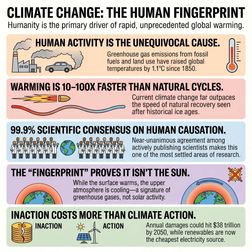
Scientific research from NASA and major academic institutions confirms a near-unanimous scientific consensus that human activity is the primary driver of modern climate change. Despite this clarity, reports reveal that the fossil fuel industry spent decades executing a disinformation campaign to stall policy changes and protect corporate profits. These sources illustrate that companies like ExxonMobil possessed internal models that predicted global warming with high accuracy as early as the 1970s, yet they publicly chose to promote doubt. This deception was amplified by media "bothsidesism," which erroneously grants equal airtime to non-expert contrarians, thereby confusing the public. To counter these denialist techniques, experts suggest inoculating the public by explaining the logical fallacies and financial motives behind climate misinformation.

We Have Genetically Engineered Live Humans For The First Time

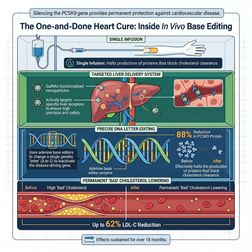
Recent clinical findings show that VERVE-102, an innovative in vivo base editing medication, successfully lowers LDL cholesterol by permanently deactivating the PCSK9 gene in the liver. Data from the Heart-2 trial indicates that a single infusion can reduce harmful cholesterol levels by as much as 62%, with results remaining stable for up to 18 months. This genetic medicine approach mimics naturally occurring protective mutations to offer a potential one-time treatment for patients with hypercholesterolemia who currently rely on chronic daily or monthly therapies. Additionally, the FDA has introduced a "plausible mechanism" regulatory pathway to expedite the approval of such ultra-rare disease and targeted genetic treatments. Beyond the liver, researchers are expanding base editing and epigenetic editing technologies to address diverse conditions like sickle cell disease and beta-thalassemia. These advancements signal a major transition in healthcare from managing symptoms to fixing the underlying molecular causes of disease.
What Does Science Have To Say About Free Will?

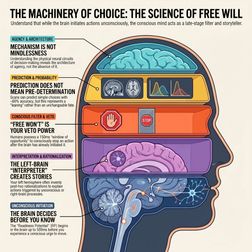
Examining how modern neuroscience impacts our conceptual understanding of free will and moral responsibility. While some scientific data suggests that brain activity precedes conscious awareness of choices, scholars argue these findings do not necessarily prove that human freedom is an illusion. Instead, the research highlights the mechanistic nature of the mind, illustrating how biological circuits integrate sensory information and value to facilitate decision-making. Also addressing the difficulty of using biological evidence to resolve long-standing philosophical debates regarding determinism and indeterminism. Ultimately, the data suggests that while brain processes are complex and physical, they still support the psychological constructs necessary for agency. Combined, the data portrays a multidisciplinary effort to reconcile biological causes with the traditional belief in voluntary action.

Gain-of-Function Research: Making Super Diseases

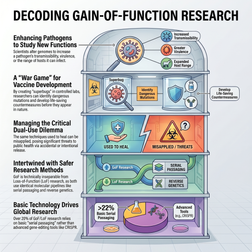
A policy brief by the Center for Security and Emerging Technology (CSET) provides a comprehensive analysis of the global gain-of-function (GOF) and loss-of-function (LOF) research landscape between 2000 and 2022. By evaluating roughly 7,000 publications, the authors demonstrate that these two methodologies are technically intertwined, often occurring within the same study to help scientists understand pathogens and develop vaccines. The report highlights that U.S.-affiliated researchers contribute to about half of this global work, which frequently utilizes common methods like serial passaging rather than just advanced gene-editing tools. Because GOF and LOF research share the same equipment and experimental procedures, the authors argue that broad regulations intended to mitigate risks could inadvertently hinder essential public health advancements. Ultimately, the brief advises policymakers to adopt nuanced, targeted oversight that accounts for varying levels of risk across different pathogens and methodologies.

Raising the Dead: De-Extinction

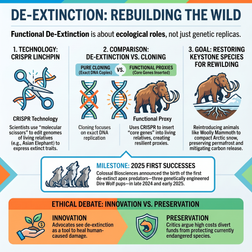
Sources detail the scientific, ethical, and logistical dimensions of de-extinction, with a primary focus on the biotechnology firm Colossal Biosciences. By leveraging CRISPR gene-editing and advanced reproductive technologies, researchers aim to revive functional proxies of lost species like the woolly mammoth and dodo. They highlight recent technical milestones, including the successful cultivation of pigeon primordial germ cells, while documenting over half a billion dollars in private investment. Beyond the laboratory, the articles examine the ecological rationale for these projects, such as using megaherbivores to combat Arctic permafrost melt. However, there are ethical controversies surrounding animal welfare and the potential for diverting funds from traditional conservation. Ultimately, there is a shift toward functional restoration, where engineered animals serve as tools for modern environmental management and biodiversity recovery.

Changing the Sky: Solar Geoengineering

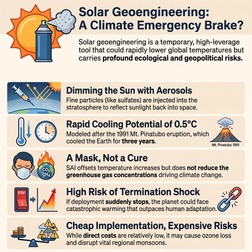
Stratospheric Aerosol Injection (SAI) is a proposed climate engineering method designed to mitigate global warming by reflecting sunlight away from Earth. The process involves using specialized aircraft or balloons to disperse reflective particles, such as sulfur or calcium carbonate, into the upper atmosphere to mimic the natural cooling effect of volcanic eruptions. While research suggests the technique is technically feasible and relatively inexpensive compared to other climate solutions, it remains controversial due to significant environmental uncertainties. Potential risks include the depletion of the ozone layer, alterations to global rainfall patterns, and various sociopolitical challenges. Consequently, the urgent need for international governance frameworks and robust legal instruments to manage the ethical and physical consequences of such a global intervention. Collectively, this provides a comprehensive overview of the scientific mechanism, historical research projects, and regulatory hurdles associated with solar radiation modification.
4 di 6