The Deep Dive

The Deep Dive

di FlyingFree

The Sunlight Paradox

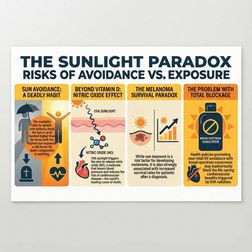
Presenting a nuanced view of sun exposure, balancing the known risks of ultraviolet (UV) radiation with its essential health benefits. Multiple sources emphasize that UV rays—specifically UVA and UVB radiation—are a major cause of skin cancer, including melanoma, particularly for outdoor workers, and they recommend comprehensive sun protection strategies like shade, protective clothing, and broad-spectrum SPF 30+ sunscreen. Conversely, other sources focus on the protective effects of sunlight beyond just vitamin D synthesis, suggesting that sun exposure is inversely associated with all-cause mortality, and can provide cardiovascular benefits, improved mood, and therapeutic effects for conditions like psoriasis, possibly through the release of nitric oxide. Ultimately, the consensus suggests that while sun avoidance may increase overall mortality risk, responsible exposure is key for vitamin D production and other health benefits, while still requiring protection to mitigate the dangers of skin cancer.

Cosmology in Crisis

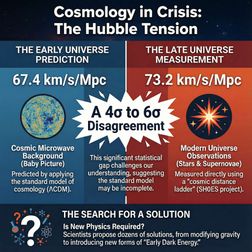
Discussing the persistent cosmological puzzle known as the Hubble Tension, which is the significant discrepancy between the universe's expansion rate (H₀) measured by local, late-time observations (like those from the Hubble and James Webb Space Telescopes using Cepheid variables and supernovae) and the lower rate predicted by early-time observations of the Cosmic Microwave Background (CMB), interpreted within the standard Lambda-CDM (ΛCDM) model. Research investigating this tension involves complex calculations using "standard rulers," such as the sound horizon scale, and evaluating numerous theoretical alternatives beyond ΛCDM, including models featuring Early Dark Energy (EDE), modified gravity, or extra relativistic particles. Crucially, recent results from the James Webb Space Telescope have affirmed the accuracy of the local measurements, strengthening the argument that new physics, rather than measurement error, may be required to resolve this fundamental crisis in cosmology. This highlights that while various models can alleviate the tension to varying degrees, no consensus solution has been found.

Radiophobia: The Real Killer

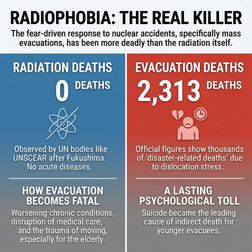
Offering an overview of the consequences of major nuclear accidents, particularly the phenomenon of "radiophobia." Several sources discuss the Fukushima and Chernobyl disasters, emphasizing that the fear of radiation (radiophobia) often resulted in more harm, particularly to the elderly through rushed evacuations, than the actual low-level radiation exposure. This concern about unnecessary fear is paralleled by discussions of the trade-offs of applying the precautionary principle to energy policy, which critics argue leads to increased reliance on fossil fuels that cause far more deaths from air pollution.

Renewables: Not So Green

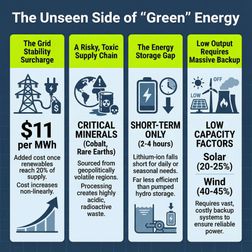
Examining the complexities of sustainable energy solutions, focusing heavily on the trade-offs between intermittent renewable sources like wind and solar, and dispatchable power options such as pumped hydro and nuclear energy. A major theme is the challenge of intermittency in renewables, necessitating large-scale storage solutions like lithium-ion batteries or pumped hydro storage (PHS), with PHS frequently noted for its maturity and longevity, despite site limitations. The materials also discuss the environmental, social, and geopolitical implications associated with various energy technologies, particularly addressing the finite nature of critical minerals used in batteries and the land-use requirements for solar and wind power compared to the small physical footprint of nuclear facilities. Furthermore, the sources stress the need for accurate and comprehensive life cycle analysis to assess the true costs and impacts of energy systems, advocating for a diversified and integrated energy mix to ensure grid reliability and minimize integration expenses.

The Unbelievable Tale of Ulcers

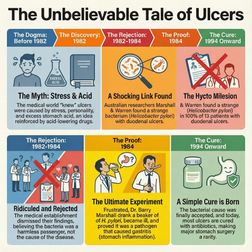
Offering an overview of the medical discovery that peptic ulcers are primarily caused by the bacterium Helicobacter pylori, rather than just stress or excess stomach acid, which was the prevailing medical dogma for decades. Centering on the efforts of Australian researchers Dr. Barry Marshall and Dr. Robin Warren, who made this controversial finding in the early 1980s. To prove their hypothesis, Dr. Marshall famously ingested the bacteria himself, developing gastritis and ulcers, which he then cured with antibiotics. Despite initial skepticism and ridicule from the medical establishment, the link between H. pylori and ulcers, and the effectiveness of antibiotic treatment, gained acceptance by the mid-1990s and is now standard therapy, leading to Marshall and Warren being awarded the Nobel Prize in 2005. The sources also highlight the irony that earlier researchers had observed similar bacteria but were blinded by the acid theory, significantly delaying the development of an effective cure.

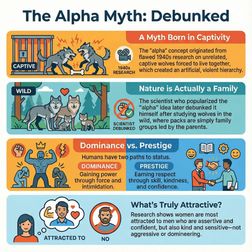
The Myth of the Alpha Male

A detailed exploration of the misinterpretation of the "alpha male" concept in popular culture, tracing its scientific origins and evolution. It explains that the idea stems from early studies of chicken dominance hierarchies and, more famously, Rudolph Schenkel's flawed 1940s observations of captive wolves, which were popularized by Dave Mech's 1970 book, The Wolf. The narrative emphasizes that later research, particularly by Mech on wild wolves, revealed that wolf packs are families and the 'alphas' are simply the parents, not aggressive dictators. Finally, we examine our closest relatives, chimpanzees and bonobos, to show that successful influence and leadership are often based on cooperation, empathy, and strong social bonds, arguing that the human emphasis on aggression for power is biologically inaccurate and that humans should seek to understand their own prestige-based societal needs for connection.

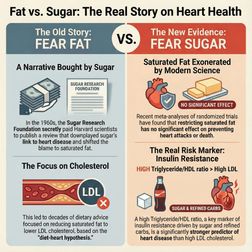
Sugar Paid and Fat Took the Blame

Exploring the evolving scientific and historical debates surrounding the dietary causes of coronary heart disease (CHD) and the impact of measurement errors in health research. Historical analyses reveal that the sugar industry strategically funded research in the 1960s to downplay the risks of sucrose while casting saturated fats as the primary dietary culprit. Contemporary experts now argue that long-standing government limits on saturated fats are scientifically unjustified, suggesting that health outcomes should be evaluated within the context of whole foods rather than isolated nutrients. Additionally, researchers emphasize that insulin resistance is more accurately predicted by specific lipid ratios, such as the triglyceride-to-HDL balance, than by total cholesterol alone. To address inaccuracies in these complex fields, the SIMFEX method is introduced as a robust statistical tool for correcting data contamination in epidemiological studies. Underscoring the necessity of objective data analysis and the critical re-evaluation of nutritional guidelines that may have been influenced by industry bias or flawed statistical modeling.

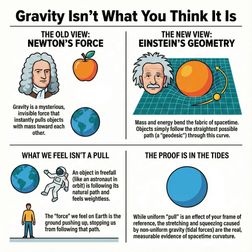
Gravity Doesn't Exist (as a force)

Exploring the evolving definition of gravity, contrasting Newtonian mechanics with General Relativity and modern entropic gravity theories. While the classical view treats gravity as a literal force that accelerates mass, Einstein redefined it as the curvature of spacetime, where objects simply follow the straightest possible paths. More recent holographic models suggest gravity is an emergent phenomenon resulting from quantum information and thermodynamics rather than a fundamental interaction. Also discussing the equivalence principle, noting that the sensation of weight arises from being pushed out of a natural free-fall state. Ultimately, "force" is often a useful approximation or cultural shorthand rather than an absolute physical reality.

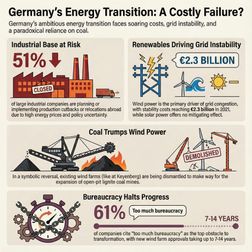
Germany: A Case Study in the Failure of Renewables

Examining the complex challenges and debates surrounding Germany’s energy transition, or "Energiewende," as the nation strives for net-zero emissions. A primary focus is the controversial decision to expand coal mining in Lützerath, which necessitated dismantling a wind farm to ensure short-term energy security following the Russian invasion of Ukraine. While some argue that nuclear power is an essential, reliable, and cost-effective partner for renewables, others document Germany’s choice to phase out atomic energy in favor of solar and wind. This shift has led to significant grid volatility, including "green blackouts" and instances of extreme price spikes during periods of low natural generation. Despite these hurdles, massive increases in wind turbine approvals and legal reforms aimed at accelerating infrastructure growth. Ultimately, this portrays a country at a crossroads, balancing environmental commitments against the immediate practicalities of industrial stability and energy independence.
Nuclear Power

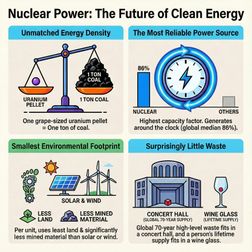
Exploring the dual nature of nuclear science, tracing its history from the discovery of uranium’s inherent energy to its modern applications. It explains the mechanics of fission and radioactive decay, detailing how researchers like Enrico Fermi transitioned from theoretical physics to creating the first self-sustaining chain reactions. Nuclear power is an essential tool for reaching net-zero emissions, it provides more reliable and material-efficient energy than wind or solar. Beyond electricity, highlighting the "peaceful atom" through medical isotopes used to treat cancer, atomic gardening to improve crop yields, and nuclear batteries that power deep-space exploration. While acknowledging the devastation of atomic weapons and high-profile accidents, emphasizing that radiation is a manageable natural phenomenon with immense potential for human progress. Ultimately, nuclear technology offers both existential risks and the key to a prosperous, decarbonized future.
2 di 6