The Conservation Conversation (TCC)

The Conservation Conversation (TCC)

di Rumbidzai Takawira
Stagione 2
THE ZIMBABWE WATER DIALOGUE : Industry Impacts and the Economics of Water
Every industry, from mining to agriculture to manufacturing, depends on water, yet, many of the same industries pollute, over-abstract, or degrade the very water systems they rely on. This is not just an environmental issue, it is an economic one. Join host Rumbidzai Takawira as she speaks to Professor Mark Nyandoro, Senior Lecturer in Economic History at the University of Zimbabwe, specialising in water, climate, and development. His work connects water governance to economic growth, inequality, and long-term development , helping us understand how history continues to shape today’s industrial choices. We ask difficult but necessary questions: Can Zimbabwe industrialise without collapsing its water systems? And is pollution cheaper than compliance?
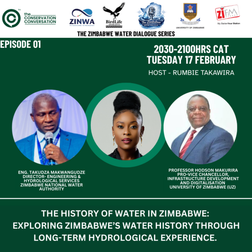
THE HISTORY OF WATER IN ZIMBABWE: EXPLORING ZIMBABWE'S WATER HISTORY THROUGH LONG-TERM HYDROLOGICAL EXPERIENCE.
Today on The Conservation Conversation (Tuesday 17 February 2026), we dive into the history and foundations of Zimbabwe’s water story in Episode 01 of the Zimbabwe Water Dialogue Series. Before we talk about shortages, pollution, or the future, we must understand where it all began. How was Zimbabwe’s water system designed?What did we inherit at independence? Was Zimbabwe ever truly water-scarce, or did management failures shape today’s crisis? Join Host Rumbie Takawira in conversation with: Eng. Takudza Makwangudze – Director, Engineering & Hydrological Services, Zimbabwe National Water Authority (ZINWA) And Professor Hodson Makurira - Pro Vice Chancellor, Infrastructure Development & Digitalisation, University of Zimbabwe
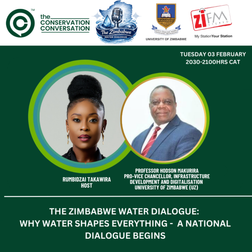
THE ZIMBABWE WATER DIALOGUE: WHY WATER SHAPES EVERYTHING - A NATIONAL DIALOGUE BEGINS
Bonus
This week on The Conservation Conversation We officially launch The Zimbabwe Water Dialogue, in partnership with the University of Zimbabwe. Rumbidzai Takawira sets the scene for a national conversation on water, why this dialogue matters, what it hopes to achieve, and how water touches every part of Zimbabwe’s future, from communities and industry to policy and climate resilience. 🎙️ Featuring Professor Hodson Makurira, Pro Vice Chancellor (Infrastructure Development & Digitalisation), University of Zimbabwe. Water is life. The conversation begins tonight. #WaterDialogue #ZimWaterDialogue #ZimWater #water #conservation
Stagione 1
CITES CoP20 WRAP UP: Africa Negotiates, Wildlife Futures & The Battle Over Use vs No-Use

In this episode of The Conservation Conversation, (9 December 2025) Rumbidzai Takawira sits down with Professor Patience Gandiwa, Director of International Conservation Affairs at ZimParks, Chairperson of the African Group of Negotiators on Wildlife and Vice-Chair of CITES CoP20, for an unfiltered breakdown of everything that went down in Samarkand, Uzbekistan. From stockpile wars to Africa’s historic united front, from Namibia’s rejected ivory and rhino horn proposals to Zimbabwe’s breakthrough on value-added elephant products… this episode pulls back the curtain on the politics, science and power struggles that shaped the 50th anniversary of CITES. We unpack: • Consumptive vs non-consumptive conservation, the ideological battle dividing Africa • Why Proposal 14 is a game-changer for Zimbabwean youth and industry • What Africa achieved, and what still lies ahead in intersessional negotiations Featuring supporting voices from CITES SG Ivonne Higuero, Namibia (Horn Nam) and Senegal.
CITES UNFILTERED: The Battle for Africa’s Voice and International Trade in Wildlife
This week (Tuesday 02 December 2025) On The Conservation Conversation , we take you inside CITES CoP20 in Samarkand, Uzbekistan, for an unfiltered look at one of the most dramatic weeks in global wildlife governance. From elephants to eels, sharks to hyenas, ivory debates to taxonomy battles, Africa’s voice is being tested on the world stage. And we’re bringing you the leaders at the heart of it. Join Rumbie Takawira as she hosts: 🇿🇼 Ambassador Tadeous Chifamba Permanent Secretary, Ministry of Environment, Climate & Wildlife (Zimbabwe) 🇰🇪 Dr Patrick Omondi Director-General, Wildlife Research & Training Institute (Kenya) 🇿🇦 Mr Narend Singh Deputy Minister, Ministry of Forestry, Fisheries & Environment (South Africa) Together, we unpack: • why Africa is divided over elephant nomenclature, • what the ivory and rhino horn votes really mean, • the politics behind giraffe, eel and hyena proposals, • and how international wildlife trade decisions impact communities.
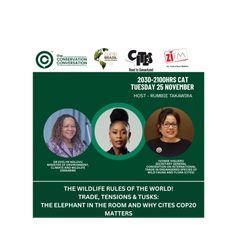
THE WILDLIFE RULES OF THE WORLD- Trade, Development and Tusks: Why the Convention on International Trade in Endangered Species (CITES) COP20 Matters
Coming to you from the 20th Conference of the Parties to the Convention on International Trade in Endangered Species of Wild Fauna and Flora, (.CITES CoP20) in Samarkand, Uzbekistan, we pull back the curtain on one of the most powerful, and most misunderstood, global environmental conventions: CITES, the body that decides the wildlife trade rules for the entire planet. In this kickoff episode from CITES CoP20, we sit down with Zimbabwe’s Environment Minister, Dr. Evelyn Ndlovu and the CITES Secretary General, Ivonne Higuero, to unpack the global wildlife trade rules shaping elephants, ivory, rhinos and more. From powerful interventions against the “stepwise approach,” to Africa’s push for fair, science-based decisions, we break down why CITES matters for communities living with wildlife, and why elephants remain the biggest political animal in the room. This is The Conservation Conversation…. clear, African, and unapologetically real.
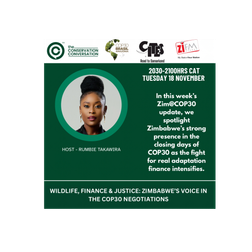
WILDLIFE, FINANCE AND JUSTICE: Zimbabwe’s Voice in the UNFCCC COP30 Negotiations
From protest chants to high-stakes negotiations, this episode takes you inside Week One of COP30 and a peak into Week Two, where finance fights, adaptation politics, and climate justice demands collided. We unpack what La been happening in Belém, why $1.3 trillion is the number echoing across the Amazon, and how Zimbabwe is participating in this global green revolution. With expert insights, on-the-ground updates, and powerful new voices from The Nature Conservancy, Audubon, and the Zimbabwean delegation, this episode breaks down the climate-power debates shaping Africa’s future.
FROM FARM TO COP30 THE FOOD FACTOR: HOW WHAT WE EAT SHAPES THE CLIMATE CRISIS AND THE REAL COST OF FEEDING THE PLANET
As COP30 unfolded in Belém, we focused on one theme which is standing out, food systems. Agriculture and food production are responsible for nearly one-third of global emissions, yet for millions in Africa and across the Global South, they’re also a matter of livelihoods, nutrition, and identity. In this episode, I speak with Oliver Camp, Environment and Food Systems Advocacy Advisor - GLOBAL ALLIANCE FOR IMPROVED NUTRITION (GAIN), to explore: • How food systems are finally making it onto the climate agenda • Where finance and ambition are (or aren’t) meeting reality • What the pledges mean for the Global South, smallholder farmers, and our shared path to 1.5°C
FROM POLLUTION TO POSSIBILITY: A Fight To Save Harare's Dying Lake (The Lake Chivero Revival and Cleanup Campaign)
We’re diving into Lake Chivero’s fight for survival, the pollution, the people, and the powerful movement to revive one of Harare’s most vital lakes. Join us as we speak with Gary Stafford - DIRECTOR OF KUIMBA SHIRI, VICE CHAIRMAN OF LAKE USERS ASSOCIATION & LAKE CHIVERO REVIVAL CAMPAIGN CO-FOUNDER and Jean Bertrand Mhandu - AFRICAN YOUTH INITIATIVE ON CLIMATE CHANGE (AYICC) NATIONAL COORDINATOR AND LAKE CHIVERO REVIVAL CAMPAIGN CO-FOUNDER … We talk about the upcoming October Lake Chivero Cleanup 2025 set for Friday 24 October, and the bold vision behind the Chivero Revival Campaign.
THE STORY OF CICADA - HARVESTING RESILIENCE IN ZIMBABWE'S EASTERN HIGHLANDS
What do avocados, macadamia nuts, conservation farming, and solar energy have in common? They are all part of a powerful transformation happening right now in rural Zimbabwe. We take you behind the scenes at CICADA, one of the Zimbabwean companies that has accessed financing under the @euzimbabwe European Union's Global Gateway initiative, through the European Investment Bank. Over the past three years, more than USD100 million has been made available in long-term loans to Zimbabwean companies, especially in the horticulture sector, boosting entrepreneurship, climate resilience, and job creation. We're on the ground in Katiyo, Honde Valley, where CICADA is empowering small-scale farmers with conservation agriculture techniques, developing avocado and macadamia plantations, and using solar energy to power change from the roots up. Tune in as we sit down with CICADA's local heroes.
1 di 2