For anyone bruised by modern dating or outdated scripts, we offer a healthier lens to look through.

For anyone bruised by modern dating or outdated scripts, we offer a healthier lens to look through.

di The Connection Audit
Stagione 1
Deep Dive - The Connection Audit - The Epidemic of Modern Loneliness & Dating Burnout

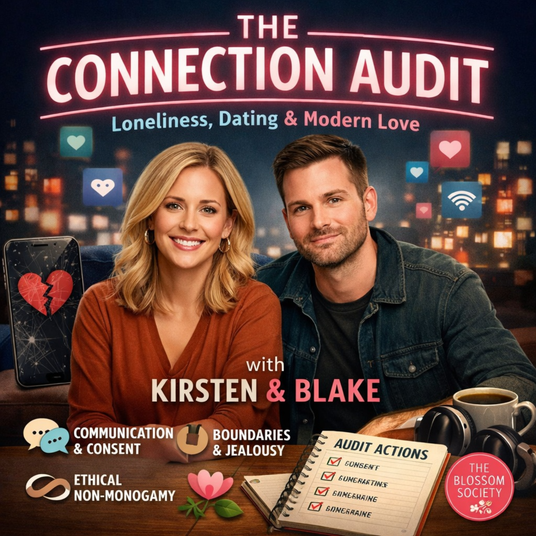
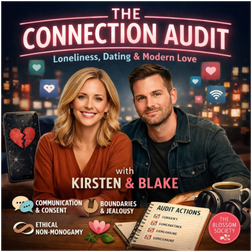
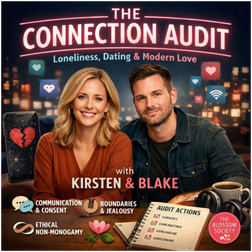
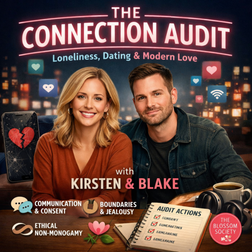
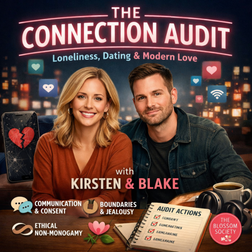
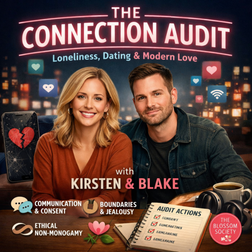
The Connection Audit explores the modern loneliness epidemic and dating burnout — and the quiet ways The Blossom Society is reshaping intimacy, commitment, and desire. Hosts Kirsten and Blake examine how technology and its incentives can erode genuine connection, reward performative behaviour, and leave people stuck in outdated relationship scripts. Each episode audits a real theme in modern relating — communication, consent, boundaries, jealousy, attachment, and repair — including the realities of ethical non-monogamy (ENM) without sensationalism or judgement. You’ll leave with practical takeaways: clear frameworks, boundary scripts you can borrow, and “audit actions” you can apply immediately. The show highlights The Blossom Society (TBS), a women-first, standards-led platform designed around education, trust, and accountability — because better relationships don’t happen by accident.
Negotiated Intimacy: Autonomy and Design in Modern Relationships
Modern relationships are shifting from institutional roles to negotiated intimacy driven by women's autonomy. This transition makes ethically non-monogamous structures more viable. Success requires men to develop emotional competence over traditional "provider" signals
Couples Re-Meet Strategy - Before Opening Up The Relationship
Podcast Notes — Protective Friction (The Blossom Society’s “earned access” design) Modern dating platforms optimise for low friction: fast sign-ups, instant messaging, high volume. The audit finding is blunt — when access is effortless, women (especially single women) absorb the cost in safety, overwhelm, and emotional labour. When they leave, the whole ecosystem fails. This episode explores Protective Friction: intentional design that slows people down on purpose — not to be awkward, but to protect the most exposed users and reward mature behaviour. Key ideas covered Why single women carry disproportionate risk in open-message environments (pressure, flooding, being treated like a commodity). Why “more access” doesn’t equal better connection — it often produces noise, entitlement, and burnout. How The Blossom Society uses friction as teaching: the barrier is the lesson. The mechanisms (what makes the friction “protective”) The Gate (men’s accreditation before messaging): Messaging is blocked until a 7-module accreditation is completed — a competency framework built around consent, boundaries, scenario judgement, and respectful communication. No “pay, join, message” pipeline. Couples’ higher standard when contacting single women: Couples can message couples and single men freely, but messaging single women requires both partners to be verified and accredited — with ongoing compliance, not a one-time tick. Maintain / “Current” status (recertification every 180 days): Trust is treated as a living behaviour. If recertification lapses, access to message single women is paused immediately. Standards are something you keep, not something you claim. Petals economy (earned access, not purchasable): Petals are required to message single women — and crucially, you can’t buy them. They’re earned through reflection and focus modules, pushing members to slow down and ask: “Is this connection worth the work?” A quality loop is built in: rebates return Petals when messages are responded to or marked as respectful, rewarding intention over spam. Sender Tag Integrity (who’s actually typing): Prevents a common deception: thinking you’re speaking to a woman, then discovering it was the male partner. Sender tags (M/F) are tied to authenticated identity. Misrepresentation is treated as a major breach and triggers remediation. Critical Fail screening (no progress with coercive patterns): Pressuring language, boundary-testing, or commodifying women triggers a hard stop in training. Progress requires remediation and a re-test — protecting the space before harm is normalised. The takeaway Protective friction reframes access as a privilege earned through skill, consistency, and accountability. The platform is designed like a garden — curated for health — not a nightclub queue optimised for throughput. Core closing line: Skills, standards, and the courage to be honest.
Inoculating Men Against Toxic Dating Behavior
A CEO faces the classic moderation trap: lock down too hard and you get a safe ghost town; loosen up and you get a toxic wasteland. Using an internal strategy thread from The Blossom Society (TBS), the episode explores a third way: engineer culture proactively. Drawing on YouGov’s 2025 study on young men, the team rejects “young men = misogyny” and instead builds a cluster-based risk model (low/medium/high) driven by scenario performance, not self-report. Medium-risk users get guardrails and coaching; high-risk users are restricted pending remediation and human review. The “inoculation” module teaches men to spot algorithm distortion, selection bias, and build rejection resilience (“attraction is not a debt”). Post-accreditation “protective friction” adds rate limits, first-message scaffolds, cool-downs after rejection, and language nudges. Success metrics: reports per 1,000 conversations by tier, repeat-offender rate, time-to-restriction, women-first trust signal in 14 days, and gate completion
The Safety Algorithm: How Platforms Score “Risk”
Platforms are stuck between a “safe ghost town” and a “toxic wasteland.” This Deep Dive unpacks a raw internal strategy thread from the Blossom Society, a dating/social platform trying to reduce harassment without broad shaming. Using insights from the 2025 YouGov study on young men and misogyny, they propose cluster-based risk tiers, scenario-based onboarding, and a psychological “inoculation” course that teaches algorithm literacy and rejection resilience (“attraction is not a debt”). We explore protective friction—rate limits, guided first messages, cool-down timeouts, and language nudges—and ask: can better interface design civilize online behavior?
The Psychology Behind Safer Dating Apps (Reactance, Rage, and Resilience)
Can a dating app be safe without turning into a joyless ghost town—and can it stay fun without becoming a toxic wasteland? In this episode of Deep Dive, we unpack a raw internal strategy thread from the team behind “The Blossom Society,” reacting to fresh research on young men, masculinity, and online behavior. You’ll hear how they translate psychology into product design: cluster-based risk tiers, scenario-based on-boarding, and “protective friction” like cool-downs, message scaffolds, and language nudges—plus a bold idea they call psychological inoculation: teaching users to spot rage-bait, resist algorithm distortion, and build rejection resilience. If you care about trust & safety, community health, dating culture, or the future of online interaction, this one will stick with you—especially the line: “Attraction is not a debt.” In this episode: Why “broad shaming” backfires (reactance + behavioral leakage) Risk stratification that tests behavior, not opinions Coaching modules that build “antibodies” to toxic narratives Friction as a feature: slowing users down to prevent harm
Replacing dating bios with competency tests
Dating profiles are all talk—so what if trust came from proof? In this Deep Dive, we unpack internal memos from The Blossom Society proposing to replace dating bios with competency tests. Men earn a Verified Conduct mark by completing scenario-led assessments across consent & safety, tone, emotional regulation, etiquette, and the underrated skill of “aftercare & repair”—how you own mistakes and rebuild trust. The system includes zero-tolerance critical fails (ignore a “no” and you fail) plus 180-day re-certification to keep standards alive. We explore why the team embraces “protective friction” (hard on purpose), and why their guiding principle shifts from “women first” to “women are sovereign.” In a world of AI-written bios and endless noise, could verified behavior become the new currency of modern dating? Replacing dating bios with competency tests Verified Conduct badge / verified behavior in dating Dating app accreditation system Scenario-based dating safety assessment Consent and boundaries “critical fail” test Emotional regulation and rejection resilience for men Aftercare and repair as relationship skills Protective friction in dating app design Women are sovereign (autonomy and consent framework) Proof before payment / trust-building on-boarding funnel
Education Precedes Engagement: The Testing Conversation Done Right
In this episode, we unpack the behind-the-scenes debate inside The Blossom Society (TBS) — a coaching-led community for ethical non-monogamy — as the team wrestles with a deceptively simple question: how do you talk about sexual health and testing in a way that keeps people safer without drifting into medical advice, legal exposure, or privacy catastrophe? You’ll hear how the Head of Coaching draws a hard line: we don’t prescribe testing intervals or interpret results — we coach the courage and language to have the conversation. The Marketing Director re-frames the message so it doesn’t feel like a clinic waiting room, tying it to a core principle: women are sovereign — boundaries aren’t “killing the mood”, they’re leadership. And the COO brings the cold realities: duty creep, GDPR “special category” health data, defamation risks, and why “verified” safety badges can create a dangerous illusion of certainty. The conclusion is blunt and surprisingly liberating: there is no app for courage. Real safety isn’t a green tick — it’s the skill to look someone in the eye, state your boundary, ask the awkward question, and walk away when values don’t match.
If You Reward Volume, You Get Noise!!
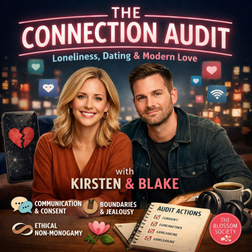
Kirsten and Blake look in to how The Blossom Society are thinking about group chats and group chat fatigue. This episode audits group chat fatigue as a design problem, not a personal failure. Using an internal strategy stack from The Blossom Society (TBS) — including a consulting psychologist’s report — we unpack “social attentional demand”, context reconstruction, and why newcomers get crushed by belonging pressure and the “status treadmill”. Then we turn it practical: a coping playbook built around Pace, Purpose, Position, and Sense-making (including the 30-message catch-up limit). Finally, we zoom out to platform solutions: front-gate announcements, default-muted timeboxed chats, slow chats, weekly digests, and rewarding conduct over volume — all framed as “consent with attention”. (Education only, not therapy.)
Privacy Panic: What To Do When You Spot Your Boss
When your “private life” collides with your public one, your nervous system treats it like a threat. In this episode, Kirsten and Blake unpack context collapse: the gut-drop moment you spot your boss, neighbour, or school parent on an ENM app or in a club. We explore why recognition triggers fight/flight/freeze, how reputational harm and power dynamics hit women harder (“women are sovereign”), and why “soft blackmail” is often about leverage, not threats. Then we audit the practical protections: the 90-second protocol (Pause → Regulate → Choose), a 10-minute partner check-in script, and a green/amber/red triage so moderators support behaviour without sliding into therapy. On the product side: protective friction, consent-before-disclosure, no outing/no hinting, fast block + cool-down mode, and calm micro-copy that helps you “protect your future self”. Audit Actions: 1) Write your next-safest-step plan. 2) Remove identifiers from photos. 3) Practise Pause-Regulate-Choose.
1 di 3