Welcome to Supply-Chain360, your all-in-one source for actual insights into the world of SCM!

Welcome to Supply-Chain360, your all-in-one source for actual insights into the world of SCM!
di Ralph Leyendecker
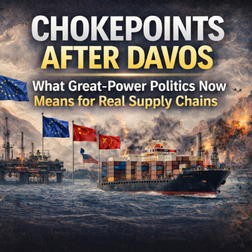
Chokepoints After Davos: What Great-Power Politics Now Means for Real Supply Chains

In this episode, I follow up on Davos 2026 by shifting from speeches and symbolism to the physical realities of global supply chains. The focus is on chokepoints: the Red Sea, Suez, Hormuz, and Taiwan, and on what happens when great-power politics starts to narrow the corridors, systems, and dependencies that modern industries rely on. I look at how recent developments have moved from rhetoric into operating conditions: fragile reopenings, renewed disruptions, and rising uncertainty around routes, energy, shipping, and trade policy. From a pharma and healthcare perspective, the key point is that even when medicines are not shipped directly through a disrupted chokepoint, the upstream systems they depend on still are, whether through energy-intensive inputs, chemical feedstocks, freight capacity, or supplier stability. This episode is about how leaders should think about chokepoints not as distant geopolitical stories, but as very real constraints on cost, replenishment reliability, and network resilience. If you work in supply chain, risk, or executive decision-making, this is an invitation to identify where your system narrows, and what levers you still control before the next disruption hits.
After Davos: Great-Power Theater, Middle-Power Strategy, and Pharma Supply Chains
In this episode, I look at Davos 2026 not as a media show, but as a live stress test of the global order. From Merz’ “age of great powers” narrative to Trump’s tariff threats, Greenland remarks, and pressure over U.S. bonds, Davos made one thing clear: the world is being run more openly as a great-power game again, and middle powers, especially in Europe, are caught in the squeeze. I translate this into the language of pharma and healthcare supply chains. We explore how tariffs, sanctions, export controls, dollar dependence, and critical infrastructure decisions (plants, APIs, IT, banks) create structural exposure for your network. Using examples from pharma, automotive, and banking, I show how the same pattern repeats across industries: highly regulated, high-stakes systems built on a few geopolitical chokepoints. Finally, I outline what a “middle-power supply chain strategy” could look like in practice: rethinking your exposure map, identifying a few structural dependencies you can actually change, and giving geopolitical risk a real home in your governance. If you’re responsible for supply chain, risk, or corporate strategy in a BANI world, this episode is an invitation to move beyond headline reactions and start managing a deliberate great-power risk portfolio. Connect with me on LinkedIn: Ralph Leyendecker | LinkedIn
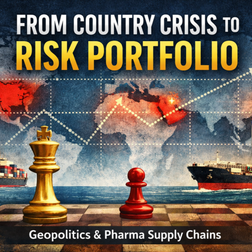
From Country Crisis to Risk Portfolio – How Pharma Supply Chains should think about Geopolitics
In this episode, I move beyond “one crisis at a time” and look at geopolitics through the lens of a risk portfolio for pharma and med-tech supply chains. Starting from recent events like Venezuela, the Red Sea, Taiwan, and Europe’s energy debate, I sketch a simple way to map exposure versus geopolitical fragility – not as a theoretical exercise, but as a practical tool for network and governance decisions. I talk about what leaders can actually control: where buffers sit, how contracts handle sanctions and export controls, how decision rights are set, and which trade lanes are treated as “single points of failure.” Using a concrete Latin America scenario, I walk through how a portfolio mindset changes the way you react to shocks, design options, and explain trade-offs to boards and regulators. If you’re responsible for supply chain, risk, or governance in a BANI world, this episode is an invitation to make your geopolitical exposure visible, link it to real levers you can set, and move from reactive crisis management to deliberate portfolio thinking.
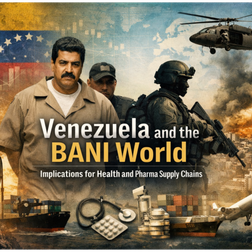
Venezuela and the BANI World – Implications for Health and Pharma Supply Chains
In this episode, I unpack the recent U.S. military operation that led to Nicolás Maduro’s capture and ongoing narco-terrorism proceedings in New York, and look at what this actually means for health and pharma supply chains in and around Venezuela. Rather than debating the politics, I focus on access to medicines, sanctions and logistics friction, and two working scenarios: a managed transition with selective relief versus a prolonged standoff where Venezuela remains a high-friction, low-priority market. I also explore how spillover effects, migration, shifting demand, and NGO procurement, could impact neighboring health systems. Finally, I translate this into practical actions for pharma and med-tech leaders: mapping exposure, separating humanitarian and commercial channels, tightening sanctions and compliance processes, building regional flexibility, and watching operational indicators instead of just political headlines, all framed through a BANI lens.
Holiday Message – Merry Christmas and see you in 2026!
This short holiday episode is a quick thank-you from me to you before I step away for a year-end break. I share a few reflections on this past year in pharma supply chains and what’s coming next for the podcast, then hit pause until the new year. Wishing you a Merry Christmas, and a healthy start into the new year. See you soon in the next season of Supply Chain 360.
From Signals to Action – SOPs and Response Playbooks in Pharma Disruption
In this episode of Supply Chain 360, we complete the arc from scenarios to signals to action. After building an early-warning radar for your pharma supply chain, the next question is: what happens when a signal actually flashes red? We explore how to turn early warnings into fast, coordinated responses using lean, scenario-specific SOPs – response playbooks. Instead of long policy documents, these mini-SOPs define, on a single page: which triggers matter, what options you have, who owns each action, and who is empowered to decide, and how quickly. We walk through concrete examples for suppliers and cold-chain lanes, show how to rehearse these playbooks in short cross-functional simulations, and discuss why clear decision rights often matter more than perfect data. Finally, we touch on how AI can support this: automatically pulling together relevant data when a trigger is hit and suggesting potential actions based on your existing playbooks—while humans stay firmly in charge. The goal: move your organization from “we saw it, but didn’t act” to a state where signals reliably drive smart, timely decisions.
From Scenarios to Signals – Building an Early-Warning System for Pharma Supply Chains
In this episode of Supply Chain 360, we move one step further along the BANI journey: from imagining possible futures to actually seeing them coming. Building on the previous episode on scenario planning, we explore how pharma organizations can turn scenarios into a practical early-warning system – a simple risk radar that helps you act before disruption fully hits. We look at how to define meaningful signals for your key scenarios: creeping lead times, recurring minor quality issues, lane performance degrading, temperature excursions, regulatory noise, or carrier behavior that hints at capacity stress. Then we translate those into clear triggers and options that can plug straight into S&OP / IBP and regular risk reviews. On top of that, we discuss how AI – including more agentic AI – can support this radar by continuously scanning internal data and external news, highlighting weak signals, and even suggesting potential actions based on your playbooks, while keeping humans firmly in the loop. The goal is not a perfect cockpit, but a habit: regularly asking “What would we see first?” so your supply chain stops being surprised and starts anticipating. Listen in to learn how to turn scenarios into signals.
From Gut Feeling to Scenarios – Preparing your Pharma Supply Chain for the Unexpected
In this episode of Supply Chain 360, we move from forecasting to future-proofing. Instead of asking “What’s the plan?”, we ask a more powerful question: “What if?” We explore how simple, practical scenario planning can help pharma supply chains prepare for the unexpected. From export restrictions and supplier failures to regulatory changes or a sudden surge in demand when a new use for a drug is approved earlier than planned. You’ll hear how to: Work with one time horizon and just a few focused scenarios Identify where service, inventory, or capacity would break first Define “no-regret moves” that help in almost any future Build options and triggers so you’re ready to act when signals appear Run short, cross-functional scenario sessions that plug into S&OP/IBP The goal isn’t to predict the future perfectly, but to be less surprised by it. Scenario planning becomes your flight simulator for disruption, and a key capability in a BANI world. Tune in to learn how to move your organization from gut feeling to structured readiness.
Leading in the BANI Decade — How Supply Chains Evolve When Leaders Do
In this final episode of the BANI mini-series on Supply Chain 360, we shift the focus from systems to the people who run them: leaders. We revisit what it means to operate in a world that is brittle, anxious, nonlinear, and incomprehensible, and explore why supply chains only become truly viable when leadership mindsets evolve. This episode looks at how the best leaders move from control to composure, from rigid plans to adaptive thinking, and from managing risk to learning from it. We discuss the leadership behaviors that enable Complexity, Orchestration, Risk, and Enablement to work in practice: creating psychological safety, making decisions with incomplete information, building cultures of curiosity instead of fear, and treating disruption as a constant condition rather than an exception. The core message: supply chains don’t just evolve because technology improves. They evolve because leaders do. Tune in for a reflective, practical close to the series, and a roadmap for leading in the BANI decade.
White Swans in Plain Sight — Europe’s Industrial Migration and What It Means for Pharma
In this episode of Supply Chain 360, part of the BANI mini-series, we explore a major shift that isn’t a sudden shock or black-swan event, but a white swan: a visible, predictable transformation that’s already reshaping Europe’s industrial landscape. Recent data shows that around 70% of energy-intensive companies are moving investments out of Germany, driven by rising energy costs, CO₂ pricing, political uncertainty, and slowing demand. This includes global players like ArcelorMittal, redirecting low-carbon steel projects to France, and German-based Schott AG, increasingly shifting its specialty glass and packaging investments abroad under a “local-for-local” strategy. But what does this mean for pharma supply chains? A lot. When upstream industries relocate, the downstream effects ripple through sourcing, intermediates, packaging availability, regulatory logistics routes, and cold-chain design. These aren’t hypothetical risks, they’re emerging realities that viable supply chains must anticipate and proactively design around. This episode breaks down why Europe’s industrial migration is a white swan in plain sight and how pharma leaders can use this predictable change as a strategic signal rather than a surprise.
1 di 3