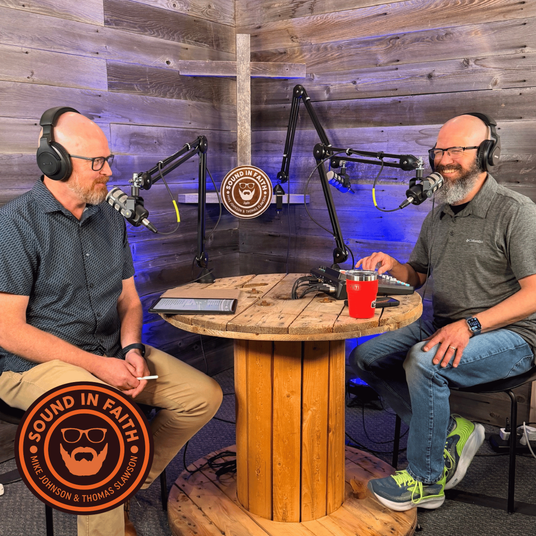
Sound in Faith

Sound in Faith

di Sound in Faith
Stagione 2

Suffering, Part 4 - Suffering for Our Sinful Choices

In the final episode of our four-part series on suffering, we explore the often-overlooked reality that Christians can still face painful earthly consequences for their sinful choices. While our sins are forgiven in Christ, there can still be long-lasting results to our sin. Yet even in these consequences, God’s mercy and discipline are at work, shaping us into the image of Christ (Heb. 12:6, 11). Rather than wallowing in regret, we’re called to repent, learn, and lean into the grace of Jesus—like Peter after his denial. Even in the mess, Christ draws near to the brokenhearted (Ps. 34:18), offering hope and restoration. And though we may suffer now, we rejoice knowing that the eternal consequences of sin have been removed—there is no condemnation for those in Christ (Rom. 8:1).

Suffering, Part 3 - Suffering For The Name of Christ

In this episode, we focus on the unique experience of suffering for the name of Christ—a kind of suffering distinct from living in a fallen world, being sinned against, or facing the consequences of our own sin. Around the world, believers endure severe persecution: imprisonment, beatings, even death, while others are ostracized, impoverished, or mocked. Even in places like the U.S., subtle forms of opposition still exist. Scripture reminds us that such suffering is not only expected (1 Pet. 4:12; 2 Tim. 3:12) but is also a mark of our identity with Christ, a gift from God, and even a blessing (Matt. 5:10-12). It sanctifies us, deepens our hope, and strengthens our confidence in God’s sustaining grace. When persecuted, we’re called to respond with prayer, trust, and honor for Christ (1 Pet. 3:15). As fellow believers, we should pray for the persecuted, support them when possible, and long for the day when all suffering ends. For those suffering now, hold fast to Christ—cling to His promises, seek Him in His Word, and lean into the support of His people.

Suffering, Part 2 - Suffering When Sinned Against

In this episode, we continue our series on suffering by looking at what it means to be sinned against and how to respond as a Christian. Because of human sinfulness, people commit grievous acts that cause deep pain, from physical and emotional abuse to betrayal and injustice. Scripture provides many examples of such suffering—Joseph’s betrayal, Israel’s enslavement, David’s sin against Bathsheba and Uriah, and ultimately, Christ’s suffering on the cross. In all of this, though, we're reminded that God sees and will bring justice in His time (Romans 12:19, Psalm 37:7-9). While we are called to trust that He works all things for good (Genesis 50:20, Romans 8:28), we also have a responsibility to seek justice when possible (Micah 6:8, Proverbs 31:8-9) and find strength in the body of Christ. Though pain is real, we endure with hope, knowing that God is at work and that one day, all suffering will end (Revelation 21:4).

Suffering, Part 1 - Suffering in a Fallen World

Suffering is a reality for every believer, and Scripture speaks extensively about it. In this episode, we explore suffering that arises simply from living in a fallen world—things like natural disasters, chronic illness, and unexpected hardships that are not tied to personal sin or poor choices. The Bible teaches that suffering exists because of the fall, as creation itself groans under the weight of sin (Rom. 8:22). Some mistakenly believe that strong faith should protect Christians from suffering, but Job’s story, the man born blind in John 9, and other examples from Scripture remind us that faithful followers of Christ are not exempt from pain. However, Scripture offers profound comfort: our suffering is not meaningless (2 Cor. 4:16-18), nothing can separate us from Christ’s love (Rom. 8:38-39), and a day is coming when all suffering will end (Rev. 21:1-4). In the meantime, believers are called to bring their pain to God (Ps. 88, 1 Pet. 5:6-7) and lean on the church for support (Rom. 12:15). As the body of Christ, we must avoid making assumptions about suffering and instead offer compassion, prayer, and tangible care, bearing one another’s burdens until the day when God makes all things new.

Our Five Loves - Love The Gospel & Commit to Share The Gospel

In this episode, we recap our Five Loves and focus on the Gospel as the foundation of our lives. We explore how the Gospel not only saves us but also sustains us daily—helping us in temptation, discouragement, relationships, and forgiveness. We discuss the Great Commission (Matthew 28:18-20), Jesus' authority, and our call to make disciples. How do we start? By sharing the Gospel locally, supporting the church, and engaging in missions, with confidence that Christ is with us and His mission will succeed (Acts 1:8, Rev. 7:9-10).

Our Five Loves - Love Our Neighbors & Commit to Serve And Give

On this episode we talk about what it means to truly love our neighbors. Just like we need God's grace to change our hearts to enable us to love him, we need is grace to enable us to love our neighbors as we should. We spend time looking a the parable of the "Good Samaritan" in Luke 10:25-37 and examine what Jesus is saying through this parable. We then talk about some practical ways we can show love to our neighbors motivated by the gospel.

Our Five Loves - Love One Another & Commit to Christian Community

Introduction: Questions Briefly recap our Five Loves and our Gospel Culture. What two loves have we covered so far? Let’s look at John 13:34-35. What is Jesus emphasizing here? Isn’t my relationship with Jesus personal? Why is it so important that I love others? Pastor and author Michael Lawrence states, “Churches have a chance to show the world what Heaven will be like.” What does he mean by this? How can the knowledge that God has saved us through the sacrifice of Jesus Christ motivate us to be in loving fellowship with other believers? Where is this idea of being in loving community with other believers rooted? What about “church hurt”? What do I say to people who might say “I love Jesus–It’s his followers I can’t stand.”? How does being gospel-centered help us maintain unity and love? What does the Bible (The New Testament in particular) have to say about how we relate to one another? How are we striving to do this at Faith? Listener Questions: What are the New Thought and Word of Faith movements that we should be alert to in today's religious culture? How do we recognize it when we hear it? What truths do we use to speak against such ideas? – Raquel Jahnke

Our Five Loves - Love God's Word And Prayer & Commit to Personal Worship

Questions Briefly recap our Five Loves and our Gospel Culture. Why are God’s Word & Prayer connected in our second love? What do we believe about the Bible at Faith? (Inspiration, Inerrancy, Authority, Sufficiency) Many people think the Bible is outdated and irrelevant. How can we respond to that thinking? What are some ways we can really grow in our love for God’s word? (Reading, Studying, Hearing & Praying the Bible). How does how we pray and a love for prayer flow from love for God’s word? What are some struggles Christians have with prayer? How can I grow in my prayer life? Why is having a commitment to personal worship important for me as a believer? Listener Questions: What does Paul mean in 1 Corinthians 5:5 when he talks about delivering someone over to Satan? Is that something that’s relevant for today? (anonymous)

Our Five Loves - Love God & Commit to Gathered Worship

Episode Questions Why are we doing this series on our Five Loves? What do we mean by “Gospel Culture?” How do our Five Loves fit into that? Why do we begin with “Love God,” and what does the Bible have to say about loving God? What’s the problem we have in our natural, sinful state when we’re faced with the command to “Love God?” Why can’t we love him as we ought? What is God’s solution to this problem? So, if God brings me into a loving relationship with him by his grace and gives me a new heart, why do I still struggle to love him as I should? How then, can I grow in my love for God? How important is it that I gather with God’s people for worship on the Lord’s Day? Listener Questions: My Bible study leader has said in the past that Christians should never say they are proud of [their] country, kids, wife, etc. because every time pride or proud is used in the Bible it is negative. At first, I pushed back a little on this, but then I thought it over & looked up some verses and being proud of someone or something is almost always because you want the focus on yourself, but as Christians, all the glory is God's. Maybe [it’s better to] say,” I am happy with how God has blessed them or this country?” [What are your] thoughts? – Dale Jelen

Christian Nationalism

Questions: What is Christian Nationalism (CN)? What is it NOT? What is its present appeal? Are there cultural or political trends that contribute to its rising popularity? If I am a Christian who loves his country, does that make me a CN? Shouldn't we desire for our nation to be a "Christian nation"? Is cultural Christianity a bad thing? What other cautions or dangers that you would suggest regarding the CN movement? Should the American church (and American Christians) be patriotic and in what settings and expressions would patriotism be appropriate or inappropriate? How do we live as dual citizens (Citizens of Heaven and Citizens of Earth)? Listener Questions: · Is Rev 3:5 insinuating there being a possibility of God blotting out someone's name in the Book of Life? – Max
3 di 8