School of Radical Imagination Podcast

School of Radical Imagination Podcast

di School of Radical Imagination
Stagione 1
Worldbuilding: Reclaiming Our Political Agency | Karina Anastasia Mathew
What if creativity is one of our most powerful tools for confronting climate collapse? In this conversation, writer, activist, educator, and Harvard PhD candidate Karina Anastasia Mathew explores what art and literature can offer us in a moment increasingly defined by climate crisis, political uncertainty, and dystopian visions of the future. Karina shares her own journey from writing utopian science fiction as a teenager to studying literature, climate, and speculative fiction—and ultimately realizing that scholarship, activism, and creative practice were never separate pursuits. Together, we explore what it means to cultivate “fierce hope,” why dystopia isn't the only way to write about crisis, how our relationship to the past shapes what futures we can imagine, and why creativity can help us reclaim a sense of political agency. In This Episode 01:57 Why Karina created Creative Responses to Climate Collapse 03:04 Bringing scholarship, creativity, and activism together 04:01 Moving beyond the traditional climate literature course 06:28 Writing utopian worlds as a teenager 08:12 Climate crisis, spiritual crisis, and asking what it means to be human 10:04 The eight-week course journey 12:46 Can we write about crisis without dystopia? 13:46 Cultivating “fierce hope” 14:13 Afrofuturism, solarpunk, and imagining otherwise 15:19 The creative challenge of representing climate collapse 18:03 “Informed meaning making”: bringing scholarship and creativity together 21:25 Art, agency, and imagining life-affirming futures 31:16 Bringing our whole selves into learning Key Takeaways Creativity can unlock political agency. Karina designed her course not simply to teach climate literature, but to help learners access their own creative power in response to this moment. We don't have to surrender the future to dystopia. Climate collapse is real, but imagining the future exclusively through catastrophe can reinforce helplessness. Other traditions—from Afrofuturism to solarpunk—give us different possibilities to think with. Hope doesn't have to mean optimism. Karina calls it “fierce hope”: making room for the reality of crisis while maintaining faith in our ability to participate in what comes next. Education can help us practice another way of being. Karina imagines a movement of educational rebellion: spaces where learning isn't simply about producing or consuming information, but using knowledge with purpose to create more life-affirming worlds. Go Deeper Karina is teaching Creative Responses to Climate Collapse: Worldmaking with Art & Literature, an eight-week live course at the School of Radical Imagination beginning October 7. Learners will explore scholarship, literature, and art while developing a creative project of their own—using imagination not as an escape from crisis, but as a way of responding to it. Explore the course + download the syllabus → [COURSE LINK] If this conversation shifted your perspective, taught you something new, or helped you imagine what else is possible, subscribe, leave a review, and share this episode with one person who would appreciate it. Until next time, keep learning, keep imagining, and keep building the world you want to live in.
When Accountability Becomes a Performance | Sonja Wiencke
What if nonprofit reporting is less about accountability—and more about the performance? In this conversation, monitoring and evaluation specialist Sonja Wiencke takes us inside the world of nonprofit accountability—where organizations spend enormous amounts of time producing reports, indicators, frameworks, and compliance documents to prove their impact, while the people closest to the work can become little more than research subjects. Drawing on nearly a decade working across international NGOs, funders, and grassroots organizations, Sonja asks us to move beyond simply recognizing the power dynamics embedded in the sector: If we know they're there, what are we going to do about them? We explore what theater and storytelling can teach us about power, why so much accountability becomes performative, what happens when communities become “extras without speaking roles,” and how we might redesign the everyday tools of the sector to actually support learning, power-sharing, and change. In This Episode 02:57 Sonja's journey from aspiring diplomat to international development 07:45 What monitoring and evaluation actually is 08:24 The expectation to “solve poverty with a six-month grant” 11:26 What Palestine and Dominica reveal about aid and grassroots work 13:01 Why don't we just ask communities what's working? 14:16 Why the aid sector keeps producing documents instead of changing relationships 17:16 What theater can teach us about accountability 19:56 Who gets to be the hero in the story of international aid? 21:16 Redesigning reports, budgets, and compliance mechanisms 26:55 Trust, emergence, and organizational design 30:59 What learners will leave the six-week course with Key Takeaways Power dynamics are the starting point, not the conclusion. Understanding why inequities exist should open the door to experimenting with what we can do differently. Trust isn't created through paperwork. More templates, contracts, and compliance procedures cannot substitute for the relational work required to build trust. Change can happen in the cracks. We may not have the power to transform an entire system, but we can identify where we have influence and begin experimenting there. Go Deeper Sonja is teaching Rewriting the Script for Accountability in Nonprofits and Philanthropy, a six-week live course at the School of Radical Imagination beginning October 13. Learners will use dramaturgy, power mapping, storytelling, and collaborative experimentation to examine the hidden scripts shaping accountability—and redesign a real reporting or compliance tool from their own work. Explore the course + download the syllabus → [COURSE LINK] If this conversation shifted your perspective, taught you something new, or helped you imagine what else is possible, subscribe, leave a review, and share this episode with one person who would appreciate it. Until next time, keep learning, keep imagining, and keep building the world you want to live in.
Practicing Freedom as Strategy | Shawna Wakefield
What if freedom isn't something we have to achieve—but something we can practice? In this conversation, social justice and embodiment facilitator Shawna Wakefield invites us to rethink what freedom feels like—not just intellectually or politically, but in our bodies, relationships, communities, and everyday choices. Drawing on nearly 30 years of work across movement building, international development, philanthropy, community organizing, and education, Shawna shares what she has learned about the relationship between inner transformation and systems change. We explore why humility and courage need each other, how our smallest ways of relating can reproduce—or disrupt—the systems we're trying to change, and what becomes possible when we orient ourselves toward what we're for, rather than only what we're fighting against. We also go inside Shawna's Fall course, The Undergrowth Sanctuary: Practicing Freedom as Strategy, an eight-week embodied journey through freedom, belonging, power, grief, imagination, strategy, celebration, and collective liberation. Resources & Links 📚 Learn more about The Undergrowth Sanctuary: Practicing Freedom as Strategy https://www.radicalimagination.school/courses/the-undergrowth-sanctuary-practicing-freedom-as-strategy In This Episode 03:43 What 30 years of social justice work has taught Shawna 06:20 Practicing humility alongside courage 08:55 What safety, dignity, belonging, and freedom feel like 09:28 Inside The Undergrowth Sanctuary: Practicing Freedom as Strategy 11:38 Creating a strategic compass for collective liberation 14:31 Teaching at Columbia, Palestine, and choosing to leave an institution 17:16 Anxiety, belonging, and our conditioned responses 21:21 The eight-week journey: freedom, belonging, power, grief, and imagination 24:32 Imagining a North Star and a thriving horizon 32:15 Shawna's radical imagination for the School Key Takeaways Freedom can be a practice, not only a destination. We can resist oppressive systems while also asking where we can remember and embody the freedom that is already ours. Humility and courage belong together. Recognizing that we're all shaped by the systems we're trying to transform doesn't require us to become passive. It can allow us to act with greater courage and less righteousness. Our bodies hold knowledge our intellects can't always access. Embodied practices can surface insights, desires, grief, and boundaries that might take much longer to reach through intellectual analysis alone. Grief belongs in the work of liberation. If we don't create ways to grieve collectively, we risk suppressing what we're carrying and trying to simply move on. We don't always need to convince. There is another way of working together rooted in connection, co-inspiration, imagination, and creating the conditions for new possibilities to emerge. Connect Enrollment is now open for The Undergrowth Sanctuary: Practicing Freedom as Strategy, beginning October 15 at the School of Radical Imagination. Over eight weeks, Shawna will guide learners through embodied practices, storytelling, reflection, and strategic imagination to develop their own compass for practicing freedom in their lives, work, organizations, and communities.
Building Hope in Dystopian Times | Keaton Wadzinski
What if we stopped asking what's broken—and started asking what's possible? In this conversation, educator, entrepreneur, and game designer Keaton Wadzinski explores dreaming as a serious practice for building a different world. After a decade working with innovation methodologies like design thinking and lean startup, Keaton began questioning their underlying premise: that the world is a collection of problems waiting to be solved. What if, instead of beginning with problems, we began with possibilities? Together, we explore Keaton's shift from problem solving to possibility finding, his Buildable Dreams framework, what collaborative storytelling games can teach us about imagining together, and why making time to dream may be one of the most responsible things we can do in moments of uncertainty. We also go inside his course, Giving Yourself Permission to Dream: Building Hope in Dystopian Times, and dream together about what the School of Radical Imagination—and education itself—could become. Resources & Links 🎓 Learn more about Giving Yourself Permission to Dream: Building Hope in Dystopian Times https://www.radicalimagination.school/courses/giving-yourself-permission-to-dream-building-hope-in-dystopian-times 📚 Explore Fall courses at the School of Radical Imagination https://www.radicalimagination.school/catalog In This Episode 04:25 Questioning the assumptions behind design thinking and creative problem solving 06:10 The Buildable Dreams framework: past, present, and future 08:15 What collaborative storytelling games can teach us about building worlds together 10:36 Hope, strength, and endurance as practices for dreaming 11:18 The transformation Keaton wants learners to experience 14:56 The School of Radical Imagination as an emergent learning community 21:46 What happens if we bring this model to younger learners? 22:24 Moving education beyond academics toward human flourishing Key Takeaways Dreaming isn't indulgent. Especially in moments of uncertainty, intentionally making space to imagine hopeful possibilities can be an act of responsibility and resistance. Dreams don't belong exclusively to the future. Keaton's Buildable Dreams framework asks us to see the past, present, and future together—grounding our dreams in lived experience while identifying what we can begin building now. Imagination can be collaborative. Tabletop role-playing and collaborative storytelling offer a model where no single person owns the story. New worlds emerge through participation, agency, and collective creativity. Connect Follow the School of Radical Imagination for conversations with scholars, artists, educators, and practitioners exploring what it takes to question the systems we've inherited and imagine what else is possible. Enrollment is now open for Giving Yourself Permission to Dream: Building Hope in Dystopian Times, beginning October 21. If this conversation shifted your perspective, subscribe to the podcast, leave us a review, and share this episode with one person who could use a little more permission to dream. Until next time, keep learning, keep imagining, and keep building the world you want to live in.
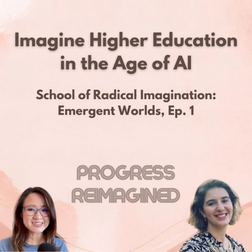
Imagine Higher Education in the Age of AI | Besan Abu-Joudeh on Progress Reimagined
This conversation originally aired on Progress Reimagined, hosted by Kathleen Chu. We're resharing it here with permission. What if more information isn't what we need to transform our lives? We live in a time when almost any answer is available within seconds. We can read the book, watch the YouTube video, listen to the podcast, or ask AI—and still find ourselves stuck. So what actually helps us transform? This week's episode is a little different. Besan Abu-Joudeh, founder of the School of Radical Imagination, joins Kathleen Chu on Progress Reimagined to share the story behind the School—and the personal unraveling that led her to imagine a different kind of education. They explore why learning alongside other people can unlock something information alone cannot, why imagination is far from "fluffy," what most of us get wrong about making an impact, and why the traditional idea that we go to school for four years and then spend the rest of our lives working may soon feel outdated. At its heart, this is a conversation about what education could become when the goal isn't simply acquiring more knowledge—but becoming someone different because of what we've learned. In This Episode 03:02 — The experience that planted the seed for the School of Radical Imagination 04:18 — A six-month pause and reorienting toward love and life 09:35 — Why the School chose live, cohort-based learning 12:07 — Why faculty have autonomy over what they teach 16:31 — What we get wrong about making an impact 21:00 — Building something with a 10-year vision 21:48 — A future beyond the traditional four-year model of higher education 27:47 — Why imagination isn't "fluffy" 29:54 — Why unlimited access to information can still leave us feeling stuck 30:34 — The difference between information and transformation 33:23 — Creating a learning space where science and spirituality can coexist Key Takeaways Learning is relational. Transformation often happens through conversation—with a teacher, a peer, or another person who says something that unlocks a room in our minds we haven't entered before. Imagination isn't fluffy. CEOs, world leaders, academics, and other people with significant power intentionally create spaciousness to step away from the day-to-day, think about where the world is going, and imagine what comes next. Everyone deserves access to spaces that cultivate that capacity. No one has all the answers. The School is intentionally built around co-learning. Faculty bring deep expertise, but they enter the classroom with questions too. The teacher is also a learner, and the learner is also a teacher. About Progress Reimagined This conversation originally appeared on Progress Reimagined, hosted by Kathleen Chu—a podcast exploring innovative ideas, technologies, and emerging economic models that put humanity and our planet first. Connect with Kathleen Chu and Progress Reimagined here. The School of Radical Imagination brings together scholars, artists, practitioners, and lifelong learners to question the systems we've inherited and imagine what else is possible. Explore our upcoming courses at radicalimagination.school.
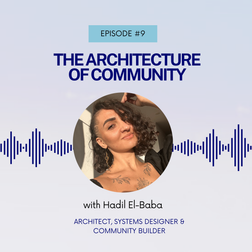
The Architecture of Community | Hadil El-Baba
How do we design the invisible structures that shape our communities? In this conversation, architect, creative leader, and systems thinker Hadil El-Baba explores what architecture can teach us about building communities that foster belonging, connection, and meaningful participation. Hadil shares why she walked away from a successful architecture career in Toronto to follow a deeper question: How do we create the conditions for a different world? Together, we explore the invisible architecture underneath every community—from power and authority to governance, relationships, and belonging—and why changing our larger systems may begin by noticing how these dynamics show up in our own lives. We also go inside Hadil’s course, The Architecture of Community, an eight-week experiment in consciously designing the communities, organizations, and projects we want to inhabit. Resources & Links 🎓 Learn more about The Architecture of Community https://www.radicalimagination.school/courses/the-architecture-of-community 📚 Explore upcoming courses at the School of Radical Imagination https://www.radicalimagination.school/courses In This Episode 04:39 Returning to Lebanon and learning about belonging, land, resistance, and love 05:51 Reaching the top of the ladder—and deciding you no longer want to play the game 08:44 What architecture teaches us about systems change 10:28 Collaboration, relationships, and learning to zoom in and zoom out 11:44 Why we need to rethink what we mean by “community” 14:41 Inside The Architecture of Community 16:24 What becomes possible when we consciously design the invisible? 17:27 Why Hadil chose to teach at the School of Radical Imagination Key Takeaways Communities aren't simply formed by bringing people together. They are shaped by often-invisible structures around power, authority, governance, participation, and belonging. We can ask not only whether we belong somewhere, but how we can belong without losing ourselves or conforming. Architecture offers a useful lens for systems change: zoom out to understand the whole while knowing when to zoom in on the relationships and structures underneath it. The relational dynamics inside an organization eventually show up in what that organization creates in the world. Connect Follow the School of Radical Imagination for conversations with scholars, artists, educators, and practitioners exploring the ideas and practices we need to imagine—and build—a different world. If this conversation shifted your perspective, taught you something new, or helped you imagine what else is possible, subscribe to the podcast, leave a review, and share this episode with one person who would appreciate it. Until next time, keep learning, keep imagining, and keep building the world you want to live in.
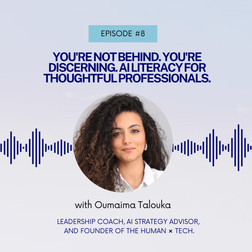
You're Not Behind. You're Discerning. AI Literacy for Thoughtful Professionals. | Oumaima Talouka
What if we still have the power to shape AI? In this conversation, leadership coach, AI strategist, and technologist Oumaima Taloua explores how we can engage with AI without getting swept up in either the hype or the fear. Drawing on more than a decade working in technology and AI, Oumaima shares why understanding these tools matters, how our choices can still shape what gets built, and why the human side of technological change may be more important than the technology itself. We also go inside her course, You're Not Behind, You're Discerning: AI Literacy for Thoughtful Professionals, and explore what happened when a group of curious, critical thinkers came together to learn about AI—not to be told what to think, but to discern for themselves. Resources & Links 🎓 Learn more about You're Not Behind, You're Discerning: AI Literacy for Thoughtful Professionals https://www.radicalimagination.school/courses/you-re-not-behind-you-re-discerning-ai-literacy-for-thoughtful-professionals In This Episode 02:31 A decade in AI—and bringing perspectives beyond Silicon Valley into the conversation 05:31 The geopolitics of AI and how geography shapes access to technological opportunity 08:14 Why Oumaima moved from engineering and product into coaching and education 12:08 Moving beyond "AI is amazing" vs. "AI is dangerous" 17:57 Inside You're Not Behind, You're Discerning 23:11 Why learning at the School is a conversation—not a transfer of information 24:19 Emotional stability, discernment, and navigating rapid technological change Key Takeaways AI literacy isn't about learning every new tool. It's about understanding enough to make informed choices about where—and whether—AI belongs in your life and work. We don't have to choose between uncritical adoption and complete rejection. We can hold both the opportunities and critiques of AI at the same time. AI is still being shaped. The more people understand these technologies and participate in the conversation, the more influence we can have over what gets built. The pace of AI can create overwhelm, but we don't have to keep up with everything. Discernment means deciding what deserves our attention. In a moment of rapid technological change, creating space to feel, talk, think, and discern may be just as important as acquiring information. Connect Follow the School of Radical Imagination for conversations with scholars, artists, technologists, educators, and practitioners exploring the knowledge we need to navigate this moment—and build what comes next. If this conversation shifted your perspective, taught you something new, or helped you imagine what else is possible, subscribe to the podcast, leave a review, and share this episode with one person who would appreciate it. Until next time, keep learning, keep imagining, and keep building the world you want to live in.
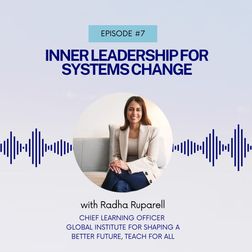
Inner Leadership for Systems Change | Radha Ruparell
Can We Change Systems Without Changing Ourselves? In this conversation, author and global learning leader Radha Ruparell explores the relationship between inner transformation and systems change. We talk about slowing down in times of urgency, staying in relationship across difference, tending to our individual and collective energy, and why hope itself can be a radical act. Drawing from her work with leaders and educators around the world, Radha reminds us that changing systems isn't only about what we do—it's also about who we are while doing it. 🎓 Explore upcoming courses at the School of Radical Imagination https://www.radicalimagination.school/courses In This Episode 02:43 Living across worlds and discovering our shared humanity 04:52 "The times are urgent, so let us slow down" 08:11 Perfection, play, and the "six by one" practice 11:27 How our energy affects the systems around us 15:30 Multiple truths, righteousness, and keeping our hearts open 18:18 Moving from fighting against to standing for something 22:28 Reweaving relationships as a way to rewire the world 25:20 How to sustain inspiration after the "mountaintop moment" 29:44 Creating cultures where people have permission to disrupt Key Takeaways Slowing down doesn't have to compete with urgency. Grounding ourselves can change the quality of the action we take. Systems change isn't only about what we do. How we show up—our energy, presence, relationships, and ways of being—can shift the systems around us. Difference and tension aren't inherently bad. Our capacity to stay in relationship through rupture and repair can open new possibilities. Instead of only fighting against what we oppose, we can ask what we are choosing to stand for. Hope isn't the absence of darkness. It can emerge from our darkest moments and become a courageous practice of looking for what is working and building from there. Connect Follow the School of Radical Imagination for conversations with scholars, artists, educators, and practitioners exploring the ideas and practices we need to build more just and liberated futures. If this conversation resonated, please subscribe, leave a review, and share it with one person who might need a little more hope today.
Decolonial Feminist Approaches to Foreign Policy | kirthi jayakumar
What if feminism wasn't about gender—but about the future? In this conversation, feminist systems change practitioner and futures researcher kirthi jayakumar invites us to reimagine foreign policy through a decolonial feminist lens. Together, we explore hope as a discipline, why feminism is fundamentally future-facing, how education can move beyond information toward transformation, and what becomes possible when we see ourselves as active participants in shaping the world rather than passive observers of it. Resources & Links 🎓 Learn more about Decolonial Feminist Approaches to Foreign Policy https://www.radicalimagination.school/courses In this Episode 01:52 The audacity to hope—and why hope became kirthi's life's work 04:31 What feminism really means through a decolonial lens 07:26 Why foreign policy belongs to all of us 14:30 Reimagining education as transformation instead of information 18:33 Critical thinking, stories, and what traditional education misses 23:20 Why we need spaces to think together, not just consume information 24:47 What learners experience in Decolonial Feminist Approaches to Foreign Policy 27:53 Why Kirti chose to teach at the School of Radical Imagination Key Takeaways Hope isn't passive optimism—it's a practice that helps us imagine and build different futures. Feminism is a future-facing project that asks us to interrogate systems of power and cultivate hope through action. Foreign policy isn't only negotiated by governments; it's shaped every day through the relationships, conversations, and communities we build. Education should transform how we see ourselves and the world—not simply increase the amount of information we retain. Stories help us notice the perspectives that dominant narratives leave out and invite us into deeper accountability. Meaningful learning happens when we reflect together, question inherited assumptions, and practice imagining new possibilities. Connect Follow the School of Radical Imagination for weekly conversations exploring education, liberation, technology, creativity, systems change, healing, and the futures we're being called to build. If you enjoyed this episode, please subscribe, leave a review, and share it with someone who is imagining—and building—a better world.
The Shadow Side of Social Change | Lena Papadopoulos
What if the way we're trying to change the world is also keeping it the same? In this conversation, Lena Papadopoulos explores how systems of oppression become internalized—and how they quietly shape the way we show up in our relationships, communities, and movements for change. Together, we discuss saviorism, martyrdom, purity politics, and why building a more liberatory future begins with radical honesty. If you've ever wondered how to care for others without losing yourself—or how to create change without recreating the systems you're resisting—this conversation is for you. Resources & Links 🎓 Learn more about Weaving Webs of Care https://www.radicalimagination.school/courses/weaving-webs-of-care Sat, Jul 25 · 11:00 AM – 2:00 PM ET Sun, Jul 26 · 11:00 AM – 2:00 PM ET 📚 Explore upcoming courses https://www.radicalimagination.school In This Episode 01:17 Why Lena created Weaving Webs of Care 03:22 Shadow work, self-expression, and collective liberation 05:49 Saviorism, martyrdom, and purity politics 09:40 How we can cause harm with the best of intentions 13:19 Inside the Weekend Intensive: from radical honesty to radical imagination 15:17 Imagining a world rooted in love rather than disconnection 17:12 Why Lena chose to teach at the School of Radical Imagination Key Takeaways Oppressive systems become internalized, shaping how we relate to ourselves and others. Saviorism, martyrdom, and purity politics often emerge from unmet needs for belonging, safety, and validation. Radical honesty is a prerequisite for collective liberation. Community creates the conditions for deeper transformation than we can achieve alone. Building a new world requires both shadow work and the courage to imagine new ways of being together. Connect Follow the School of Radical Imagination for weekly conversations exploring education, liberation, creativity, systems change, healing, and the futures we're being called to build. If this conversation resonated with you, please subscribe, leave a review, and share it with someone who is committed to building relationships and communities rooted in care rather than extraction.
1 di 2