sat with

sat with

di Courtney C

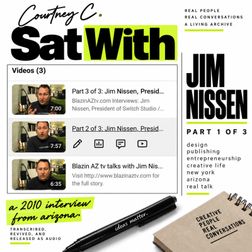
Part Two 2010 - Jim Nissen, Risk Failure Creative Entrepreneurship

-- “i wake up with sand in my hair every morning. i do what i love. it’s hard and it’s not always easy to work, but i wouldn’t do anything else because i work with ideas.” -- “i did the everything bet. i put everything on the line to buy it. and it didn’t work.” -- “hope makes a great breakfast but a lousy dinner.” -- “skateboarding is one of the most creative things you can do because you fail all the time.” this throwback conversation with designer, entrepreneur, and creative director jim nissen was recorded in arizona in 2010. this is part 2 of 3, released as audio from the original video interview. part two moves beyond the mechanics of running a design studio and into the way jim thinks about entrepreneurship, creativity, failure, work, and survival. jim opens by talking about what happens when entrepreneurship stops feeling secure. he considers whether he should find a traditional nine-to-five job, but describes design as something inseparable from who he is: he goes to bed a designer and wakes up a designer. for him, the work is difficult, but the opportunity to work with ideas keeps him in it. he then tells the story of deciding to become a magazine publisher in 2007. after watching publishers make money from magazines he was already doing much of the creative work for, jim bought a publication himself. he put everything on the line just before the financial crisis hit. when the stock market fell and home-equity credit disappeared, the timing became what he describes as nearly the worst possible scenario for a magazine. the investment did not work the way he expected. instead of walking away, jim found himself doing things far outside his usual role as a creative director, including going door to door in old town scottsdale selling advertising during a period when some businesses were struggling to get customers through their own doors. his immediate goal became survival. that experience changed his perspective on failure. jim talks about hope, persistence, and reaching a point where surviving one major setback made future failure feel less frightening. he also questions what money actually means when compared with what someone chooses to do with their life. the conversation then goes further back. jim talks about starting his first company at 14, selling things as a kid, drawing, biking, skating, and eventually recognizing how much skateboarding shaped the way he understood creativity. falling repeatedly taught him that failure was part of getting closer to being able to do something successfully. he also gets into the less visible side of self-employment: making his own schedule, understanding his creative rhythms, staying disciplined without a boss, organizing himself through writing and lists, and deliberately surrounding himself with people who are better than he is. for jim, work matters, but he is also clear that work should not define the entirety of a person. find jim nissen today: -- personal website: https://www.jimnissen.design/ -- current business: https://commandshiftoption.com/ -- instagram: https://www.instagram.com/jimnissen/ this interview was conducted by Courtney Crosslin, now also known as Sisi in Brasil. find Sat With and my other podcasts at https://FAAFO.app.

Jim Nissen: Magazine Design & Creative Entrepreneurship — Part 1 (2010)

"New York really elevates your game.” “I started this business, and then I’ve made every single mistake since.” “There’s good money, good project, good person. You have to have two of the three.” “We’re specialized in working with people who care.” This throwback conversation with designer and creative business owner Jim Nissen was recorded in Arizona in 2010. This is Part 1 of 3, released as audio from the original video interview. At the time of this conversation, Jim was running Switch Studio, a design company specializing in magazine design. He talks through the path that took him from graduating college and starting his business on January 1, 1993, to building a studio working on publications across the country. His story includes the early projects that taught him how magazines actually worked, the evolution from Jim Nissen and Associates to Switch Studio, and the influence of Arizona’s publishing and creative community on the direction of his work. Jim also talks about expanding into New York and why working there changed the way he approached business, talent, deadlines, and creative standards. He describes finding clients almost immediately, spending years traveling between Arizona and New York, and learning from a business culture he saw as faster, more direct, and highly skilled. But this is not simply a conversation about design. Jim gets into what happens when a creative company grows, takes risks, gets overextended, and has to survive when the business underneath it changes. He recalls three internet-company clients going out of business in the same month, having to lay off his entire staff, and then working 100 to 120 hours a week for roughly a year to keep the company alive. That period changed how he thought about efficiency, clients, money, projects, and the people he wanted to work with. His rule became simple: good money, good project, good person. You need at least two of the three. Talking points: magazine design, editorial design, publishing, and the business of running a creative studio entrepreneurship, business growth, financial setbacks, layoffs, recovery, and surviving difficult periods choosing clients, creative partnerships, client relationships, and balancing good money with good work and good people New York versus Arizona creative culture, professional development, competition, collaboration, and raising your standards the evolution of Switch Studio, independent design businesses, deadlines, production, and building a sustainable creative career Jim’s current work continues to center design, production, publications, and creative community. His updated bio notes more than 20 years operating Switch Studio, service on the AIGA boards in both Arizona and Los Angeles, and his role as a founding member involved in the creation and development of Phoenix Design Week. Find Jim Nissen today: - Personal website: https://www.jimnissen.design/ - Current business: https://commandshiftoption.com/ - Instagram: https://www.instagram.com/jimnissen/ - This interview was conducted by Courtney Crosslin, now also known as Sisi in Brasil. Find Sat With and my other podcasts at https://FAAFO.app.

Sherri Y. McDonald - Part 2

-- Recorded date: circa early 2000s -- Guest: Sherri Y. McDonald -- Original format: archived video conversation, now revived as audio Sherri Y. McDonald joined Courtney Crosslin, now also known as Sisi in Brasil, for a throwback Sat With conversation about building a boutique hair business before online entrepreneurship became polished personal-brand language. These conversations began as video recordings in 2006. Now they are transcribed, revived, and released as audio for the people who need to hear them. Sherri talks about the shock of early traction, including the moment when “four days later, I sold out,” and what it took to manage real customers, inventory, content, bookkeeping, and beauty education while still keeping the business personal. This conversation is useful for small business owners, beauty entrepreneurs, solopreneurs, and creators learning how to turn skill, taste, and customer trust into an actual offer. Sherri’s approach is practical: “I keep my business small,” not because she lacks ambition, but because she understands capacity, service, and sustainability. She also reframes doubt clearly: “Criticism is not going to throw you off track, but it’s only going to help you.” Topics include: -- Early traction, first sales, and selling out inventory -- Building a boutique hair business with customer trust at the center -- Using blogging, YouTube, and education to support product sales -- Staying organized with bookkeeping, inventory, systems, and follow-up -- Defining success as turning something you love into something sustainable Standout quotes: -- “Four days later, I sold out.” -- “I keep my business small.” -- “Criticism is not going to throw you off track, but it’s only going to help you.” This podcast can be found on all major podcast networks, including Spotify, Apple Podcasts, iHeartRadio, YouTube, and wherever you listen. Visit faafo.app/radio for more information.

Part 1 with Sherri Y. McDonald

-- Recorded date: circa early 2000s -- Guest: Sherri Y. McDonald Part: Part 1 -- Original format: archived video conversation, now revived as audio Sherri Y. McDonald joined Courtney Crosslin, now also known as Sisi in Brasil, for Part 1 of a throwback Sat With conversation about building Hair Sugar, her online hair boutique, before social media selling, content marketing, and personal-brand retail became everyday business language. These conversations began as video recordings in 2006. Now they are transcribed, revived, and released as audio for the people who need to hear them. Sherri explains how she turned a lifelong obsession with hair into a boutique built around human hair extensions, personal delivery in Atlanta, client education, and trust. She is clear that she is “more so of a buyer,” not a beautician, but her strength is helping clients understand what they are purchasing and how to care for it. This conversation is useful for beauty entrepreneurs, boutique owners, service-based sellers, and anyone trying to turn a hobby into a business without skipping the research. Sherri talks about starting with the network already around her, using a blog and YouTube to bring in traffic, and building a memorable brand experience through packaging, product names, and customer care. Her advice is grounded and practical: “having a strong online presence is really, really important,” but so is knowing your market, your environment, and the people who can help you get started. Topics include: -- Turning a personal hobby into a real boutique business -- Building Hair Sugar through salons, word of mouth, blogging, YouTube, and social media -- Using packaging, product names, and brand details to make the business memorable -- Researching distributors, tax rules, accountants, attorneys, and the market before scaling -- Customer service, setbacks, Atlanta’s beauty culture, and staying committed at the two-year mark Standout quotes: -- “I have an online hair boutique. It’s called Hair Sugar.” -- “I can kind of counsel and educate without necessarily having to do hair too.” -- “Wherever my laptop can go, I can go do business.” This podcast can be found on all major podcast networks, including Spotify, Apple Podcasts, iHeartRadio, YouTube, and wherever you listen. Visit faafo.app/radio for more information.

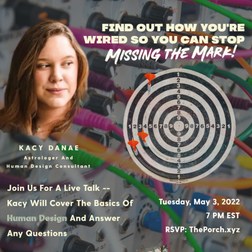
Chat with Kacy Danae - Human Design beyond the basics of type, strategy, and authority

Recorded date: May 3, 2022 Guest: Kacy Danae Original format: video conversation Kacy Danae joined Courtney Crosslin (also now known as Sisi in Brasil) for a May 2022 video conversation originally recorded for The Porch Talks, offering an accessible introduction to Human Design through the lens of energy, environment, decision-making, and self-understanding. This conversation is especially useful for anyone curious about Human Design beyond the basics of type, strategy, and authority. Kacy walks through how Human Design can help explain the way people take in life, respond to pressure, work with others, process emotion, and choose environments that support their energy instead of draining it. Courtney also shares pieces of her own chart throughout the conversation, which turns the teaching into a practical, real-time example instead of a lecture. Topics include: Human Design as an energetic operating system The difference between astrology and Human Design Generators, Manifesting Generators, Manifestors, Projectors, and Reflectors Strategy, authority, and why your type is not a box Reflectors, open centers, empathy, and energetic mirroring The four arrows, also called variables or the four transformations Digestion as the way you process life experiences, not only food Left-facing versus right-facing arrows Why some people thrive with structure while others need flexibility Human Design environments: caves, markets, kitchens, mountains, valleys, and shores How your environment can affect work, creativity, business offers, and daily energy Perspective, view, manifestation, and whether you need details or feeling Motivation and why some people need a clear plan while others move best organically Defined versus undefined centers Conditioning, deconditioning, and the pressure people absorb from others The head, ajna, throat, identity, heart, solar plexus, sacral, spleen, and root centers Productivity, self-worth, emotional waves, intuition, stress, and burnout How Human Design can support solopreneurs, teachers, creators, and small business owners This podcast can be found on all major podcast networks, including Spotify, Apple Podcasts, iHeartRadio, YouTube, and wherever you listen. Visit faafo.app for more information.

Part 1/3: Sat With Evo Terra: Digital Strategy, Creative Work, and the Phoenix Internet Scene

Evo Terra is a digital strategist whose work moved through e-commerce, online radio, advertising, social media, consulting, and community building before those lanes had fully settled into what they are now. This throwback conversation, recorded somewhere between 2006-2015, captures him thinking through the balance between creativity and business, why small companies and entrepreneurs often move faster than large organizations, and how Phoenix’s digital community grew from scattered groups into a more visible creative ecosystem. He also talks about choosing enough money and meaningful work over chasing the biggest paycheck, bridging creative ideas with practical ROI, and keeping room for play through projects like Improv Arizona. find more podcasts at faafo.app/radio
David Monteith

David Monteith is a London actor, acting teacher, and co-host of Geek Syndicate, known for blending classical theatre work with a sharp love of comics and sci-fi. In this archived throwback conversation from somewhere between 2006–2015, he reflects on performing Shakespeare in Poland at the Gdansk Shakespeare Festival in a stage-less promenade format, working with local community cast members, and navigating the experience of being a visibly different outsider in that environment. He also shares the practical side of sustaining a creative life, including his long career in the social sector, training professionals in drug work, and why Geek Syndicate grew from two friends talking into a global listenership and a wider podcast network. find more podcasts at faafo.app/radio