Same Soul Productions

Same Soul Productions

di Same Soul Productions
Stagione 2

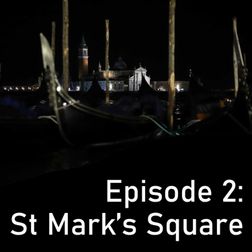
Venice: Episode 2 - Saint Mark's Square

Piazza San Marco, often known in English as St Mark's Square, is the principal public square of Venice, Italy, where it is generally known just as la Piazza ("the Square"). All other urban spaces in the city (except the Piazzetta and the Piazzale Roma) are called campi ("fields"). The Piazzetta ("little Piazza/Square") is an extension of the Piazza towards San Marco basin in its southeast corner. The two spaces together form the social, religious and political center of Venice and are commonly considered together.

Venice: Episode 1 - General History

Venice is a city in northeastern Italy and the capital of the Veneto region. It is built on a group of 118 small islands that are separated by canals and linked by over 400 bridges. The islands are in the shallow Venetian Lagoon, an enclosed bay lying between the mouths of the Po and the Piave rivers. The name is derived from the ancient Veneti people who inhabited the region by the 10th century BC. The city was historically the capital of the Republic of Venice for over a millennium, from 697 to 1797. It was a major financial and maritime power during the Middle Ages and Renaissance, and a staging area for the Crusades, as well as an important center of commerce—especially silk, grain, and spice, and of art from the 13th century to the end of the 17th. The city-state of Venice is considered to have been the first real international financial center, emerging in the 9th century and reaching its greatest prominence in the 14th century. This made Venice a wealthy city throughout most of its history. For centuries Venice possessed numerous territories along the Adriatic Sea and within the Italian peninsula, leaving a significant impact on the architecture and culture that can still be seen today. The sovereignty of Venice came to an end in 1797, in the hands of Napoleon. Subsequently, in 1866, the city became part of the Kingdom of Italy.
Stagione 1

Rome: Episode 8 - The Pantheon

The Pantheon is a former Roman temple and, since 609 AD, a Catholic church (Basilica of St. Mary and the Martyrs), on the site of an earlier temple commissioned by Marcus Agrippa during the reign of Augustus. The building is cylindrical with a portico of large granite Corinthian columns under a pediment. A rectangular vestibule links the porch to the rotunda, which is under a coffered concrete dome, with a central opening (oculus) to the sky. Almost two thousand years after it was built, the Pantheon's dome is still the world's largest unreinforced concrete dome. The height to the oculus and the diameter of the interior circle are the same: 142 feet. It is one of the best-preserved of all Ancient Roman buildings, in large part because it has been in continuous use throughout its history and is visited by over 6 million people a year.

Rome: Episode 7 - Saint Peter's Basilica

The Papal Basilica of Saint Peter in the Vatican , or simply Saint Peter's Basilica, is a church built in the Renaissance style located in Vatican City. It was initially planned by Pope Nicholas V and then Pope Julius II to replace the aging Old St. Peter's Basilica, which was built in the fourth century by Roman emperor Constantine the Great. Construction of the present basilica began on 18 April 1506 and was completed on 18 November 1626. Designed principally by Donato Bramante, Michelangelo, Carlo Maderno and Gian Lorenzo Bernini, St. Peter's is the most renowned work of Renaissance architecture and the largest church in the world by interior measure. While it is neither the mother church of the Catholic Church nor the cathedral of the Diocese of Rome, St. Peter's is regarded as one of the holiest Catholic shrines. Catholic tradition holds that the basilica is the burial site of Saint Peter, chief among Jesus's apostles and also the first Bishop of Rome (Pope). Saint Peter's tomb is supposedly directly below the high altar of the basilica, also known as the Altar of the Confession.
Rome: Episode 6 - Vatican City

Vatican City, officially the Vatican City State, is an independent city-state and enclave surrounded by Rome. Also known simply as the Vatican, the state became independent from Italy in 1929 with the Lateran Treaty, and it is a distinct territory under "full ownership, exclusive dominion, and sovereign authority and jurisdiction" of the Holy See, itself a sovereign entity of international law, which maintains the city state's temporal, diplomatic, and spiritual independence. With an area of 121 acres and a population of about 453, it is the smallest state in the world both by area and population. Vatican City contains religious and cultural sites such as St. Peter's Basilica, the Sistine Chapel, and the Vatican Museums. They feature some of the world's most famous paintings and sculptures. The unique economy of Vatican City is supported financially by donations from the faithful, by the sale of postage stamps and souvenirs, fees for admission to museums, and sales of publications.

Rome: Episode 5 - The Spanish Steps

The Spanish Steps climb a steep slope between the Piazza di Spagna at the base and Piazza Trinità dei Monti, dominated by the Trinità dei Monti church at the top. The monumental stairway of 135 steps was built with French diplomat Étienne Gueffier's bequeathed funds of 20,000 scudi, in 1725, linking the Trinità dei Monti church under the patronage of the Bourbon kings of France and the Spanish Embassy at the top of the steps to the Holy See in the Palazzo Monaldeschi at the bottom of the steps.

Rome: Episode 4 - Trevi Fountain

The Trevi Fountain is an 18th-century fountain in the Trevi district in Rome. Standing 86 feet high (26 meters) and 161 feet wide (49 meters), it is the largest Baroque fountain in the city and one of the most famous fountains in the world. The fountain has appeared in several films including: Roman Holiday (1953); Three Coins in the Fountain (1954); La Dolce Vita (1960); Sabrina Goes to Rome (1998); and The Lizzie McGuire Movie (2003).

Rome: Episode 3 - The Forum(-ish)

The Roman Forum, or Forum Romanum in Latin, is a rectangular plaza surrounded by the ruins of several important ancient government buildings at the center of the city of Rome. For centuries the Forum was the center of day-to-day life in Rome: the site of triumphal processions and elections; the venue for public speeches, criminal trials, and gladiatorial matches; and the nucleus of commercial affairs. The teeming heart of ancient Rome, it has been called the most celebrated meeting place in the world, and in all history. Located in the small valley between the Palatine and Capitoline Hills, the Forum today is a sprawling ruin of architectural fragments and intermittent archaeological excavations attracting over 4.5 million sightseers a year.

Rome: Episode 2 - Colosseum

The Colosseum is an oval amphitheater in the centre of the city of Rome and is the largest ancient amphitheater ever built. Construction began under the emperor Vespasian in 72 AD and was completed in 80 AD under his successor and Titus. It is still the largest standing amphitheater in the world today, despite its age. Although substantially ruined by earthquakes and stone robbers, the Colosseum is still an iconic symbol of Imperial Rome and was listed as one of the New 7 Wonders of the World.

Rome: Episode 1 - General History

Rome is the Italy's most populated city and the third most populous city in the European Union. It's also home to the world's smallest country, Vatican City, which is also the only country in the world to be completely inside the boundaries of a city. The complex history of this city spans more than three millennium and this episode will briefly explore that story.
2 di 2