
Note sull'episodio
Use code QXQ25 for all my deals
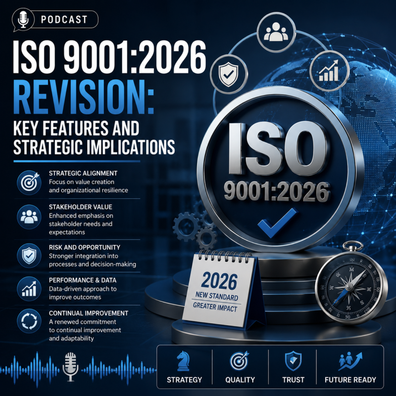
The International Organization for Standardization (ISO) is currently in the process of revising the ISO 9001 standard, with the updated version—ISO 9001:2026—expected for publication in mid-2026. This revision aims to ensure the standard remains relevant amidst evolving technology, legislation, and market practices. Critical updates focus on integrating climate change considerations, adapting to digital transformation (including AI and automation), and reinforcing ethics, transparency, and risk-based management. Organizations will be granted a three-year transition period following publication to adapt their Quality Management Systems (QMS). Proactive preparation through gap analysis, digital readiness, and a reinforced culture of sustainability is recommended to ensure a seamless transition.
The revision is driven by three primary catalysts:
Relevance: The 2015 version predates the mainstream explosion of AI, the mass adoption of remote work, and the urgency of the circular economy. The new standard adapts to stay useful in this high-tech, high-speed operating environment.
Correction: Auditing the 2015 version revealed "gray areas"—ambiguities regarding risk and opportunity that led to inconsistent application. The 2026 revision provides the necessary technical corrections to ensure uniform compliance.
Alignment: Using the "High-Level Structure" (now Harmonized Structure), the revision ensures that ISO 9001 remains perfectly compatible with other standards like ISO 14001 (Environmental) and ISO 45001 (Safety), allowing for a seamless, integrated management system.
Understanding the why behind these changes is the first step toward mastering the how of the new requirements.