
Note sull'episodio
A portrait by Nathalie Singer & Elisabeth Schimana (2017). Language: Français
How the tones come together (Sabine Sanio)
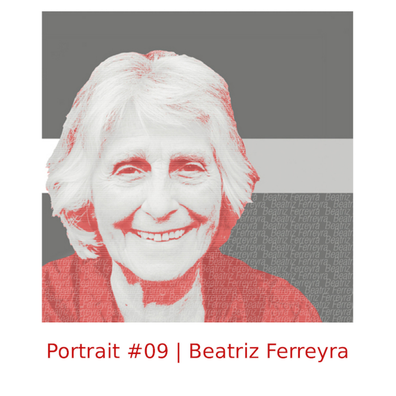
Beatriz Ferreyra (1937) comes from a wealthy Argentinian family. Raised in Cordoba, her family moved to Buenos Aires when she was twelve. Nevertheless, they continued to spend every summer together with two other families and five pianos in their large house in Cordoba. Her entire family was musical, but everyone had different preferences: her father favored Wagner, Brahms, and Chopin; her mother was interested in Debussy, Stravinsky, jazz—and always brought back the latest records from visits to her family in the USA; one aunt played Brahms, another sang tangos, and Beatriz and her brother took piano lessons.
It took her a long time to decide on music and a life as a composer. Searching for alternatives, she went to the USA at the age of 18, and finally, in 1961, to Europe, where she stayed with friends in Paris. Her parents refused to support her, and for a long time she took on all sorts of jobs, living in a small basement apartment.
Her attempts to make a living from drawing were unsuccessful, so she spontaneously seized the opportunity to study composition with Nadja Boulanger. From her, she learned the seriousness and precision of the work. But when a composer friend, Edgardo Cantón, took her to a concert by the Groupe des Recherches Musicales, she was so captivated that she gave up her composition lessons. The music reached into infinity and opened up incredible possibilities for her. She became Cantón's assistant, learning how to edit tapes and work with filters. Shortly afterward, she participated in a course by Pierre Schaeffer and joined the team that created Schaeffer's "solfège de l'objet sonore."
The road to recognition was long. During her time at the GRM, she began composing. To be independent of Schaeffer, Ferreyra left the GRM the moment she received a commission. Afterward, she did everything she could to compose: she accepted every commission and participated in every competition. Françoise Barriere and Christian Clozier, who were founding the Bourges Festival of Electronic Music, commissioned her to write a new piece after hearing her work "Medisances" (1968). She soon received a new commission every two years.
One of the central aspects of electroacoustic music is the collection of sounds. Each of her compositions has its own unique sounds; she never reuses sounds from one piece for another. With a microphone, she records animals, people, or machines: her garden and household appliances serve as sources for "Les Larmes de l'inconnu."
Equally important to her is the exploration of space, which she considers a central element of music: “For me, music is surrounding, music is like life.” She often compares large soundscapes to an orchestral score or a painting. The vast soundscapes in "La rivière de l'oiseaux" (1998/99) are based on grids generated from short, overlapping notes.
Ferreyra uses the technique of shifting perspectives in her compositions, a technique familiar to her from Pierre Schaeffer's concept of reduced listening: one perceives sound as such, not as an effect or indication of something else. She composes intuitively; she has no rules: "It either works or it doesn't." Since "Canto del Loco" (1974), anything—image, sound, color, or form—can be the starting point for her associative composing.
Following the trilogy "La rivière des oiseaux," another series of works emerged: four pieces she describes as her esoteric compositions. In "Dans un point infini" (2005), the sounds of violinist Veronika Kadlubkiewicz transport the listener to a boundless realm. "L'autre rive" (2007) originated from percussive sounds while reading the Tibetan Book of the Dead. "Un fil invisible" (2009/10) reflects her reading of C.G. Jung. "Les larmes de l'inconnu" (2011) is the final composition in this series.