GrimSpotting

GrimSpotting

di Nick Montelupo
Stagione 1
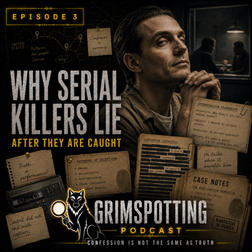
Why Serial Killers Lie After They Are Caught
Capture does not always end a serial killer’s need for control. Sometimes it simply changes the weapon. After arrest, offenders may deny, minimise, exaggerate, invent victims, withhold locations, trade information for privileges, or reshape themselves into the criminal mastermind they want history to remember. Even a confession can be truthful, manipulative—or both. In Episode 3 of the GrimSpotting Podcast, we examine why serial killers continue lying after they are caught, using the cases of Ted Bundy, Dennis Rader, Henry Lee Lucas and Samuel Little to explore confession as currency, self-mythology, inflated body counts and the calculated use of uncertainty. Because when the murders stop, the battle over the story may only be beginning. The case is not closed.
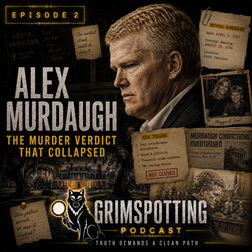
Alex Murdaugh Retrial — The Murder Verdict That Collapsed
Alex Murdaugh was supposed to be finished. After one of the most watched murder trials in modern American true crime, the disgraced South Carolina lawyer was convicted of killing his wife Maggie and his son Paul. The dynasty had fallen. The verdict had landed. The story seemed closed. Then the murder convictions collapsed. In this episode of GrimSpotting, Nick Montelupo revisits the Murdaugh case through the lens of the upcoming retrial: the kennel video, the lies, the financial crimes, the courtroom spectacle, and the alleged jury influence that forced the justice system to start again. This is not an innocence argument. It is not a defense of Alex Murdaugh. It is a forensic story about what happens when a verdict feels emotionally satisfying — but the process behind it becomes contaminated. Because in true crime, the most dangerous ending is often the one that feels too clean.

Gabby Petito and the Pre-Crime Pattern
Gabby Petito’s case is not an unresolved whodunit. It is a solved homicide with an unfinished lesson. In this GrimSpotting episode, we examine the case as a pre-crime pattern autopsy: not asking who did it, but what was visible before the final crime, how coercive control may have shaped the relationship, how the Moab police encounter was interpreted, and how hindsight can both reveal and distort warning signs. This is not a replay of bodycam footage for entertainment. It is a disciplined reconstruction of the pattern: relationship danger, institutional under-reading, public misinterpretation, and the difficult question of what can be learned without pretending we know more than the evidence allows. Facts first. Conclusions after. Do not mythologize the perpetrator. Reconstruct the catastrophe.