Been There, Dunn That

Been There, Dunn That

di Angela Dunn-Cartledge
Stagione 2

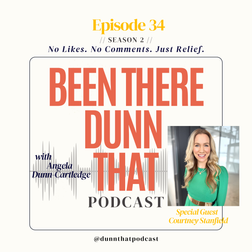
EP 2.34: No Likes. No Comments. Just Relief.

What we don’t say, we store. In this episode, Angela and Courtney unpack why unspoken thoughts keep looping in our bodies and how expression—not external validation—creates relief. Courtney shares the origin story of Air Out, a simple, anonymous app that “greenlights” self-expression: no usernames, no likes, no comments—just space to move the energy so your mind gets quiet and your body can exhale. They explore grief in the everyday (from butterflies that feel like a hello to the pea under a stack of mattresses), the surprising power of anonymity for men and teens, and why healing starts inside-out, not outside-in. Key takeaways: Expression is the exit. The opposite of depression is expression; unexpressed thoughts stay on your brain’s “to-do” list until you move them out. You are not your thoughts. The quality of your thoughts reflects your current emotional state—not your worth or identity. Anonymity lowers the cost of honesty. No usernames, likes, or comments = less performance, more truth, faster relief. Grief lives everywhere. From parenting to work to love—grief shows up as adjustment; small releases count (the butterfly moment matters). Aim for the 1% shift. Micro-relief today compounds into a quieter mind and better presence for the people you love.Find the app anywhere you get your apps or on ⁠airoutapp.com⁠ and Courtney is on ⁠Instagram⁠.

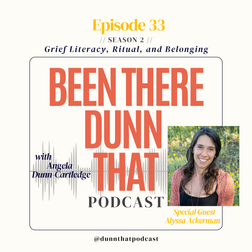
Ep 2.33: Grief Literacy, Ritual, and Belonging

In this deeply grounding conversation, host Angela Dunn-Cartledge talks with death doula, grief guide, and ritualist Alyssa Ackerman about building a grief-literate culture—before and after loss. We explore why untended grief behaves like trauma in the body, how pre-existing connection boosts resilience, and practical ways to create containers that let us ask for what we need. Alyssa walks us through community grief tending, the “no fixing, no advice, no cheerleading” agreements, and ritual as an everyday practice of remembrance and integration. We also touch the sister-threads of grief and regret, how to hold presence without absorbing someone else’s pain, and Frances Weller’s Gates of Grief as a map back to belonging. Key Takeaways Grief is woven into all change—not only death; untended grief can mirror trauma. Connection before crisis matters: stronger social ties → faster recovery, less PTSD. Build a care team (listeners, laughers, “been-there” folks) before you need it. Create containers: time limits, consent, and clear asks (“Please just listen,” “Call me weekly about my mom”). In circles, practice presence over rescuing: no fixing, advice, or cheerleading. Ritual (altars, food, music, nature, movement) helps us remember and integrate, not erase. The Gates of Grief (loss/impermanence; unloved parts; sorrows of the world; expectations unmet; ancestral grief; and the harm we’ve caused) widen literacy and compassion. You can be with big emotions without absorbing them: breath, body, nature, after-care. You can find Alyssa on her website, on Instagram and on this Tedx Talk.

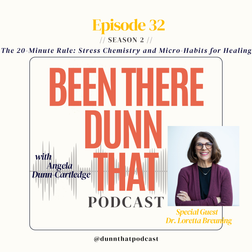
EP 2.32: The 20-Minute Rule: Stress Chemistry and Micro-Habits for Healing

Author and Inner Mammal Institute founder Dr. Loretta Breuning joins Angela to demystify our “animal brain”—why cortisol makes small triggers feel huge, how dopamine drives relief-seeking, and what it actually takes to build new emotional pathways. You’ll learn the 20-minute half-life rule for stress, how to spot social-comparison loops, and practical ways to design healthy, fun rewards so change sticks. Takeaways: Your brain saves relief pathways early; adulthood feels “stuck” because electricity follows the biggest, fastest old routes. Cortisol ≠ truth. It’s a threat signal, often from past associations. Treat it as data, not a directive. Wait 20 minutes before big decisions or responses. Problem-solving inside the first spike just hunts for “evidence of danger.” Change sticks when it’s rewarded. Build small, enjoyable wins that make the new path attractive. Social comparison is mammalian, not moral. Notice it, name it, and step back into personal metrics you can control. Think “template, not destiny.” You can edit the template—slowly, repeatedly—until it fits the life you want. Work with Loretta at her ⁠website⁠ and take the 5 day FREE happy emotion email challenge!

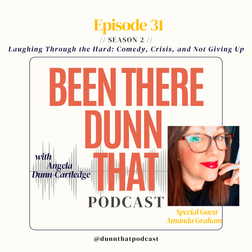
EP 2.31: Laughing Through the Hard: Comedy, Crisis, and Not Giving Up

Esplicito
Angela sits down with writer, stand-up comic, and professional “build-your-own-table” human Amanda Graham for a raw, funny, and fiercely honest convo about breaking into TV/film late, navigating gatekeepers, living through “the wilderness years,” and choosing hope when life keeps piling on. Amanda shares how discovering she’s autistic (and likely ADHD) reframed her direct communication style, why she stopped tap-dancing for approval, and how she’s “punk-rocking” her book after publishers said, “This is brilliant—who is she?” You’ll hear practical encouragement (10 minutes a day changes the ship’s course), a reframe on goals (chasing the why more than the trophy), and a tender peek at the children’s book about a lonely goldfish finding connection. Takeaways: Build your own table: Stop proving yourself to rooms that don’t get you; find your people and create momentum. Direct ≠ destructive: Authentic, truth-first communication can clash with industry norms—own it anyway. Grief in the creative grind: We grieve lost time, unpaid labor, and moving goalposts—naming it helps us keep going. Start “late,” start anyway: Audacity compounds; consistency (even 10 minutes/day) is the real accelerant. Chase the why, not the trophy: Let the deeper intention (making people feel less alone) guide the path. Hope as fuel: Even when life is brutal, noticing your still-flickering light is the first step out. Work with Amanda through her ⁠website⁠ and ⁠Threads⁠ (where I found her). She's also on ⁠LinkedIn⁠, ⁠Instagram⁠ and Facebook.

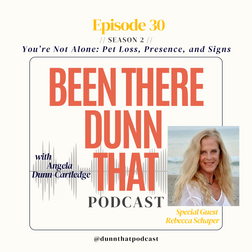
EP 2.30: You’re Not Alone: Pet Loss, Presence, and Signs

TRIGGER WARNING: Suicide is discussed in this episode. Please listen at your discretion. Rebecca shares an extraordinary life story—losing both parents to suicide, surviving childhood sexual abuse, and being separated from her brother for 20 years—then finding deep healing through storytelling, spirituality, and the love of her “soul dog,” Gus. After Gus’s unexpected passing in 2023, Rebecca experienced a grief more profound than the deaths of her parents. She chronicles the signs, synchronicities, and comfort she received—from rainbows and hawks to an animal communicator’s transcripts—and how welcoming Zeke into her life helped her “allow, not force” the healing process. She and Angela explore why pets bond with us so intensely (unconditional love + presence), how grief is transformative, and practical ways to move through pet loss with compassion and ritual. Takeaways: Why the connection felt different—and deeper than parental loss Why we bond so strongly with pets: unconditional love + present-moment embodiment Grief as transformation: heartbreak, strength, and growing empathy Holding pain and joy together; loving forward Working with an animal communicator Work with Rebecca through her ⁠website⁠. Her book is available on ⁠Amazon⁠.

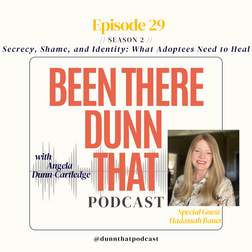
EP 2.29: Secrecy, Shame, and Identity: What Adoptees Need to Heal

Angela and Hadassah dive into adoptee secrecy, shame and identity, the power (and pitfalls) of the story we tell ourselves, and how to move from rumination to repair. Hadassah explains her “tell the true story, then heal it” approach, why secrecy fuels shame, how to prepare emotionally before a search/reunion, and what open vs. closed adoption looks like in practice. Angela shares her family’s embryo-adoption path, the complexities of medical history and openness, and the importance of telling children their story early and often. Takeaways: Story vs. facts: Many of us “add” to our stories over time. Separate facts from interpretations, then write a new, healing script. (≈ 02:00–05:29) Ruminating keeps us stuck: Getting the story out is essential—but staying in it reinforces a victim identity. (≈ 02:00–03:27) Identity & genetic mirroring: Not seeing yourself reflected in family can complicate identity formation for adoptees. (≈ 16:53–18:39) Secrecy → shame: Closed records (e.g., the “Adoption-Sealed” era) deprive adoptees of agency and health info; reforms are improving access in some states. (≈ 07:34–09:35) Reunion readiness: Do inner work first; not everyone who’s found wants contact. Decide boundaries before you engage. (≈ 09:35–12:42) Tell kids early: Delayed disclosure can trigger profound identity rupture and betrayal. (≈ 18:39–20:38) Embryo adoption nuances: Gestational bonding matters; carrying a child can lessen certain layers of early separation trauma, while genetic disconnection still brings questions. (≈ 25:08–27:25) Forgiveness: It’s multi-directional—birth parents, systems, self. (≈ 05:29–07:34) How to work with Hadassah on her ⁠website⁠ On ⁠Instagram⁠ & ⁠Facebook⁠ Through her Adoptee-focused journal with guided prompts (available on ⁠Amazon⁠)

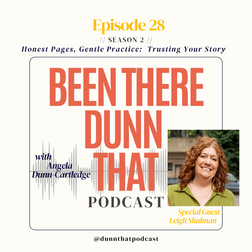
EP 2.28: Honest Pages, Gentle Practice: Trusting Your Story

In this episode of Been There, Dunn That, Angela sits down with author and writing mentor Leigh Shulman to explore what it really takes to start—and sustain—a writing life. From the “just 10 minutes” practice to separating writing from publishing, Leigh shares a compassionate, practical path for anyone ready to tell their story. You’ll learn how to handle harmful feedback, why perfection blocks momentum, and how community, accountability, and respectful self-storying create healing and connection. What you’ll hear: Why your story is both unique and universally connective, just like grief itself “Just 10 minutes”: the small habit that builds a big writing life Writing vs. publishing: opposite processes, different mindsets Feedback triage: what to ignore, what to use, how to move forward Making peace with comparison and choosing your version of success Bespoke writing retreats in Salta, Argentina & the Inspired Writer Community Work with Leigh through her ⁠website⁠.

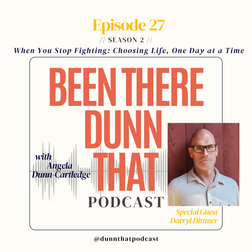
EP 2.27: When You Stop Fighting: Choosing Life, One Day at a Time

TRIGGER WARNING: This episode includes candid discussion of addiction and suicidal ideation. Please listen with care. In this powerful conversation, host Angela Dunn-Cartledge sits down with author and speaker Daryl Dittmer to unpack the long, honest work of recovery and resilience. Daryl shares how a downward spiral through his teens ended with a life-or-death crossroads on New Year’s Eve 1984—and how treatment began his second act. From the mentor line that changed everything—“When you stop fighting, the fighting stops”—to Step 11, gratitude, and daily practices, Daryl offers a practical, compassionate roadmap for anyone ready to put the shovel down and climb out of the pit. You’ll hear about The moment Darrell chose to live—and why “attempting to try” is enough to start “Clearing the wreckage”: responsibility without self-hatred Step 11’s role (prayer & meditation) in day-to-day sanity The routines: breathwork, meditation, gratitude, movement How writing/journaling helps you see patterns and track progress Forgiveness vs. forgetting: letting go without minimizing the past “First things first—and the rest shall be added on” Find the author: Books by Daryl Dittmer: ⁠When I Stop Fighting⁠; ⁠When You Stop Fighting⁠ (audiobooks in his voice!) on Amazon Journals on his ⁠shop⁠: Rewrite Your Life Story; Stop Stopping Yourself; Stop Fighting, Start Living ⁠www.daryldittmer.com

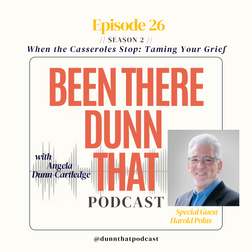
EP 2.26: When the Casseroles Stop: Taming Your Grief

TRIGGER WARNING: Unaliving, su*cide, and drug overdose are discussed heavily in this episode. Please listen at your discretion. After the casseroles stop and the world moves on, grief can feel like being dropped in a forest without a map. In this deeply honest episode, host Angela Dunn-Cartledge sits down with grief counselor and child-loss survivor Harold Polus to talk identity, judgment, community, and the slow, real work of healing. Harold shares the seven-month spiral that led him to prayer, the moment hope returned, and the three pillars—spiritual, emotional, physical—that guide his work with clients today. Together, Angela and Harold unpack powerful metaphors (waves, forests, backpacks) that make grief feel navigable, and they offer compassionate permission to heal at your pace. You can’t “get back to normal,” but you can build a life worth living—one small step at a time. Release. Feel. Heal. You can work with Harold on on Instagram ⁠@taming_your_grief⁠ (taming_your_grief with underscores), ⁠YouTube⁠, and Facebook at ⁠Finding Peace After Passage⁠.

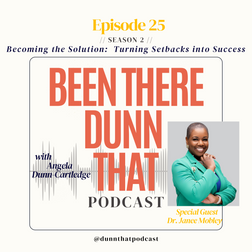
EP 2.25: Becoming the Solution: Turning Setbacks into Success

Dr Janee does not mince words - your faith can create a positive outlook on your current environment and circumstances. In this inspiring episode of Been There, Dunn That, host Angela Dunn-Cartledge sits down with Dr. Janee Mobley — pharmacist, entrepreneur, author, and “solutionist.” Dr. Janee shares her raw and powerful story of going from being fired and homeless with her husband, to discovering her purpose in helping women turn their gifts into profitable businesses. Together, Angela and Dr. Janee dive deep into resilience, faith, and mindset shifts. They talk about the courage to create even in the darkest moments, why stagnation is the true enemy of growth, and how to shift perspective when life forces you to pivot. What you’ll hear in this episode: Dr. Janee’s story of becoming homeless after job loss, and the powerful decision she made that changed her life. Why movement is essential — physically, mentally, and spiritually — and how stagnation keeps us stuck in grief and fear. The “solutionist” mindset: how to reframe obstacles into opportunities. The connection between healing emotionally and creating courageously. The importance of choosing one thing to implement, instead of trying to fix everything at once. This conversation will leave you encouraged, challenged, and equipped with practical steps to take when life shifts unexpectedly. ✨ Connect with Dr. Janee Mobley: Free Guide: 5 Mistakes Women Make That Prevent Profit From Purpose → ⁠drjanee.net/5mistakes⁠ Instagram, Facebook, LinkedIn & YouTube: @DrJaneeMobley 🌟 Connect with Angela & the Been There Dunn That podcast: Website: ⁠dunnthatpodcast.com⁠Follow on Instagram & Facebook: @dunnthatpodcast Release. Feel. Heal. 💛
3 di 8