The Reading Instruction Show

The Reading Instruction Show

di Dr. Andy Johnson
Stagione 25

Dyslexia Summits, Disinvitations, and Reading Camps

Let’s review. A couple of months ago, I recorded an online interview for a dyslexia summit. I also put together and recorded a short video presentation. These were both to be shown at a dyslexia summit. I was to then attend the online summit for a live question-and-answer session. On the day of the summit, I emailed to see what time I needed to be online. It was at this point that I was told that I had been disinvited. And my disinvitation had occurred without so much as a disinviting word. It was a gentle but wordless disinvitations. Can you imagine such a thing? The stated reason for my wordless disinvitation was that the writing tone used on some of my digital platforms “is fairly abrasive when speaking about those in other camps in the reading world”. In a previous excerpt, I examined how the abrasiveness of one’s writing tone is determined largely by the cognitive framework held by the reader. I also said that the wordless disinvitation I received was a form of silencing. And any abrasiveness in my writing tone pales in comparison with the continued abrasion endured by teachers and professors as well as the constant attacks on Lucy Calkins, Ken Goodman, and Marie Clay. In this excerpt, we’ll examine reading camps.

John Stossel: My Adventure in Television – Part I

It is very hard to have a serious and substantive discussion about a topic like reading instruction with somebody whose knowledge base is shallow and disjointed. You end up in a teaching role.
Stagione 24

Dyslexia Summits, Disinvitations, and Abrasiveness
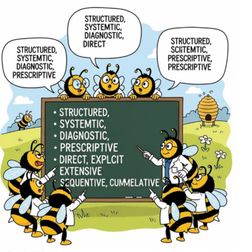
The abrasiveness of a writing tone is determined largely by the cognitive framework held by the reader. A cognitive framework is the mentally constructed structures that guide individuals in interpreting the world. It becomes the lens through which the world is viewed. Much like a theory, a cognitive framework is used to explain facts and understand phenomena. Some see my writing as abrasive and ill-informed. Others see my writing as non-abrasive and insightful. Regardless, to silence, dismiss, or disinvite somebody based on their perceived tone … is … well, it’s the Science of Reading.

Academic Buzzwords, Weasel Words, and Propagating Lexiconic Locution: Claude Goldenberg, and the International Dyslexia Association
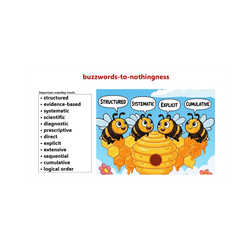
This podcast describes the following: Words - sound groups that represent things in the real world. Buzzwords - are words used to elicit an emotional response rather than accurately transmitting information. Propagating lexiconic locution – an overuse of academic buzzwords. Weasel words - words are used to give the impression of something without really saying something. Strawman argument – Creating a cartoonish or distorted version of something then arguing against the cartoon.

Academic Buzzwords, Weasel Words, and Propagating Lexiconic Locution: Claude Goldenberg, and the International Dyslexia Association

This podcast defines the following: Words - sound groups that represent things in the real world. Buzzwords - are words used to elicit an emotional response rather than accurately transmitting information. Propagating lexiconic locution – an overuse of academic buzzwords. Weasel words - words are used to give the impression of something without really saying something. Strawman argument – Creating a cartoonish or distorted version of something then arguing against the cartoon.
Stagione 24

Selective Umbrage: Emily Hanford is an Alexa App
In a recent show, I referred to Emily Hanford as the Alexa App of reading instruction. This was a metaphor, a common literary device in which one makes a comparison without using the words ‘like’ or ‘as’. It creates an image. When we say America is a melting pot, we don’t literally mean there’s a big pot bubbling somewhere. Metaphors create images and communicate things that lists of words cannot. Recently, somebody took great umbrage of my use of metaphor. This was selective umbrage. If you want to take umbrage at something, take umbrage at the money wasted to pay for commercial products and services. Take umbrage at over-crowed classrooms and poor teaching conditions. Take umbrage at low teacher pay and lack of legitimate professional development opportunities. Take umbrage at tax cuts that make tuition costs rise. Take umbrage when the public cannot afford to go to our public colleges and universities. Take umbrage at the lack of health care, food insecurity, and mass shootings.

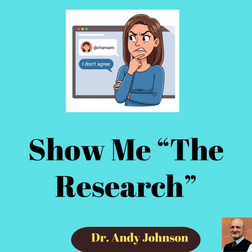
Show Me "The Research'

If somebody makes the claim that research says something, one has an obligation to have read a research article at least once in their life. And if somebody says, “Show me the research,” that person should know what research is and how to read and interpret it.

Legitimate Professional Development for Reading Teachers

Legitimate professional development for teachers is necessary. I used the term ‘legitimate’ to exclude programs and services that are profit-based. These are usually little more than infomercials disguised as professional development. Here, there is no check and balance. There is no blind peer review of the information provided. Only the information that supports their product or service is presented. Information that does not is not. The best example of this is LETRS professional development for teachers. As described in earlier chapters, there is no legitimate research provided to suggest that using LETRS (a) enhances students' reading achievement, (b) enhances teachers’ ability to teach effectively, and (c) is more effective than other types of professional development. (Remember, having elements that are supported by research doesn’t make the program research-based. Every program has some element that can be supported by research.)

Toadys, Transaction, and Reading Instruction
Toadys sometimes call themselves “consultants”. They promote methods and say things that just happen to coincide with the products and services being sold by Big Publishing. Quite a coincidence, yes? Right and wrong are not determined based on what’s right and wrong; rather, by what will sell.

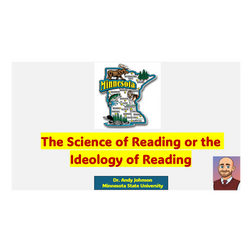
The Ideology of Reading

Despite having the word “science” in their title, the proposals put forth by the SoR are not grounded in science at all, but in pseudo-science, I-think-isms, and anecdotal evidence. In fact, they are promoting an ideology. Real science. Real science puts forth conclusions and recommendations based on a wide body of research. Real science uses systematic methods to collect and analyze data. Real science draws conclusions only from data collected. And real science uses blind peer review for an objective system of checks and balances. Ideology. An ideology is a system of ideas and beliefs. An ideology puts forth a dogma based on a very narrow range of data that must be adhered to. What the SOR promotes is based far more on a reading belief system than reading science. Hence, the SOR would be more accurately named, the Ideology of Reading.
5 di 34