Crafts That Changed Everyday Life

Crafts That Changed Everyday Life

di Crafts That Changed Everyday Life

How Papermakers Turn Pulp Into Sheets

Follow suspended plant fibers as they are gathered, pressed and dried into a continuous sheet. Small choices in fiber preparation and formation shape the paper's texture, strength and appearance. Inside this episode: - Paper starts with fibers - The mould captures a layer - Couching builds a post - Why the fibers stay together - Drying sets the sheet Sources include Georgia Tech Paper Museum, Washi Sheet Formation, Cellulose, hydrogen bonding in paper, and Paper strength review. This episode is a researched narrative summary. Historical records may be incomplete, translated differently, or interpreted differently by scholars. We distinguish documented facts, estimates, disputed interpretations, and later stories where material. Corrections are logged and incorporated into future editions. Follow Crafts That Changed Everyday Life for more researched stories about the crafts and tools that shaped daily life.
Why Mortise and Tenon Joints Hold

See how a fitted projection and cavity can turn separate pieces of wood into a durable structure. Shoulders, grain direction, friction and pegs all help explain why mortise and tenon joints endure. Inside this episode: - The basic geometry - Wood is strong in different directions - The shoulders resist rotation - Friction helps, but shape does more - The joint can deform Sources include Construction and Building Materials, mortise-and-tenon behavior and Heritage Science, traditional timber joints. This episode is a researched narrative summary. Historical records may be incomplete, translated differently, or interpreted differently by scholars. We distinguish documented facts, estimates, disputed interpretations, and later stories where material. Corrections are logged and incorporated into future editions. Follow Crafts That Changed Everyday Life for more researched stories about the crafts and tools that shaped daily life.

How Blacksmiths Shape Steel With Heat

Enter the forge to understand how heat, force and repeated shaping change a piece of steel. The story focuses on the craft and material science, not on hazardous how-to instruction. Inside this episode: - Steel remains solid - The forge supplies controlled heat - The hammer moves material - Drawing out and upsetting - Punching and drifting Sources include Victoria and Albert Museum, Metalworking Techniques and National Park Service, Blacksmithing at Herbert Hoover. This episode is a researched narrative summary. Historical records may be incomplete, translated differently, or interpreted differently by scholars. We distinguish documented facts, estimates, disputed interpretations, and later stories where material. Corrections are logged and incorporated into future editions. Follow Crafts That Changed Everyday Life for more researched stories about the crafts and tools that shaped daily life.

How Glassblowers Shape Molten Glass

This episode explores Heat, rotation, air and tools as a history of craft rather than a hazardous how-to guide. The story keeps the mechanisms clear and the research grounded for a casual listener. Inside this episode: - Glass between solid and flowing - The gather - The marver centers the mass - Breath creates an inner surface - Rotation answers gravity Sources include Corning Museum of Glass, Glass Dictionary, Gather, Corning Museum of Glass, Glass Dictionary, Blowing, and Corning Museum of Glass, Marver. This episode is a researched narrative summary. Historical records may be incomplete, translated differently, or interpreted differently by scholars. We distinguish documented facts, estimates, disputed interpretations, and later stories where material. Corrections are logged and incorporated into future editions. Follow Crafts That Changed Everyday Life for more researched stories about the crafts and tools that shaped daily life.

What Holds a Bound Book Together

This episode explores Sections, sewing, adhesive, boards and spines across major binding structures. The story keeps the mechanisms clear and the research grounded for a casual listener. Inside this episode: - A book is a moving object - Folds create sections - Sewing links the text block - The spine is a controlled hinge - Boards protect and carry Sources include Library of Congress, Bach to Baseball Cards, Library of Congress, Rebacking Gouverneur Morris's Encyclopedie, and Library of Congress, Why We Bind. This episode is a researched narrative summary. Historical records may be incomplete, translated differently, or interpreted differently by scholars. We distinguish documented facts, estimates, disputed interpretations, and later stories where material. Corrections are logged and incorporated into future editions. Follow Crafts That Changed Everyday Life for more researched stories about the crafts and tools that shaped daily life.

Why Pottery Is Glazed

This episode explores Surface, porosity, decoration and firing, while distinguishing broad principles from culture-specific practices. The story keeps the mechanisms clear and the research grounded for a casual listener. Inside this episode: - Fired clay is not one material - A thin layer of glass - Sealing the pores - Color comes from chemistry - Decoration can sit above or below Sources include Smithsonian National Museum of Asian Art, glaze, Smithsonian, Ceramics in Mainland Southeast Asia, Surfaces, and Victoria and Albert Museum, An A to Z of Ceramics. This episode is a researched narrative summary. Historical records may be incomplete, translated differently, or interpreted differently by scholars. We distinguish documented facts, estimates, disputed interpretations, and later stories where material. Corrections are logged and incorporated into future editions. Follow Crafts That Changed Everyday Life for more researched stories about the crafts and tools that shaped daily life.

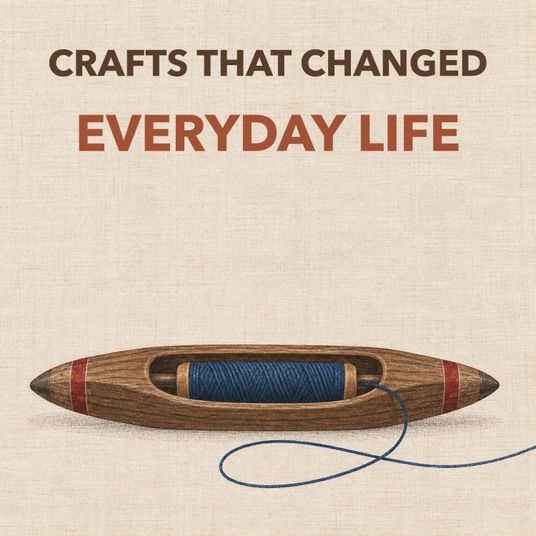
How a Loom Organizes Threads

This episode explores Warp, weft, shedding and the mechanical problem that looms solve across different traditions. The story keeps the mechanisms clear and the research grounded for a casual listener. Inside this episode: - Two directions - Tension creates a working field - The shed - Heddles hold the order - The weft makes the journey Sources include Victoria and Albert Museum, What is tapestry?, Metropolitan Museum of Art, How Medieval and Renaissance Tapestries Were Made, and Metropolitan Museum of Art, Tapestries and How They Are Made. This episode is a researched narrative summary. Historical records may be incomplete, translated differently, or interpreted differently by scholars. We distinguish documented facts, estimates, disputed interpretations, and later stories where material. Corrections are logged and incorporated into future editions. Follow Crafts That Changed Everyday Life for more researched stories about the crafts and tools that shaped daily life.