Cooper UNion

Cooper UNion

di Joshua Cooper
Stagione 1

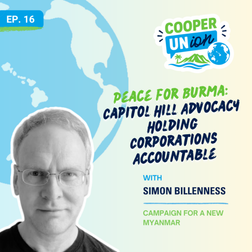
Peace for Burma: Capitol Hill Advocacy Holding Corporations Accountable

For 30 years, Simon Billenness, director of the Campaign for a New Myanmar and former head of the Free Burma Coalition, has turned consumer boycotts, shareholder resolutions, and bipartisan lobbying into real pressure on Myanmar's military junta. He traces the coup history, from the 2015 NLD election win under Aung San Suu Kyi to the 2021 military takeover, then walks through the campaigns that pushed Chevron, Pepsi, and the Japanese brewer Kirin out of Burma, and the current push in Congress for the Brave Burma Act and the Burma GAP Act. Billenness makes the case that everyday people, as citizens, consumers, and shareholders, have real power to hold corporations and governments accountable. Subscribe and follow to join future conversations with voices from across civil society, academia, diplomacy, social movements, and international institutions. * * * FOLLOW & CONNECT 🌐 Website | 🎧 Spotify | 🍎 Apple Podcasts | ▢️ YouTube | πŸ¦‹ BlueSky | πŸ’Ό LinkedIn | πŸ“Έ Instagram For collaboration, guest suggestions, or media inquiries: joshua@cooperunion.tv * * * SUPPORT Cooper UNion is an independent project. If you would like to support the podcast and help us continue creating accessible global conversations, you can support us through Ko-fi: https://ko-fi.com/cooperunion * * * Music Credits Music provided by: Johnny Helm https://www.johnnyhelm.com/ * * * Disclaimer The views expressed by guests are their own and do not necessarily reflect the views of the hosts or affiliated organizations.

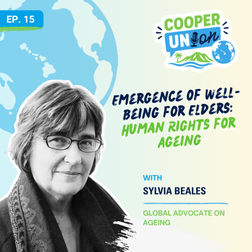
Emergence of Well-Being for Elders: Human Rights for Ageing

We are all aging, every day, yet older people are the one group without a binding UN human rights treaty to protect them. Sylvia Beals unpacks why: ageism keeps the issue invisible, treated as charity rather than rights, even as the world now holds more older people than children under five. She debunks the myths still slowing a UN Convention on the Rights of Older Persons β€” that aging means decline, that older people only receive care rather than give it, that employing them costs the young β€” and points to the same fight disability rights already won: visibility, voice, and law with teeth. Twenty years in, governments are finally starting to listen. Subscribe and follow to join future conversations with voices from across civil society, academia, diplomacy, social movements, and international institutions. * * * FOLLOW & CONNECT 🌐 Website | 🎧 Spotify | 🍎 Apple Podcasts | ▢️ YouTube | πŸ¦‹ BlueSky | πŸ’Ό LinkedIn | πŸ“Έ Instagram For collaboration, guest suggestions, or media inquiries: joshua@cooperunion.tv * * * SUPPORT Cooper UNion is an independent project. If you would like to support the podcast and help us continue creating accessible global conversations, you can support us through Ko-fi: https://ko-fi.com/cooperunion * * * Music Credits Music provided by: Johnny Helm https://www.johnnyhelm.com/ * * * Disclaimer The views expressed by guests are their own and do not necessarily reflect the views of the hosts or affiliated organizations.
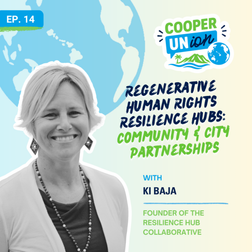
Regenerative Human Rights Resilience Hubs: Community & City Partnerships

Frustrated that a city's mandated hazard-mitigation meetings were reaching no one, Baja, Co-CEO of Embodied Ecosystems and the Resilience Hub Collaborative, spent a year listening in Baltimore neighborhoods before landing on the answer: communities need a trusted, self-determined place of belonging. Thirteen years later, that idea has spread worldwide as resilience hubs: community-run spaces built around six core components, from programs and power backup to accessibility, that serve people every day, not just during disasters. Baja traces the movement's growth across Hawaii and Maui's post-fire recovery, and makes the case that resilience hubs are a rehearsal for the government that should exist: one that shifts power to the people it serves. Subscribe and follow to join future conversations with voices from across civil society, academia, diplomacy, social movements, and international institutions. * * * FOLLOW & CONNECT 🌐 Website | 🎧 Spotify | 🍎 Apple Podcasts | ▢️ YouTube | πŸ¦‹ BlueSky | πŸ’Ό LinkedIn | πŸ“Έ Instagram For collaboration, guest suggestions, or media inquiries: joshua@cooperunion.tv * * * SUPPORT Cooper UNion is an independent project. If you would like to support the podcast and help us continue creating accessible global conversations, you can support us through Ko-fi: https://ko-fi.com/cooperunion * * * Music Credits Music provided by: Johnny Helm https://www.johnnyhelm.com/ * * * Disclaimer The views expressed by guests are their own and do not necessarily reflect the views of the hosts or affiliated organizations.
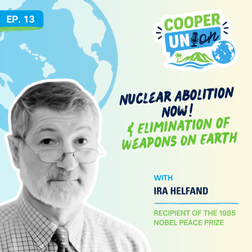
Nuclear Abolition Now! & Elimination of Weapons On Earth

ER physician Ira Helfand, co-founder of Back from the Brink and a leader of the Nobel Peace Prize-winning International Campaign to Abolish Nuclear Weapons, lays out just how close the world has already come to nuclear war, and how much closer it is getting. He walks through today's flashpoints, from Ukraine and Iran to India-Pakistan and the Koreas, the physical reality of a single detonation, and the global famine that would follow a US-Russia exchange, before making the case that abolition, not deterrence, is the only real safeguard, and that ordinary people will have to force that change. Subscribe and follow to join future conversations with voices from across civil society, academia, diplomacy, social movements, and international institutions. * * * FOLLOW & CONNECT 🌐 Website | 🎧 Spotify | 🍎 Apple Podcasts | ▢️ YouTube | πŸ¦‹ BlueSky | πŸ’Ό LinkedIn | πŸ“Έ Instagram For collaboration, guest suggestions, or media inquiries: joshua@cooperunion.tv * * * SUPPORT Cooper UNion is an independent project. If you would like to support the podcast and help us continue creating accessible global conversations, you can support us through Ko-fi: https://ko-fi.com/cooperunion * * * Music Credits Music provided by: Johnny Helm https://www.johnnyhelm.com/ * * * Disclaimer The views expressed by guests are their own and do not necessarily reflect the views of the hosts or affiliated organizations.
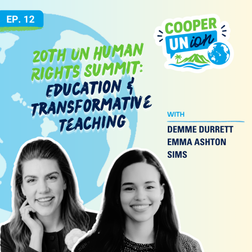
20th UN Human Rights Summit: Education & Transformative Teaching

Fresh from the 20th annual Human Rights Summit, hosted by Timor-Leste at UN headquarters, Demme Durrett, co-director of Youth for Human Rights USA, and Emma Ashton Sims, executive director of United for Human Rights and Youth for Human Rights International, unpack why human rights education drives their work. They discuss Article 29 of the Universal Declaration, the flash mobs and peace walks their global volunteer network uses to make human rights approachable, and the sobering reality that some delegates organize in countries where just saying the words human rights can bring the police. Subscribe and follow to join future conversations with voices from across civil society, academia, diplomacy, social movements, and international institutions. * * * FOLLOW & CONNECT 🌐 Website | 🎧 Spotify | 🍎 Apple Podcasts | ▢️ YouTube | πŸ¦‹ BlueSky | πŸ’Ό LinkedIn | πŸ“Έ Instagram For collaboration, guest suggestions, or media inquiries: joshua@cooperunion.tv * * * SUPPORT Cooper UNion is an independent project. If you would like to support the podcast and help us continue creating accessible global conversations, you can support us through Ko-fi: https://ko-fi.com/cooperunion * * * Music Credits Music provided by: Johnny Helm https://www.johnnyhelm.com/ * * * Disclaimer The views expressed by guests are their own and do not necessarily reflect the views of the hosts or affiliated organizations.
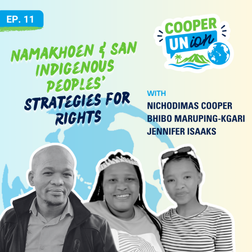
Namakhoen & San Indigenous Peoples' Strategies for Rights

More than a century after the 1904–1908 genocide scattered the Nama people across Namibia and Botswana, their descendants are demanding a seat at the table in the ongoing reparations talks between Namibia and Germany. Nicodemus Cooper of Botswana's Namakhoen Network of Heritage Advocacy, Bhibo Maruping-Kgari of the San community's Indigenous Women's Rights Advocacy, and Jennifer Isaacks of Namibia's Traditional Leaders Association join fresh from the UN Expert Mechanism on the Rights of Indigenous Peoples' 19th session in Geneva to discuss Botswana's new government moving toward ratifying ILO Convention 169, the San people's continued exclusion from Botswana's constitution, and why states must listen to β€” rather than decide for β€” the Indigenous communities on their own land. Subscribe and follow to join future conversations with voices from across civil society, academia, diplomacy, social movements, and international institutions. * * * FOLLOW & CONNECT 🌐 Website | 🎧 Spotify | 🍎 Apple Podcasts | ▢️ YouTube | πŸ¦‹ BlueSky | πŸ’Ό LinkedIn | πŸ“Έ Instagram For collaboration, guest suggestions, or media inquiries: joshua@cooperunion.tv * * * SUPPORT Cooper UNion is an independent project. If you would like to support the podcast and help us continue creating accessible global conversations, you can support us through Ko-fi: https://ko-fi.com/cooperunion * * * Music Credits Music provided by: Johnny Helm https://www.johnnyhelm.com/ * * * Disclaimer The views expressed by guests are their own and do not necessarily reflect the views of the hosts or affiliated organizations.
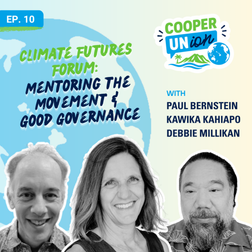
Climate Futures Forum: Mentoring the Movement & Governance

Long before they're old enough to vote, hundreds of young people across Hawaii are drafting testimony, coordinating campaigns, and pushing lawmakers toward climate justice through the Climate Future Forum. Three of the mentors behind that work β€” Kawika Kahiapo, who leads food-systems advocacy connecting food, ʻāina, and policy; Debbie Milliken, Director of Sustainability Programs at Punahou School; and Paul Bernstein, a UH Economic Research Organization researcher and Hawaii coordinator for the Citizens' Climate Lobby β€” reflect on the Forum's first years: what keeps youth coming back, why avoiding tokenism matters, and the bills, from farm-to-school to balcony solar, they hope the 34th legislature finally passes. Subscribe and follow to join future conversations with voices from across civil society, academia, diplomacy, social movements, and international institutions. * * * FOLLOW & CONNECT 🌐 Website | 🎧 Spotify | 🍎 Apple Podcasts | ▢️ YouTube | πŸ¦‹ BlueSky | πŸ’Ό LinkedIn | πŸ“Έ Instagram For collaboration, guest suggestions, or media inquiries: joshua@cooperunion.tv * * * SUPPORT Cooper UNion is an independent project. If you would like to support the podcast and help us continue creating accessible global conversations, you can support us through Ko-fi: https://ko-fi.com/cooperunion * * * Music Credits Music provided by: Johnny Helm https://www.johnnyhelm.com/ * * * Disclaimer The views expressed by guests are their own and do not necessarily reflect the views of the hosts or affiliated organizations.
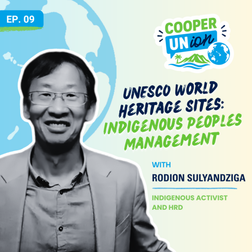
UNESCO World Heritage Sites: Indigenous Peoples Management

For more than three decades, Rodion, an Udege leader from Russian Siberia, has fought to protect his community's ancestral forest from industrial logging. That fight led to a landmark win: UNESCO World Heritage status for the Bikin River Valley, one of the last untouched forests on Earth and home to the Amur tiger. Now director of the Center for Support of Indigenous Peoples of the North (CSIPN) and co-chair of the International Indigenous Peoples Forum on World Heritage, Rodion shares how organizing, science, and diplomacy secured this "Russian Amazon," and why Indigenous peoples must keep pushing for a real seat at the table in global heritage governance. Subscribe and follow to join future conversations with voices from across civil society, academia, diplomacy, social movements, and international institutions. * * * FOLLOW & CONNECT 🌐 Website | 🎧 Spotify | 🍎 Apple Podcasts | ▢️ YouTube | πŸ¦‹ BlueSky | πŸ’Ό LinkedIn | πŸ“Έ Instagram For collaboration, guest suggestions, or media inquiries: joshua@cooperunion.tv * * * SUPPORT Cooper UNion is an independent project. If you would like to support the podcast and help us continue creating accessible global conversations, you can support us through Ko-fi: https://ko-fi.com/cooperunion * * * Music Credits Music provided by: Johnny Helm https://www.johnnyhelm.com/ * * * Disclaimer The views expressed by guests are their own and do not necessarily reflect the views of the hosts or affiliated organizations.
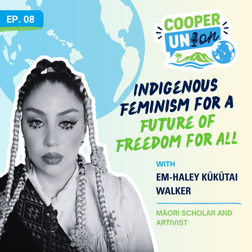
Indigenous Feminism for a Future of Freedom for All

In this episode of Cooper Union, Em Haley, a Māori spoken-word artist, scholar, and human rights advocate from Waikato-Tainui, Aotearoa, discusses the fight to protect Māori language, land, and self-determination under a government rolling back Treaty of Waitangi protections. She reflects on the historic ToitΕ« Te Tiriti march, her interventions at the UN Permanent Forum on Indigenous Issues, and her research into traditional Māori peacebuilding practices led by wāhine, or women. Weaving her great-grandmother's legacy of resistance through song and ceremony, Em shows how storytelling, music, and indigenous feminism carry forward a living fight for justice and cultural survival. Subscribe and follow to join future conversations with voices from across civil society, academia, diplomacy, social movements, and international institutions. * * * FOLLOW & CONNECT 🌐 Website | 🎧 Spotify | 🍎 Apple Podcasts | ▢️ YouTube | πŸ¦‹ BlueSky | πŸ’Ό LinkedIn | πŸ“Έ Instagram For collaboration, guest suggestions, or media inquiries: joshua@cooperunion.tv * * * SUPPORT Cooper UNion is an independent project. If you would like to support the podcast and help us continue creating accessible global conversations, you can support us through Ko-fi: https://ko-fi.com/cooperunion * * * Music Credits Music provided by: Johnny Helm https://www.johnnyhelm.com/ * * * Disclaimer The views expressed by guests are their own and do not necessarily reflect the views of the hosts or affiliated organizations.
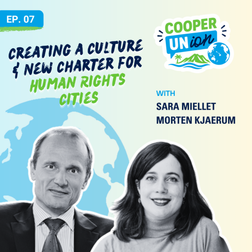
Creating a Culture & New Charter for Human Rights Cities

In this episode of Cooper Union, Sarah, a community organizer and researcher in Utrecht, and Morten, a longtime human rights advocate from Denmark, discuss UCLG's new Global Charter-Agenda for Human Rights in the City, just adopted by 250,000 cities worldwide. They unpack the charter's 37 rights across seven clusters, from essential services and the right to food to digital rights, climate justice, and feminist municipalism. Sarah shares grassroots research from Utrecht, while Morten reflects on decades building the human rights-based approach, from Vienna to Guangzhou to today, arguing that real change starts locally, with everyday people as human rights actors. Subscribe and follow to join future conversations with voices from across civil society, academia, diplomacy, social movements, and international institutions. * * * FOLLOW & CONNECT 🌐 Website | 🎧 Spotify | 🍎 Apple Podcasts | ▢️ YouTube | πŸ¦‹ BlueSky | πŸ’Ό LinkedIn | πŸ“Έ Instagram For collaboration, guest suggestions, or media inquiries: joshua@cooperunion.tv * * * SUPPORT Cooper UNion is an independent project. If you would like to support the podcast and help us continue creating accessible global conversations, you can support us through Ko-fi: https://ko-fi.com/cooperunion * * * Music Credits Music provided by: Johnny Helm https://www.johnnyhelm.com/ * * * Disclaimer The views expressed by guests are their own and do not necessarily reflect the views of the hosts or affiliated organizations.
1 di 2