BSPE Legal Marketing Podcast

BSPE Legal Marketing Podcast

di Viktoria Altman
Stagione 5

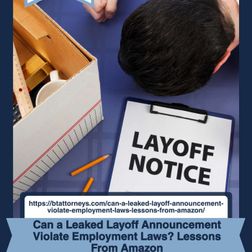
Can a Leaked Layoff Announcement Violate Employment Laws? Lessons From Amazon - BT Law Group, PLLC

From BT Law Group, PLLC - Can a Leaked Layoff Announcement Violate Employment Laws? Lessons From Amazon explains what can happen when layoff news leaks early and employees learn about job cuts through an email or calendar invite rather than an official announcement. Using Amazon’s “Project Dawn” meeting invite incident as the backdrop, Miami employment attorneys Jason D. Berkowitz and Anisley Tarragona discuss why timing, wording, and who receives the message can change the legal and practical stakes for workers. The episode breaks down the Worker Adjustment and Retraining Notification Act (WARN Act), including the 60-day notice requirement for certain plant closings and mass layoffs, and the thresholds that can trigger obligations for employers with 100 or more full-time employees. They cover what WARN notice typically must include, such as the anticipated date of separation, whether the layoff is permanent or temporary, and where employees can go for additional information, then explain why informal or premature disclosure can spark disputes over whether notice requirements were satisfied, especially in large-scale events like the 16,000-person Amazon layoffs described. Next, the conversation focuses on how early knowledge can affect severance, continued health coverage, and compensation tied to being actively employed, including bonuses, equity, and commissions. The attorneys explain why quitting before an official termination date can jeopardize benefits, how fast decisions based on incomplete information can have lasting consequences, and how concerns about retaliation or shifting selection criteria may complicate an already stressful situation. Finally, Berkowitz and Tarragona outline what employees should avoid after a layoff leak, including resigning prematurely, signing documents without fully understanding them, or treating Human Resources as a source of legal advice. Drawing on their experience handling disputes involving the FLSA, FMLA, ADA, Title VII, and the Florida Civil Rights Act, they share practical steps for protecting your rights during a reduction in force and what to consider before signing any separation or severance agreement. BT Law Group, PLLC 3050 Biscayne Blvd STE 205, Miami, FL 33137 (305) 507-8506 https://www.google.com/maps?cid=1652198006057542154
What Happens to My Connecticut Car Accident Case If I'm 51% at Fault Under § 52-572h? - Dan Petroskey

From DeFronzo & Petroskey, P.C. - What Happens to My Connecticut Car Accident Case If I'm 51% at Fault Under § 52-572h? explores how Connecticut General Statutes § 52-572h and the state’s modified comparative negligence rule can completely bar recovery when a driver is found 51% or more at fault. This episode breaks down the critical 50% threshold, explaining why accident victims in Waterbury and throughout New Haven County must fight to keep their assigned fault at or below that line. If you’ve been injured in a crash, understanding how fault allocation affects your compensation is essential under Connecticut law. We walk through how courts and insurance adjusters determine fault in Connecticut car accident cases, including the role of police reports, witness statements, traffic violations, event data recorders, and physical evidence. You’ll hear how cases move through the Waterbury Judicial District at Waterbury Superior Court on Grand Street, and why even a small shift from 50% to 51% fault can mean the difference between partial compensation and zero recovery. The discussion highlights real-world examples—30%, 50%, and 51% fault scenarios—to show how damages are reduced or barred entirely. The episode also examines how insurance adjusters use comparative fault to minimize payouts, especially on busy roadways like I-84 and Route 8. Learn the tactics insurers use to increase your assigned percentage of fault, how shared fault works when multiple drivers contribute to a crash, and what steps you can take to protect your claim under § 52-584’s statute of limitations. We also explain when comparative negligence may not apply, including cases involving reckless conduct, intentional misconduct, or strict liability claims. Finally, Dan Petroskey, Esq., owner of DeFronzo & Petroskey, P.C., shares insight from more than 20 years representing injured clients in car accidents, motorcycle crashes, pedestrian injuries, and premises liability cases across Connecticut and New York. A graduate of Albany Law School and Colby College, and recognized by Super Lawyers and Best Lawyers, Dan Petroskey discusses how his firm helps clients challenge unfair fault assignments and pursue economic and non-economic damages. For those facing disputed liability in Waterbury, Wallingford, or anywhere in New Haven County, this episode clarifies your rights and what’s at stake when fault percentages are on the line. DeFronzo & Petroskey, P.C. 255 Bank St # 2b, Waterbury, CT 06702, United States (203) 756-7408 https://www.google.com/maps?cid=2074756120617399372

When Does the Two-Year Statute of Limitations NOT Apply to Connecticut Car Accident Cases Under § 52-584? - Dan Petroskey

From DeFronzo & Petroskey, P.C. - When Does the Two-Year Statute of Limitations NOT Apply to Connecticut Car Accident Cases Under § 52-584? explains the filing deadlines that can control whether an injured person can pursue compensation after a crash in Connecticut. This episode walks through the standard two-year rule in Connecticut General Statutes § 52-584 and clarifies how the deadline is measured from when an injury is first sustained or discovered. It also highlights the separate three-year statute of repose that can cut off claims even when an injury is found later. You’ll learn how the discovery rule can change when the two-year clock starts for injuries that are not immediately obvious, including internal injuries, soft tissue damage, whiplash, herniated discs, and neurological symptoms tied to traumatic brain injury (TBI). The discussion covers what Connecticut courts look at when deciding whether an injury should have been discovered sooner through reasonable care, and why the discovery rule does not extend the three-year maximum tied to the date of the accident. The episode also breaks down government-related claims, where deadlines can be much shorter than two years. It covers state claims that typically must be presented to the Office of the Claims Commissioner under Conn. Gen. Stat. § 4-148, and explains how permission-to-sue rules under § 4-160 can affect the timeline. For municipal claims, it outlines strict notice requirements that may require written notice within six months, and explains how defective road and highway claims can trigger a 90-day notice period under § 13a-149 and § 13a-144, potentially barring a claim even if a lawsuit is filed within two years. Finally, the show explores tolling and alternate timelines, including fraudulent concealment under § 52-595, where a defendant’s intentional concealment of facts can pause the statute of limitations. It also discusses what happens when a defendant leaves Connecticut under § 52-590, which can pause the clock when the person is unavailable for service of process, up to a seven-year extension. You’ll also hear how wrongful death claims follow different rules under § 52-555, how product liability claims involving defective vehicles or parts operate under § 52-577a, and how Waterbury attorney Dan Petroskey of DeFronzo & Petroskey, P.C. helps clients in Waterbury and New Haven County protect their right to compensation while tracking critical deadlines. DeFronzo & Petroskey, P.C. 255 Bank St # 2b, Waterbury, CT 06702, United States (203) 756-7408 https://www.google.com/maps?cid=2074756120617399372

Bronx Drug Defense Lawyer - David Mejia Colgan

From David Mejia Colgan, Esq. – Bronx Drug Defense Lawyer examines what individuals and families need to know when facing drug charges in the Bronx and throughout New York. This episode explores how drug arrests can threaten your freedom, career, and future, and explains the importance of understanding both prosecution tactics and defense strategies from the very beginning of a case. Drawing on more than 25 years of criminal-law experience, including time as an Assistant District Attorney in the Bronx County District Attorney’s Office, David Mejia Colgan discusses common drug charges such as criminal possession of a controlled substance, intent to sell, criminal sale, and major drug trafficking offenses under New York Penal Law Article 220. The podcast explains how prosecutors rely on factors like drug quantity, substance schedules, packaging, surveillance, and confidential informants, and how these elements influence whether a case is charged as a misdemeanor or a serious felony. The episode also breaks down how New York classifies drug possession offenses from seventh-degree misdemeanors to first-degree Class A-I felonies, including the role of the aggregate weight rule and how laboratory procedures, packaging errors, and scale calibration can affect charges and sentencing exposure. Listeners will learn how search and seizure laws, Fourth Amendment protections, and motions to suppress evidence often play a decisive role in Bronx drug cases. Finally, Bronx Drug Defense Lawyer addresses the real-world consequences of drug convictions, including incarceration, fines, criminal records, employment barriers, housing issues, professional licensing problems, and immigration consequences for non-citizens. David Mejia Colgan, Esq. explains what to do immediately after a drug arrest, how Bronx Criminal Court and Bronx County Supreme Court handle these cases, and why early legal guidance can shape the outcome of a case from arraignment through resolution. David Mejia Colgan, Esq 910 Grand Concourse, Bronx, NY 10451, United States (718) 484-8820 https://www.google.com/maps?cid=10458568621536558650

Nassau County, New York Immigration Lawyer - Rajat Shankar

From Shankar & Associates, PC – Nassau County, New York Immigration Lawyer delivers critical insight into the U.S. immigration process, drawing directly from the firm’s decades of experience helping individuals and families navigate complex legal pathways. In Nassau County, New York Immigration Lawyer, listeners will hear how founding attorneys Srinivas Jayashankar and Rajat Shankar guide clients through every phase of their immigration journey, from employment-based green card strategies to family-based petitions and visa maintenance. With over 45 years of combined experience and a boutique-level approach, the firm ensures that each case receives personal attention and honest, strategic support. Immigration in New York is no small challenge. With over 4.5 million immigrants in the state, and 37 percent of residents in the city and suburbs born abroad, the system is complex and often shifting. In this podcast, the Shankar & Associates, PC team sheds light on key topics such as EB-2 National Interest Waivers, EB-3 visa options for skilled workers, and the all-important priority date and Visa Bulletin tracking process. Listeners will gain a better understanding of how to prepare strong documentation, meet evolving legal criteria, and move forward without unnecessary delays. Whether you’re an entrepreneur seeking an EB-5 investor visa, a researcher applying for EB-1B status, or a professional with extraordinary ability looking into the O-1 or EB-1A categories, this podcast offers clear guidance tailored to your goals. Rajat Shankar’s personal immigration story and his work with clients across Long Island and New York City bring a human lens to the legal framework, while real-world tips help listeners avoid common setbacks. The show also tackles issues like consular processing, source-of-funds documentation, and responding to RFEs or NOIDs under tight deadlines. Every episode is a roadmap, designed to help you take the next step with clarity and confidence. From filing family-based I-130 petitions to managing adjustment of status interviews at 26 Federal Plaza, the attorneys at Shankar & Associates, PC are there to walk beside you. Tune in to understand your options, protect your progress, and build a future in the U.S. with a team that understands both the law and the personal stakes involved. Ready to begin your journey? Call 212‑461‑1467 to schedule a consultation today. Shankar & Associates PC 518 Plainview Rd, Plainview, NY 11803, United States (800) 461-1467 https://www.google.com/maps?cid=12579413868790841333

Arkansas Third-Party Workers' Injury Claims Lawyer - Joseph Gates

From Gates Law Firm PLLC - Arkansas Third-Party Workers' Injury Claims Lawyer explains what happens when you’re hurt on the job in Little Rock, AR, but the real blame sits with someone outside your employer—like an equipment manufacturer, a negligent driver, a property owner, or a contractor. Joseph Gates breaks down why workers’ compensation can cover medical bills and partial wage loss, yet leave out the damages that often matter most: pain and suffering, full lost income, and reduced future earning capacity. In this episode, we dig into what a third-party workplace injury claim actually is in Arkansas—and why Arkansas Code § 11-9-105 typically blocks lawsuits against your employer while still allowing claims against outside parties. You’ll hear how these cases can run on separate tracks: benefits through the Arkansas Workers’ Compensation Commission alongside a personal injury lawsuit that may move through Pulaski County Circuit Court (or even federal court), depending on the defendants and circumstances. We also walk through the most common real-world scenarios: defective forklifts, failed safety guards on industrial tools, crane design flaws tied to out-of-state manufacturers (and how AR Code § 16-4-101 can still bring them into Arkansas courts), work-day vehicle crashes on roads like Cantrell Road and near Shackleford Road, and multi-party construction site hazards involving general contractors and subcontractors. Plus: what full damages can include—future medical costs, complete wage loss, loss of enjoyment of life, emotional distress, disfigurement, and in rare situations, punitive damages. Finally, the conversation tackles one of the most misunderstood issues in these claims: subrogation and workers’ comp liens under Arkansas Code § 11-9-410, and what that can mean for your net recovery after attorney fees and costs. We cover deadlines like the three-year personal injury window under Arkansas Code § 16-56-105, why early evidence matters, and how Gates Law Firm PLLC serves communities across Little Rock, North Little Rock, Sherwood, Jacksonville, Maumelle, Conway, Benton, and Bryant, and throughout Pulaski County, Faulkner County, Saline County, Lonoke County, and Grant County. For a free consultation, call (501) 779-8091—and remember: you pay nothing unless compensation is recovered. Gates Law Firm PLLC 2725 Cantrell Rd Ste 200 Little Rock, AR 72202, United States (501) 779-8091 https://www.google.com/maps?cid=4114337096292287489

Syracuse Elder Law Attorney - Davies Law Firm

From Davies Law Firm – Syracuse Elder Law Attorney explains how elder law addresses the legal, financial, and healthcare challenges facing seniors and their families in Central New York. This podcast episode explores long-term care planning, Medicaid eligibility in New York, guardianship, estate planning, and protecting legal rights while aging, with a focus on families in Syracuse and Onondaga County. Drawing on decades of experience, the discussion highlights how Frederick P. Davies and William P. Davies have guided Central New York families through Medicaid planning, asset preservation, and elder law matters. The episode covers working with the Onondaga County Department of Social Services, understanding the local Medicaid application process, and avoiding unnecessary spend-down of life savings while qualifying for nursing home and assisted living benefits. Listeners will learn what an elder law attorney does, when to create powers of attorney and healthcare directives under New York law, and how guardianship proceedings work when incapacity arises. The podcast also explains key topics such as the five-year Medicaid look-back period, countable versus exempt assets, spousal impoverishment protections, Medicaid-compliant annuities, pooled income trusts, caregiver agreements, veterans’ Aid and Attendance benefits, and recognizing and addressing elder abuse. The episode concludes with an overview of special needs trusts, Medicaid applications in Syracuse, and practical steps families can take before a crisis occurs. Featuring insights from Davies Law Firm, this podcast is designed for individuals planning for aging parents or their own future care who want clear guidance on elder law, Medicaid planning, and long-term care options in Onondaga County and throughout Central New York. Davies Law Firm 210 E Fayette St, Syracuse, NY 13202, United States (315) 472-6511 https://www.google.com/maps?cid=11885144913064493862

Bronx Criminal Defense Attorney - David Mejia Colgan

From David M. Colgan, Esq. – Bronx Criminal Defense Attorney explores how decades of prosecutorial insight and dedicated legal representation can protect your future in the face of serious criminal charges. This episode highlights the core message behind Experienced Bronx Criminal Defense Attorney | David M. Colgan, Esq. and dives into how one attorney’s unwavering commitment to advocacy sets him apart in New York’s legal landscape. As a former Bronx Assistant District Attorney, David M. Colgan, Esq. brings over 30 years of courtroom experience to the table. From handling complex cases involving assault, robbery, sex crimes, and homicide to defending clients facing DWI, drug possession, and domestic violence charges, David’s approach is deeply rooted in strategy, honesty, and a relentless pursuit of justice. He doesn’t delegate your defense—he personally manages every stage of your case, from arraignment to trial. Fluent in both English and Spanish, he ensures his clients feel heard, informed, and empowered. Listeners will hear how David’s Bronx roots and prior work as a prosecutor give him a unique edge in the courtroom. Whether it's fighting charges involving weapons possession, grand larceny, or conspiracy, David uses his insider knowledge to dismantle weak prosecution arguments and expose flawed evidence. His dedication extends beyond criminal law—he also represents clients in family and matrimonial cases involving custody, visitation, and divorce, always with the same no-nonsense, compassionate approach. This episode is essential for anyone facing the weight of the criminal justice system or wanting to understand what real, hands-on advocacy looks like. From challenging unconstitutional searches to defending against sentencing enhancements, David M. Colgan, Esq. shows what it means to fight for clients—not just with skill, but with purpose. If you or someone you know has been charged in The Bronx or beyond, tune in to learn why starting with the right defense can make all the difference. David Mejia Colgan, Esq. 910 Grand Concourse, Bronx, NY 10451, United States (718) 484-8820 https://www.google.com/maps?cid=10458568621536558650

What is NJ 2C:58-15 / 2C:58-16 - Minor-Access and Safe-Storage Firearm Statutes? - Adam M. Lustberg

From Lustberg Law Offices, LLC – What is NJ 2C:58-15 / 2C:58-16 - Minor-Access and Safe-Storage Firearm Statutes? explains New Jersey’s strict firearm safe-storage and minor-access laws and how they apply when a child gains access to a loaded gun. This episode walks through N.J.S.A. 2C:58-15 and N.J.S.A. 2C:58-16, outlining why New Jersey treats firearm storage and child safety seriously and how these statutes are enforced in real investigations. Listeners will learn what NJ 2C:58-15 prohibits, including how an adult can face a disorderly persons offense if a minor under 16 gains access to a loaded firearm at premises under their control. The discussion focuses on the “knew or reasonably should have known” standard, how prosecutors analyze access and control, and why a lack of intent does not prevent charges. The episode also explains what qualifies as proper storage, including locked boxes or containers, trigger locks, and locations a reasonable person would believe to be secure. The podcast also covers penalties and collateral consequences for violating 2C:58-15, such as potential jail time, fines, and background check issues that can affect employment, licensing, and education. Common enforcement scenarios are discussed, including accidental discharges, school-related incidents, and home investigations, as well as how cases are handled in municipal court or in Bergen County Superior Court in Hackensack. Finally, the episode breaks down the firearm dealer warning requirements under N.J.S.A. 2C:58-16, including written warnings and posted signage, along with the limited exceptions tied to lawful minor firearm use under 2C:58-6.1 and unlawful entry situations. Featuring insights from Adam M. Lustberg of Lustberg Law Offices, LLC, this episode explains what to do if you are questioned, investigated, or charged under New Jersey’s minor-access and safe-storage firearm statutes, and why early legal guidance can make a critical difference. Lustberg Law Offices, LLC 1 University Plaza Dr #212, Hackensack, NJ 07601, United States (201) 880-5311 https://www.google.com/maps?cid=17248268094099978177

Chicago Divorce Attorney - Caesar & Bender, LLP

From Caesar & Bender, LLP – Chicago Divorce Attorney walks listeners through the realities of divorce in Chicago and throughout Cook County, addressing the uncertainty, stress, and life-changing decisions that come with ending a marriage. This episode draws directly from the firm’s in-depth guide to help individuals understand what to expect under Illinois law, from filing requirements to final judgment, while highlighting how local courts handle divorce, parenting issues, and financial disputes. The discussion features Molly Caesar and Michael Ian Bender, founders of Caesar & Bender, LLP, who bring nearly 50 years of combined experience in Illinois family law. The podcast explores key topics such as irreconcilable differences under the Illinois Marriage and Dissolution of Marriage Act, residency requirements, and the difference between contested and uncontested divorce cases in Cook County. Listeners gain clarity on timelines, including why uncontested divorces may resolve in 60 to 90 days while contested cases can take a year or more. This episode also breaks down how Illinois courts approach equitable distribution of marital property and debts under 750 ILCS 5/503, what qualifies as marital versus non-marital property, and how commingling can affect asset division. The conversation covers spousal maintenance under 750 ILCS 5/504, including how maintenance is calculated, how long it may last based on the length of the marriage, and when maintenance can be modified or terminated. Finally, Chicago Divorce Attorney examines child-related issues, including the allocation of parental responsibilities and parenting time under 750 ILCS 5/602.5 and 750 ILCS 5/602.7, as well as child support calculations using Illinois’ income shares model. The episode also touches on mediation, high-net-worth divorce concerns, post-decree modifications, and enforcement options. Throughout the podcast, Caesar & Bender, LLP provides practical insight for those navigating divorce in Chicago, helping listeners better understand their rights, responsibilities, and options as they plan their next steps. Caesar & Bender, LLP 150 N Michigan Ave #2130, Chicago, IL 60601 (312) 236-1500 https://www.google.com/maps?cid=10482794179944044586
46 di 178