Breaking News To Trading Moves

Breaking News To Trading Moves

di Shirish Agarwal
Stagione 1
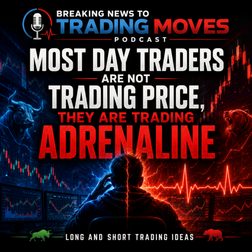
Most day traders are not trading price, they are trading adrenaline
Day trading is usually described as a technical game of charts, entries, levels and momentum. Yet for many traders, the real force behind their decisions is not price action. It is adrenaline. A fast candle, sudden breakout or rapidly changing profit can create a powerful rush. Once traders become attached to that feeling, they stop calmly reading the market and start using trades to create excitement. The goal changes from executing a good setup to feeling something intense. A disciplined trader waits when the market is quiet. An adrenaline-driven trader enters weak setups, increases size or chases a move that has already happened. When excitement replaces analysis Adrenaline changes how risk is perceived. A controlled trade may feel too slow, while an oversized position feels important. A patient setup may be ignored for a volatile stock moving quickly. Excitement and profitability are not the same. The trades that feel most thrilling often have the weakest risk-to-reward. Buying after a vertical move or entering a breakout without confirmation can create stimulation, but rarely consistency. Signs you may be trading adrenaline • You feel frustrated when there are no trades. • You enter because the market feels active. • You increase size after a win. • You revenge trade after a loss. • You abandon your plan when volatility rises. • You feel bored by controlled gains. • You judge the session by how exciting it felt. Why adrenaline damages decisions Adrenaline narrows attention. Traders focus on immediate movement and ignore higher-timeframe levels, volume, market conditions, risk limits and planned exits. It also creates urgency. The trader believes they must act now or miss the opportunity. This leads to late entries, poor sizing and impulsive decisions. A win creates a desire for another rush. A loss creates a desire to recover quickly. Both can push the trader into another position before they have reset. The market rewards process, not intensity A professional process may feel repetitive. The setup appears, risk is defined, the trade is taken and the result is accepted. It may not be exciting, but it is sustainable. Overtrading increases costs, mistakes and exposure to weak setups. Planned trades soon become mixed with emotional ones. How to reduce adrenaline-driven trading • Define valid setups before the session. • Set a maximum number of daily trades. • Use fixed risk on every position. • Never increase size because you feel confident. • Take a break after a large win or loss. • Record the emotional reason behind each entry. • Stop when urgency or excitement takes control. • Review whether every trade followed the plan. Boredom can be a trading advantage Good trading is often boring. Waiting for confirmation, using the same risk, skipping poor setups and following a stop are not exciting. But boring trading protects capital. The objective is to make repeatable decisions under uncertainty. Traders who tolerate boredom are less likely to chase moves, revenge trade or manufacture opportunities. #DayTrading #TradingPsychology #StockMarket #Trading #Investing #RiskManagement #TraderMindset #Overtrading #PriceAction #TradingDiscipline #EmotionalTrading #SwingTrading
Super Micro books $60 billion in orders as margins surge
Super Micro Computer said it received more than $60 billion in new orders during its fiscal fourth quarter, taking its backlog to a record level. It now expects gross margins of 15% to 17%, well above its previous forecast of 8.2% to 8.4%. Revenue is still expected near the lower end of its $11 billion to $12.5 billion guidance range. The update confirms strong AI infrastructure demand, but investors need evidence that the backlog can become deliveries, revenue and cash flow. Why This Matters Super Micro sits at the centre of the AI server buildout. Its systems combine GPUs, networking, power management and liquid cooling. The order total suggests cloud providers and AI operators are still spending aggressively. Winners AI server platforms Names: $SMCI (Super Micro Computer), $DELL (Dell Technologies), $HPE (Hewlett Packard Enterprise) Super Micro is the clearest winner because the higher margin forecast addresses fears that rapid growth was producing weak profitability. Dell and HPE may benefit from stronger AI server demand. Their upside could be smaller if Super Micro is taking market share through faster delivery and custom configurations. GPU and accelerator suppliers Names: $NVDA (Nvidia), $AMD (Advanced Micro Devices) Large AI deployments require advanced processors, so Super Micro’s backlog supports demand expectations for Nvidia and AMD. Nvidia has the strongest read-through because its GPUs power many leading AI systems. AMD may benefit as customers seek alternative accelerators and more supply. Networking, power and cooling Names: $ANET (Arista Networks), $AVGO (Broadcom), $VRT (Vertiv), $ETN (Eaton) AI clusters require fast networking, reliable power and advanced cooling. Arista and Broadcom are exposed to connectivity, while Vertiv and Eaton may benefit from the electrical and thermal needs of dense computing facilities. Losers Server rivals facing market-share pressure Names: $DELL (Dell Technologies), $HPE (Hewlett Packard Enterprise) Dell and HPE become relative losers if Super Micro captures more large AI projects. Traders should compare their orders, margins and delivery timelines with Super Micro. Strong sector demand may not be enough if customers prefer Super Micro’s speed and customisation. Hyperscalers facing heavier spending Names: $MSFT (Microsoft), $AMZN (Amazon), $GOOGL (Alphabet), $META (Meta Platforms) The backlog suggests major cloud companies may commit huge sums to AI infrastructure. That supports future capacity, but may pressure free cash flow if AI revenue does not grow quickly enough. These stocks can struggle when investors demand clearer returns on capital spending. Financing-sensitive AI operators Names: $CRWV (CoreWeave), $NBIS (Nebius Group), $IREN (IREN) Smaller AI infrastructure operators may benefit from strong demand, but expansion requires heavy upfront spending on chips, facilities, power and cooling. Higher equipment costs, delays or new financing needs could hurt these companies more than cash-rich technology giants. The Trading Setup The bullish setup is strongest if $SMCI holds its post-announcement gap on high volume. Momentum could spread into $NVDA, $AMD, $ANET and $VRT as traders position for continued AI demand. The bearish setup appears if $SMCI gives back the gap and attention returns to low-end revenue guidance, financing requirements or order quality. Some orders may still be delayed or cancelled, and the figures remain preliminary ahead of full results on 11 August 2026. #StockMarket #Trading #Investing #DayTrading #SwingTrading #SuperMicro #SMCI #AIStocks #DataCenters #Semiconductors #Nvidia #AMD #TechStocks #Earnings #MarketNews
Why chasing the opening move is usually a beginner’s tax
The opening bell creates urgency. Prices jump, volume surges, headlines hit the screen, and traders feel they must act immediately or miss the move. Chasing the open often means paying the worst price, accepting wider spreads and entering before the market has revealed whether the move is genuine or simply a trap for late buyers and sellers. Why the open feels irresistible The open compresses overnight news, earnings reactions, analyst changes, economic data and institutional orders into a short period. A stock that gaps higher can look unstoppable, while one breaking lower can appear destined to collapse. But the first move is not always the start of a trend. It may be price discovery, forced covering, emotional order flow or a temporary imbalance. Traders buying after a large spike may be purchasing from professionals who entered earlier and are now taking profits. Traders shorting after a sharp drop may be selling just as stronger buyers step in. The hidden costs of chasing Chasing creates several disadvantages at once: • You enter far from a logical stop. • Spreads and slippage are often worse. • Risk increases while potential reward shrinks. • Decisions become driven by fear of missing out. • A normal pullback feels dangerous because the entry was poor. • Movement is mistaken for confirmation. This is why chasing can be called a beginner’s tax. The market charges inexperienced traders for impatience and the belief that every fast move must be traded. A correct idea can still become a bad trade A stock can continue higher all day and still punish someone who chased the opening surge. Direction alone does not make an entry good. A trader buying after a vertical candle may need a wide stop below the opening range. If the stock pulls back before continuing, that trader may be stopped out and then watch the original idea work without them. The same applies on the short side. A weak stock may eventually fall, but shorting after an opening flush can expose the trader to a violent bounce and poor risk-to-reward. Good trading means entering where the downside is controlled and the upside justifies the risk. What disciplined traders wait for Experienced traders often let the opening range develop. They watch price around pre-market highs, previous-day levels, volume-weighted average price and clear support or resistance. They may wait for: • A pullback that holds above a breakout level. • A failed spike that confirms sellers are taking control. • A retest of the opening range with calmer price action. • Volume to confirm continuation rather than exhaustion. • A clear stop level that keeps position size reasonable. Waiting does not guarantee success, but it improves the information available before capital is committed. A better opening routine Before the bell, identify key levels and decide what would confirm or invalidate the setup. During the first minutes, observe rather than react. Let other traders fight over the first price. If the stock later offers a clean entry, take it with a defined stop. If it never provides reasonable risk-to-reward, let it go. Missing a move costs nothing. Chasing one can cost money, confidence and discipline. #StockMarket #Trading #Investing #DayTrading #SwingTrading #TradingPsychology #RiskManagement #MomentumTrading #FOMO #PriceAction #TradingDiscipline #OpeningBell #MarketOpen #TraderMindset
Farnborough Airshow: Aerospace Demand and Execution Strategies
Farnborough International Airshow opened with investors watching two major themes: commercial aircraft demand and accelerating global defence spending. Aircraft manufacturers and defence contractors are highlighting opportunities, but traders are focused on whether companies can convert demand into revenue growth. Boeing and Airbus are expected to compete for aircraft orders, but production constraints remain a major issue. Shortages of engines, components and manufacturing capacity continue to limit how quickly new aircraft can be delivered. Order announcements matter, but execution and cash flow will determine which stocks benefit most. Why this matters The airshow comes during elevated geopolitical uncertainty. Defence companies are seeing demand for missile systems, drones and autonomous technology, while aerospace firms must manage supply-chain challenges. Winners Commercial aerospace manufacturers and suppliers $BA (Boeing), $GE (GE Aerospace) and $RTX (RTX) could benefit from stronger aircraft demand. Boeing may gain from additional aircraft orders, while GE Aerospace and RTX benefit from engines, aerospace systems and long-term maintenance contracts. Investors will watch whether these companies can improve deliveries and convert backlogs into revenue. Names: $BA (Boeing), $GE (GE Aerospace) and $RTX (RTX) Defence contractors and military technology $LMT (Lockheed Martin), $NOC (Northrop Grumman) and $GD (General Dynamics) may benefit from higher defence budgets and increased demand for military equipment. These companies provide fighter aircraft, naval systems, missiles and advanced defence platforms. New contracts could create growth opportunities. Names: $LMT (Lockheed Martin), $NOC (Northrop Grumman) and $GD (General Dynamics) Drone and autonomous systems companies $AVAV (AeroVironment), $KTOS (Kratos Defense & Security Solutions) and $LHX (L3Harris Technologies) could benefit from growing demand for drones, battlefield communication systems and autonomous technology. Modern conflicts have increased the importance of unmanned systems. Names: $AVAV (AeroVironment), $KTOS (Kratos Defense & Security Solutions) and $LHX (L3Harris Technologies) Losers Airlines facing aircraft delivery delays $LUV (Southwest Airlines), $ALK (Alaska Air Group) and $AAL (American Airlines Group) could face pressure if aircraft manufacturers continue struggling with deliveries. Delays can restrict fleet growth, increase maintenance expenses and reduce efficiency. Airlines depend on reliable deliveries to modernise fleets. Names: $LUV (Southwest Airlines), $ALK (Alaska Air Group) and $AAL (American Airlines Group) Low-cost carriers facing fleet pressure $JBLU (JetBlue Airways), $ULCC (Frontier Group Holdings) and $SAVE (Spirit Airlines) may remain vulnerable to higher aircraft costs and limited fleet availability. Smaller carriers are more sensitive to delays and rising expenses. Names: $JBLU (JetBlue Airways), $ULCC (Frontier Group Holdings) and $SAVE (Spirit Airlines) Aerospace suppliers if expectations become too high $HWM (Howmet Aerospace), $SPR (Spirit AeroSystems Holdings) and $BA (Boeing) could see short-term selling pressure if order announcements disappoint investors or supply-chain problems continue. Aerospace remains growth market, but stocks can become volatile when expectations are high. Names: $HWM (Howmet Aerospace), $SPR (Spirit AeroSystems Holdings) and $BA (Boeing)
The best trade of the day may be no trade
Trading can create the feeling that every market session should produce an opportunity. Screens are open, prices are moving, news is breaking and traders feel pressure to act. But activity is not the same as progress. Some days offer clean setups and clear risk levels. Other days are noisy, directionless and full of false signals. On those days, the smartest decision may be to stay out. Why traders feel forced to participate Many traders believe sitting on the sidelines means missing out. This pressure can lead to rushed entries, poor timing and trades that were never part of the plan. The market does not reward screen time or the number of orders placed. It rewards good decisions. A trader who takes no position on a bad day may protect more capital than someone who enters several low-quality setups. No trade is still a decision Choosing not to trade is not laziness. It is an active risk-management decision. You are assessing the market and deciding that current conditions do not offer enough potential reward for the risk involved. A no-trade day may be appropriate when: • The market has no clear direction. • Volatility is too low or too high. • The setup does not match your strategy. • The entry is too late after a large move. • The stop-loss would be too wide. • Major news could create unpredictable price action. • You are tired, distracted or emotional. The hidden cost of forcing a trade A forced trade can do more than create a financial loss. It can damage confidence, weaken discipline and encourage revenge trading. One poor entry may lead to another as the trader tries to recover quickly. Repeated weak trades can slowly reduce an account. The deeper problem is building the habit of trading without a genuine edge. Quality matters more than frequency Professional trading is not about being active every hour. It is about waiting for the market to match a tested process. Before entering, ask: • Is the market structure clear? • Is there a defined catalyst? • Does the setup fit my strategy? • Can I define an entry, stop and target? • Is the potential reward worth the risk? • Am I entering because of evidence or boredom? If the answers are weak, the trade is probably weak too. Cash is a valid position Holding cash preserves flexibility. It allows you to return tomorrow with full buying power and the ability to act when a better opportunity appears. You do not lose money by missing a random move that did not fit your plan. You lose money when you abandon your process to chase it. Trading becomes easier when you stop treating every move as your only chance. Use no-trade days productively A day without a position does not have to be wasted. You can review charts, study previous trades, update watchlists or examine how the market reacted to news. Useful tasks include: • Reviewing winning and losing trades. • Identifying repeated execution mistakes. • Marking key support and resistance levels. • Studying sectors showing relative strength or weakness. • Preparing scenarios for the next session. This work may create more long-term value than entering a trade simply to feel productive. #StockMarket #Trading #Investing #DayTrading #SwingTrading #TradingPsychology #RiskManagement #TradingDiscipline #Overtrading #TraderMindset #CapitalProtection #TechnicalAnalysis #MarketVolatility #TradingStrategy #NoTrade
The Ripple Effect of Shifting Medical Procedure Demand
Intuitive Surgical has become the centre of a healthcare demand debate after its shares fell sharply following its latest results. The company reported slower growth in US robot-assisted procedures and warned that insurance coverage, premiums and patient affordability could influence treatment timing. Many procedures performed with Intuitive Surgical’s da Vinci systems are not emergencies. Patients may postpone them when deductibles rise, slowing procedure growth, recurring instrument sales and servicing revenue. Winners Managed-care insurers Names: $UNH (UnitedHealth Group), $CI (The Cigna Group), $HUM (Humana) Why they may win: If patients delay expensive surgeries, insurers may pay fewer claims. Lower medical utilisation can improve medical cost ratios and support profitability. Lower enrolment or policy changes could offset this benefit, so these are possible relative winners rather than guaranteed beneficiaries. Chronic-care medical devices Names: $ABT (Abbott Laboratories), $DXCM (DexCom), $PODD (Insulet) Why they may win: These companies sell products used continuously to manage chronic conditions rather than products dependent on elective hospital procedures. Patients cannot easily postpone glucose monitoring or insulin delivery in the same way they might delay an operation, which could make these stocks more resilient. Defensive pharmaceutical companies Names: $LLY (Eli Lilly), $MRK (Merck), $ABBV (AbbVie) Why they may win: These companies generate most of their revenue from medicines rather than surgical procedures. Their earnings still face competition, patent risks and pricing pressure, but they are less directly tied to elective surgery volumes. Losers Surgical robotics and capital equipment Names: $ISRG (Intuitive Surgical), $SYK (Stryker) Why they may lose: Intuitive Surgical depends heavily on procedure growth. Fewer operations mean weaker demand for instruments, accessories and services used with each da Vinci procedure. Hospitals may also delay buying new systems if demand becomes less predictable. Stryker could face similar pressure through its Mako robotic platform and orthopaedic products. Elective procedure medical devices Names: $BSX (Boston Scientific), $MDT (Medtronic), $ZBH (Zimmer Biomet) Why they may lose: These companies sell products used in cardiovascular, orthopaedic and surgical procedures. Some treatments can be postponed from one quarter to another. Zimmer Biomet may be particularly sensitive because joint replacements are scheduled in advance, while softer hospital volumes could also affect Boston Scientific and Medtronic. Hospital operators Names: $HCA (HCA Healthcare), $THC (Tenet Healthcare), $UHS (Universal Health Services) Why they may lose: Hospitals could face lower elective surgery volumes while also seeing more uninsured or underinsured patients. That can reduce profitable procedures, weaken the payer mix and increase unpaid medical bills. Their earnings will help show whether the weakness is company-specific or part of a broader trend. What traders should watch Upcoming earnings across medical devices, hospitals and insurers will be crucial. Traders should listen for comments about elective procedures, hospital spending, deductibles, uninsured patients and medical utilisation. If more companies report the same pattern, this could become a healthcare-sector theme. If procedure volumes recover quickly, the sell-off in Intuitive Surgical and related names may prove excessive. #StockMarket #Trading #Investing #DayTrading #SwingTrading #HealthcareStocks #MedTech #MedicalDevices #Earnings #IntuitiveSurgical #SurgicalRobotics #HospitalStocks #HealthInsurance
Intraday noise can make good traders look stupid
A good trading decision can look completely wrong for several hours before the market proves it right. Intraday price action is full of false breaks, sharp reversals, algorithmic moves, headline reactions and emotional order flow. None of these automatically mean your analysis was poor. Many traders judge themselves by what happens immediately after entry. If price moves against them, they assume they made a mistake. If it moves in their favour, they assume they were right. But short-term movement is not always evidence. Sometimes it is simply volatility doing what volatility does. Why Good Trades Often Look Bad First A high-quality setup can still experience: • A sharp move against the position before reversing • A false breakout that triggers obvious stops A liquidity sweep above or below a key level • A temporary reaction to news or sentiment • A slow period before momentum arrives • A gap between the thesis and the market’s timing Judging a trade too early is dangerous. The market does not have to validate your idea immediately. Price may test your stop placement and patience before the trade develops. Noise Is Not New Information Noise is movement that does not materially change the setup. New information is something that genuinely weakens or invalidates the thesis. Traders who cannot tell the difference may exit strong positions too early, move stops impulsively or reverse at the worst moment. Before reacting, ask: • Has the technical structure actually broken? • Has the catalyst changed? • Has the company or sector received meaningful news? • Has the expected time horizon expired? • Has the original risk level been reached? • Or am I simply uncomfortable because price is moving against me? Discomfort is not always a signal. Sometimes it is only the emotional cost of holding through normal volatility. Good Trading Is About Process Professional trading is not about looking right every minute. It is about repeatable decisions based on defined risk. A good trade can lose, while a bad trade can win. One outcome does not prove the quality of the process. A strong process includes: • A clear reason for entering • A defined invalidation level • A position size that allows normal volatility • A realistic time horizon • A plan for taking profits • A willingness to accept uncertainty With these elements in place, intraday fluctuations become easier to tolerate. You stop treating every candle as a verdict on your ability. Match the Trade to the Timeframe A swing trade should not be managed like a scalp. A multi-day idea should not be abandoned because of one weak 15-minute candle. A reversal may look dramatic on a 5-minute chart but remain irrelevant on the daily chart. Return to the timeframe that produced the idea. Do not let a short-term emotional response overrule a longer-term plan without genuine evidence. Patience Is Not Blind Hope Patience does not mean holding forever or refusing to admit you are wrong. It means allowing the trade enough space and time to work while respecting the original invalidation point. Blind hope says, “It will come back.” Disciplined patience says, “The thesis remains valid, the risk is defined and the market has not reached the level that proves me wrong.” #StockMarket #Trading #Investing #DayTrading #SwingTrading #TradingPsychology #RiskManagement #PriceAction #MarketNoise #TradingDiscipline #TraderMindset #Patience
Abbott’s Resilient Medical Device Growth and Market Impact
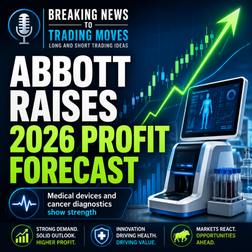
Abbott Laboratories delivered a stronger-than-expected second quarter and raised its full-year profit outlook. Revenue reached $12.59 billion, adjusted earnings were $1.31 per share, and the company increased its 2026 adjusted EPS forecast to $5.45-$5.60 from $5.38-$5.58. $ABT rose around 12% as investors focused on resilient demand for cardiovascular devices, diabetes technology and cancer screening. Medical-device sales increased 9% to $5.85 billion, while diagnostics revenue reached $3.09 billion. The reported diagnostics increase included the Exact Sciences acquisition, while Cologuard generated mid-teens growth from new and repeat users. Winners Diversified medical-device companies Names: $ABT (Abbott Laboratories), $BSX (Boston Scientific), $SYK (Stryker), $MDT (Medtronic) Abbott is the direct winner because stronger results and higher guidance challenge fears that device demand is weakening. Boston Scientific, Stryker and Medtronic also gained after the update. These companies sell products used in cardiovascular treatment, surgery and chronic care. Resilient procedure demand could lift earnings expectations and medtech valuations. Diabetes and chronic-care technology Names: $PODD (Insulet), $TNDM (Tandem Diabetes Care), $EW (Edwards Lifesciences) Abbott said patients with diabetes, cardiovascular disease and cancer are less likely to postpone treatment. That supports Insulet and Tandem Diabetes Care, which sell insulin-delivery systems, and Edwards Lifesciences, which is exposed to structural-heart procedures. These businesses depend on recurring medical need rather than discretionary spending. Procedure-dependent surgical technology Names: $ISRG (Intuitive Surgical), $JNJ (Johnson and Johnson), $ZBH (Zimmer Biomet) Intuitive Surgical, Johnson and Johnson and Zimmer Biomet could benefit if Abbott improves procedure-related sentiment. Abbott’s cardiovascular growth suggests essential and semi-elective treatments may hold up better, supporting surgical robots, implants and hospital equipment. Losers Managed-care insurers Names: $UNH (UnitedHealth Group), $HUM (Humana), $ELV (Elevance Health), $CVS (CVS Health) Stronger procedure demand is not positive for every healthcare company. UnitedHealth, Humana, Elevance Health and CVS Health can face higher claims when patients continue using hospitals, diagnostics and specialist treatments. Resilient treatment volumes can pressure insurers’ medical-cost ratios. Continuous glucose-monitoring competitors Names: $DXCM (DexCom), $SENS (Senseonics Holdings) DexCom and Senseonics face greater competition as Abbott expands Libre technology, distribution and its product range. Abbott’s scale could create pricing pressure, raise customer-acquisition costs and make health-plan coverage harder to secure. Cancer-screening challengers Names: $GH (Guardant Health), $GRAL (GRAIL) Guardant Health and GRAIL may face a stronger competitor as Abbott builds a broader cancer-diagnostics platform around Cologuard. Abbott’s resources may make adoption, reimbursement and investor attention harder for smaller companies. #StockMarket #Trading #Investing #DayTrading #SwingTrading #Abbott #ABT #HealthcareStocks #MedTech #MedicalDevices #Diagnostics #CancerScreening #DiabetesTechnology #Earnings #HealthcareInvesting #LongIdeas #ShortIdeas #MarketNews
Why holding overnight is not as risky as traders think
Many traders believe every position must be closed before the session ends because holding overnight automatically creates unacceptable risk. The fear usually comes from price gaps, unexpected headlines, earnings surprises or changes in global markets while the trader is asleep. Those risks are real, but the conclusion is often exaggerated. Holding overnight is not automatically reckless. What matters is position size, setup quality, liquidity, event awareness and preparation for an adverse move. Overnight risk is easier to see An overnight gap is obvious because the market may open away from the previous close. Intraday risk feels less dramatic, although sudden reversals and breaking news can strike at any time. Closing everything before the bell may avoid some gap risk, but it can create other problems: • Taking weaker trades because of pressure to make money quickly • Overtrading because every position must work within a few hours • Using tight stops that are hit by normal market noise • Missing trends that need several sessions to develop Risk does not disappear when a position is closed before the market shuts. It simply changes form. Time can improve a good setup Strong trades do not always move immediately. A breakout may need time to attract volume. A trend may pause before continuing. Forcing every idea into a single day can lead to premature exits. Holding overnight can provide exposure to multi-day momentum, breakout continuation, sector rotation, post-earnings drift and wider market trends. The advantage is giving a well-researched setup enough time while keeping risk controlled. Position size matters more than the clock A large overnight position can be dangerous. A smaller position may be manageable. Traders often focus too much on the holding period and not enough on exposure. Before holding overnight, ask: • How much could the stock realistically gap against me? • Is earnings, economic data or company news due? • Is the stock liquid enough to exit without excessive slippage? • Is my position small enough to survive an abnormal move? • Would a gap damage my account or create only a planned loss? When the size is appropriate, an overnight move does not have to threaten the account. The position should already allow for a different opening price. Not every trade belongs overnight Earnings, regulatory decisions, court rulings, clinical trial results or major economic announcements can create unusually high uncertainty. Thinly traded stocks may also gap sharply because liquidity is limited. Avoid holding when: • The original reason for entering is no longer valid • A major binary event is approaching • The position is too large for the possible gap • Liquidity is poor • The trade has become a hope-based rescue attempt The decision should come from the setup, not hope or emotional attachment. The real skill is planned exposure Risk management is not about eliminating uncertainty. It is about choosing acceptable risks and limiting the damage when the market behaves unexpectedly. Holding overnight can reduce screen time, lower the urge to overtrade and allow stronger trends to develop. The goal is not unlimited overnight exposure. It is to stop treating every overnight position as automatically irresponsible. A carefully selected trade, held at the correct size, with no major event risk and a clear exit plan, may be less dangerous than several rushed intraday trades. #StockMarket #Trading #Investing #DayTrading #SwingTrading #OvernightTrading #TradingPsychology #RiskManagement #PositionSizing #TradingDiscipline #GapRisk #TradingStrategy
The BlackRock Hegemony and the Asset Management Divide
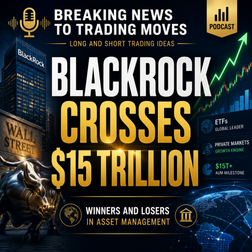
BlackRock reported adjusted earnings of $13.91 per share, while assets under management reached a record $15.34 trillion. Clients added $192 billion of net new money, with strong demand across iShares ETFs, bonds, private credit and infrastructure. Its operating margin rose to 45.9%, and management increased planned 2026 share repurchases to $2 billion. The results show that BlackRock is benefiting from rising markets, ETF adoption and demand for private assets. Why the story matters Its growth shows that investors are still allocating money across public and private markets, although smaller managers may struggle as more capital flows towards global platforms. Winners Large diversified asset managers Names: $BLK (BlackRock), $BX (Blackstone) Reason: BlackRock is the direct winner from record assets, strong inflows, higher margins and increased share repurchases. Blackstone may benefit as investors continue allocating money to large private-market platforms with global brands and broad product ranges. Alternative asset managers Names: $KKR (KKR), $ARES (Ares Management) BlackRock’s private-market inflows indicate that demand for private credit and infrastructure remains healthy. KKR and Ares could benefit if pension funds, insurers and wealthy investors continue increasing allocations outside public stocks and bonds. Borrowers are also using private lenders when bank financing is restricted. Market infrastructure companies Names: $NDAQ (Nasdaq), $CME (CME Group) Reason: More assets flowing into ETFs can support trading activity, market data, index licensing and risk-management demand. Nasdaq benefits from exchange services and index products. CME benefits from futures and options activity across multiple asset classes. Losers Traditional active managers Names: $TROW (T. Rowe Price), $JHG (Janus Henderson) Reason: The strength of BlackRock’s iShares business highlights the continuing shift towards lower-cost ETFs and passive funds. Traditional active managers may face fee pressure and weaker flows if investors prefer index products. They must deliver stronger performance or specialised strategies to justify higher charges. Mid-sized investment managers Names: $BEN (Franklin Resources), $VCTR (Victory Capital) Reason: BlackRock can invest heavily in technology, compliance and distribution while spreading those costs across a much larger asset base. Mid-sized firms may struggle to match its pricing, brand and product range, even while the wider industry grows. Private-credit competitors Names: $OWL (Blue Owl Capital), $APO (Apollo Global Management) Reason: Blue Owl and Apollo can benefit from growing private-credit demand, but BlackRock is becoming a stronger competitor. More competition may raise fundraising costs, make attractive loans harder to secure and force managers to offer better terms. Trading takeaway The bullish interpretation is that BlackRock’s quarter confirms healthy fund flows, strong ETF demand and continued expansion in private markets. The bearish interpretation is that more industry profits may be captured by a small number of financial giants. For traders, $BLK is the main stock to watch. The reaction in $BX, $KKR, $ARES, $TROW, $BEN, $OWL and $APO may show whether investors view these results as positive for the sector or as proof that BlackRock is becoming harder to compete against. #StockMarket #Trading #Investing #DayTrading #SwingTrading #BlackRock #BLK #AssetManagement #ETFs #WallStreet #FinancialStocks #PrivateCredit #PrivateMarkets #AlternativeInvestments #MarketNews #Earnings #FundFlows
1 di 57