Blackoak the Adventures

Blackoak the Adventures

di Myia Hanson and Jeremy Hanson

The Beast of Gévaudan: The Monster That Terrorized France | Black Oak: The Adventures

In the remote mountains of Gévaudan, France, something began killing. Between 1764 and 1767, a mysterious predator known as the Beast of Gévaudan terrorized the historic province of Gévaudan in southern France, leaving behind one of Europe’s most enduring monster mysteries. Witnesses described an enormous wolf-like creature unlike anything they had seen before, and the attacks became so notorious that King Louis XV became involved in the hunt. In this episode of Black Oak: The Adventures, we journey into 18th-century France to explore the terrifying history and legends surrounding the Beast of Gévaudan. Was it an unusually large wolf? A pack of wolves? An exotic animal? A trained killer? Or was there something roaming the forests that history has never adequately explained? Follow the trail through isolated French villages, dark forests, eyewitness accounts, royal hunters, mysterious attacks, and centuries of speculation as Black Oak confronts the legend behind one of history’s most infamous unexplained beasts. If you enjoy cryptids, werewolf legends, historical mysteries, monster stories, unexplained creatures, French folklore, dark history, true legends, and cinematic adventure storytelling, this is an episode you don't want to miss. Black Oak: The Adventures — where history, legend, and the unknown collide. RSS keywords: Beast of Gévaudan, Beast of Gevaudan, Gevaudan France, French cryptids, French folklore, werewolf legends, wolf attacks, monster legends, historical mysteries, unexplained creatures, cryptid podcast, monster podcast, King Louis XV, 18th century France, Black Oak The Adventures

BLACKOAK: THE ADVENTURES THE DRAGON OF THE GOLDEN FLEECE

An old sailor dies on a calm night on the Black Sea, and the last thing he does with his hands is push a bundle of oilskin into his grandson's arms. Inside are a journal, a burned map, a bronze key shaped like a fang, and a single name. Blackoak. Eleven days later that package appears in the center of Blackoak's desk with no postage, no return address, and no explanation for how it crossed three international borders to get there. What follows takes Blackoak, historian Elias Voss, and engineer Mara Vale from the rain-soaked harbor of Batumi into the Caucasus Mountains, chasing the oldest treasure story in the Western world. Jason. The Argonauts. The Golden Fleece hanging in a sacred grove in ancient Colchis, guarded by a dragon that never sleeps. Every schoolchild knows the ending. Jason took the Fleece and sailed home a hero. Every schoolchild has been told a lie. Guided by an old woman whose family guarded the mountain road for generations, and pursued by a collector named Lucien Varro whose bloodline has hunted the Fleece since the fall of Constantinople, Blackoak descends beneath a ruined thirteenth-century monastery into a sanctuary that was never built to worship the Fleece. It was built to contain it. Because the thing coiled in the roots of that tree was not placed there by a king. It was made by what it guards, it has learned the shape of human thought, and it has not closed its eyes in three thousand years. This is a story about greed, inheritance, and the difference between finding a treasure and being fit to walk away from one. It is also a story about a young man named Giorgi Beridze, whose grandfather spent sixty-two years carrying a key he never explained, and about what a guardian remembers when everyone who wronged it is dust. Some doors are locked from the inside. Some are locked for a reason. And when the age of guardians ends, something else has to choose to watch. QUESTIONS THIS EPISODE ANSWERS SIMPLECAST FIELD: Episode Notes, second block Running prose. Do not convert to a bulleted list. Simplecast will render the paragraph cleanly across Apple, Spotify, and Overcast. What was the Golden Fleece in the original Greek myth, and what does the historical record actually support? Where was ancient Colchis located, and why does modern western Georgia sit at the center of the story? Why do historians connect the legend of the Fleece to the practice of washing river gold through sheep skins in the Caucasus mountain streams? Who was King Aeetes, and what role did his daughter Medea play in the Argonauts' escape? What is the Colchian Dragon, and how does its portrayal differ between Greek sources and local Kartvelian tradition? What happened to Soviet-era antiquities officers who investigated confiscated monastery records in the Caucasus? Why would a sanctuary be constructed to contain an artifact rather than to venerate it? What does Blackoak mean when he says the test was never finding the Fleece, but walking away from it? And what is Talos, the bronze guardian of Crete, and why does his map turn up sewn into the binding of a dead sailor's journal? Episode Notes, third block Timestamps run in the notes for listener navigation. For true in-player chapter markers, embed Section 8 into the file ID3 before upload. 00:00 Cold Open: The Calm Sea 06:10 Act One: The Package from the Black Sea 16:40 Act Two: The Land of Colchis 27:20 The Pursuit 32:05 Act Three: The Valley That Watched 41:30 Act Four: The Dragon That Never Slept 55:15 Act Five: The Last Guardian of Colchis 61:40 Epilogue: The Bronze Hand Keywords Comma separated, no hash symbols, no quotation marks. Simplecast passes these into the feed as itunes:keywords. Blackoak, Blackoak The Adventures, Golden Fleece, Colchian Dragon, Jason and the Argonauts, Medea, King Aeetes, ancient Colchis, Republic of Georgia, Batumi, Caucasus Mountains, Kutaisi, Black Sea, adventure fiction podcast, audio drama, treasure hunting fiction, archaeology fiction, Greek mythology ret

THE DRAGON QUEEN OF THE SOUTH CHINA SEA

History remembers kings, emperors, and admirals in carved stone. It forgets the woman who beat them all. In this episode, Blackoak, the ancient sentient tankard, remembers the most successful pirate who ever lived: the woman the world would come to know as the Dragon Queen of the South China Sea. She began her life listening in a floating brothel in Guangzhou around the year eighteen hundred, gathering the secrets of every captain, merchant, and magistrate who passed through the door. When the pirate captain Zheng Yi took an interest, she did not become his wife so much as his partner, negotiating equal command, control of the money, and a full share of the treasure before the vows were dry. Together they raised the Red Flag Fleet into something the world had never seen: as many as eighteen hundred ships and seventy to eighty thousand pirates, run not as a mob but as a disciplined enterprise with divisions, admirals, supply lines, spies, tax collectors, and a written code enforced by death. The Qing navy tried to break her and failed. The Portuguese tried and failed. The British watched with unease and could do nothing. For a time she did not merely raid the coast of China. She governed it. And when the empire finally understood it could not defeat her, it did the unthinkable and offered her peace. She kept her fortune, kept her property, saw her followers pardoned, watched many of her pirates take commissions in the imperial navy, and retired to run a gambling house and grow old and wealthy in her own bed. Blackoak tells it from the plank tables of her captains, where the maps and the rum and the ink lived, and where the truest secret of her power was not the cannon but the quiet room that fell silent the moment she chose to speak.QUESTIONS THIS EPISODE ANSWERSWho was the Dragon Queen of the South China Sea? She was a Chinese pirate leader, active in the early nineteenth century, widely regarded as the most successful pirate in recorded history, who commanded a fleet of up to eighteen hundred ships and as many as eighty thousand pirates. How did she begin? She started out working in a floating brothel in the port of Guangzhou, where she quietly gathered intelligence on shipping routes, corruption, and the secrets of every captain who passed through. How did she come to power? Rather than simply marrying the pirate captain Zheng Yi, she negotiated equal authority over the fleet, control of its finances, and a full share of its plunder. What was the Red Flag Fleet? It was her vast pirate confederation, run less like a mob and more like a corporation, with divisions, admirals, supply chains, repair docks, tax collectors, a spy network, and merchant agreements. Did the pirates have rules? Yes. A strict written code forbade stealing from the common fund, unauthorized violence, and the assault of female captives, all punishable by death, because discipline made the whole fleet richer. Who tried to stop her? The Qing dynasty, the Portuguese at Macau, and, watching warily, the British, and none of them could defeat her. How did her story end? The Chinese government offered her amnesty, which she accepted on her own terms, keeping her wealth, seeing her people pardoned, and retiring to run a gambling house before dying old, wealthy, and at peace, one of the only pirates in history never truly defeated.Dragon Queen of the South China Sea, Zheng Yi Sao, Ching Shih, Shi Yang, most successful pirate in history, female pirate leader, Red Flag Fleet, South China Sea pirates, Chinese pirate confederation, Zheng Yi, Zhang Bao, Qing dynasty pirates, history of piracy, women in history, pirate code of conduct, eighteen hundred ships, eighty thousand pirates, pirate amnesty, Guangzhou history, nineteenth century China, narrative history podcast, biography podcast, storytelling podcast, Blackoak the Adventures, sentient tankard narrator, historical adventure podcast, true history storytelling, greatest pirate ever, pirate empress, queen of the pi

BLACKOAK: THE ADVENTURES Sir Ernest Shackleton's Greatest Adventure

In this episode of Blackoak: The Adventures, the ancient sentient tankard turns from kings and conquerors to a rarer kind of hand — one that wanted not to take the world but to bring everyone home. The story is that of Sir Ernest Shackleton and the Imperial Trans-Antarctic Expedition, the journey that set out to be the first crossing of Antarctica coast to coast and became, instead, one of the greatest survival stories ever lived.Blackoak follows Shackleton and his ship Endurance into the Weddell Sea, a great cold trap of grinding pack ice, where the vessel is frozen fast a single day's sail from the coast and begins to drift, a prisoner of the ice, through the total darkness of the polar winter. He recounts the slow crushing of the ship by millions of tons of pressure, the order to abandon her, and the moment she slips beneath the frozen sea, leaving twenty-eight men stranded more than a thousand miles from any other human being. And he marks the hinge of the whole tale — the afternoon Shackleton sets down the dream of crossing the continent and replaces it with a single line: every man comes home.From there the episode carries the listener across the drifting floes and the disintegrating camps, into the open lifeboats and the brutal landing on Elephant Island, and then out onto the most violent ocean on earth aboard the twenty-two-foot James Caird — eight hundred miles to South Georgia, sixteen days of frozen spray and impossible navigation. It tells of the landing on the wrong, empty side of the island, the first crossing of South Georgia's uncharted mountains in thirty-six sleepless hours, the whaling station whistle, and the words spoken in a doorway to a man who did not recognize the ruined figure before him. It ends with the promise kept: the return, again and again turned back by the ice, until at last a small Chilean tug breaks through and Shackleton counts the figures stumbling down to the shore — twenty-two, every one alive.This is not a story about conquering nature. Nature was never beaten; nature does not lose. It is a story about the only choice left to us when we cannot win — to surrender, or to refuse. Twenty-eight men refused.I am Blackoak. And I remember everything.QUESTIONS THIS EPISODE ANSWERSThis episode of Blackoak: The Adventures opens on the question of what truly makes a leader great when every plan has failed and survival itself is in doubt. It explores who Ernest Shackleton was and why a man who had already nearly died reaching for the South Pole would gamble everything again to cross the entire frozen continent. It examines why he named his ship Endurance, and how completely that single word would be tested. It follows what happens when the Endurance is caught and frozen fast in the Weddell Sea, why a trapped ship becomes a drifting prison, and what the long polar darkness does to the minds of the men inside it. It asks how Shackleton held a frightened company together through months on the ice — through routine, equal rations, shared hardship, and a performed confidence he did not always feel — because he understood that hopelessness, not cold or hunger, is what kills first. It traces the destruction of the ship, the loss of the original mission, and the new mission that replaced it: every man comes home. It recounts the open-boat journeys to Elephant Island, the near-impossible voyage of the James Caird to South Georgia, and the first crossing of that island's mountains. And it answers the question the whole story builds toward — whether one man could keep a promise made on a frozen beach, and bring all twenty-two men he left behind back out of the ice alive.The episode unfolds across five chapters. Chapter One introduces Blackoak and the restless ambition of Ernest Shackleton, his obsession with crossing Antarctica, the ship he names Endurance, the company he gathers, and the voyage south into the Weddell Sea as the trap begins to close. Chapter Two tells of the ship freezing fast in the pack, t

BLACKOAK: THE ADVENTURES THE DECK THAT WAS WET — WHAT NO ONE ADMITTED SEEING

A working ship is not a single mind. A working ship is sixteen to forty men, in close quarters, on a small piece of wood in the middle of a great deal of water, all of whom have been trained to notice the same things. That is the small old strength of working men at sea. That is also, on rare occasions, the small old danger. Because a working crew, having seen the same thing, can also — by the same training, by the same trade, by the same small unspoken agreement that holds them together — collectively decide they did not see it.In this episode of Blackoak: The Adventures, the ancient sentient tankard narrates the story of Hollis Keller, a working boatswain in his thirteenth year of service aboard the brig Threnody Belle, who came up onto the deck at first light on the eighth morning of an unremarkable passage and found water on the planks. Not damp. Not misted. Soaked. In radiating lines that started in the middle of the deck and went outward to the captain's quarters, the bow, the rails, and the top of the crew companionway. A young deckhand on the night watch had seen something but would not say what. The captain, in the second after his eyes took in the deck, made a decision in less than a second — not to investigate, not to ask, not to write it down. To make it go away.The episode follows Keller through two mornings of evidence the entire crew agrees not to see — including a second night with footprints that are longer than human feet by perhaps a third, narrower, dragging slightly at the edges, leading from the center of the deck to the door of the captain's quarters, then to the top of the crew companionway where the water gathers deep, then back to the center, where the trail simply ends. It then enters the tavern between worlds, where Blackoak waits on the bar and a vision shows Keller exactly what the third night will bring if the crew of the Threnody Belle continues to refuse to admit what they have been seeing — the small steady breathing of fourteen working sailors going quiet, bunk by bunk, in sequence.The story is about complicity. About the cost of collective silence. About a captain who has been told something he should not have agreed to carry, and a crew who have agreed, by the small unspoken agreement of working men at sea, to help him pretend the cargo is not waking up. About the moment one man — a bos'n in his thirteenth year, with no formal authority to refuse a captain's order — chooses to gather his witnesses, knock on the captain's door, and break the silence the entire ship has been depending on.Some things do not arrive from the sea. They rise from where you have already been. And sometimes, the only reason they stop is because someone, at last, is willing to admit they saw them. I am Blackoak. And I remember everything.QUESTIONS THIS EPISODE ANSWERSThis episode of Blackoak: The Adventures opens on the question of what happens when an entire crew sees the same impossible thing and silently agrees not to admit it. It explores why a wet deck — the most ordinary sight at sea — becomes a horror when the water radiates in five deliberate lines from the center of the ship toward the captain's door, the bow, the rails, and the hatch above the sleeping men, with no spray, no rain, and no leak to explain it. It follows what a careful, well-liked captain does in the single second after his eyes take in that pattern, and why his choice to call it heavy dew and make it go away is the true beginning of the danger rather than the end of it. It asks why the silence aboard the Threnody Belle is built not out of cowardice but out of kindness toward a captain the crew genuinely likes, and why that makes the silence stronger and far more costly. It examines what the second morning's footprints reveal about where the thing is going and who it is waiting for, and why a trail that begins and ends at the center of the deck points downward into the hold rather than outward to the sea. It reveals what Blackoak shows Hollis

BLACKOAK: THE ADVENTURES The Knife That Rusted Overnight

There is a kind of time that does not pass. It waits.In this episode of Blackoak: The Adventures, the ancient sentient tankard narrates the story of Jacob Rourke, a forty-one-year-old ship's cook who had served twelve faithful years in the galley of the working barque Halcyon — and who set down a clean, polished, sharpened knife one ordinary night and woke in the morning to find it black, pitted, and eaten through, as if a hundred years had passed for the blade alone while the rest of the galley had stood still. The other knives were untouched. The pots hung dry. Only the one tool had changed. And near the base of the corroded blade, where the steel met the bone of the handle, marks had begun to surface — not scratches, not damage, but the small private record of every act the knife had been part of in the years before Jacob Rourke became a cook.The episode follows Jacob through the long sleepless night that follows the discovery, the slow steady darkening of the cloth on the galley table, the lantern that flickered and showed his blade reflecting a room that was not the galley, and his arrival in the tavern between worlds where Blackoak waited on the bar. It walks through the drink, the vision, and the truth the man behind the bar finally explains: the rust is not corrosion. The rust is time of a kind most men never meet — the kind that gathers in tools used for the work Jacob Rourke had done before the sea, and that releases all at once on the night the man holding the tool has finally gone soft enough for the steel to let it go.This is a story about the strange family of objects that remember what their owners refuse to. About the knife that becomes the cup. About the choice between leaving a tool on the bar of a tavern that will not be there in the morning, or carrying it home, black and pitted and honest, for the rest of a man's working life.blackoak podcast, blackoak the adventures, sentient tankard narrator, knife that rusted overnight, ship's cook horror story, jacob rourke, working barque halcyon, supernatural maritime horror podcast, ghost ship podcast, narrative horror podcast, single narrator horror podcast, immersive narrated podcast, tools that remember horror, time that waits horror, guilt horror podcast, age of sail horror, paranormal maritime history, cinematic horror podcast, atmospheric horror podcast, slow burn horror podcast, headphones horror podcast, podcasts for long drives, fuzzy life entertainment, mr hanson podcast network, podcasts like lore, podcasts like darkest night, the past catches up horror, hired blade story, retired killer horror story, what tools remember podcast, narrative confession podcast, voice of an object podcast, talking object narrator, the only kind of healing podcast, weight not punishment horror, philosophical horror podcastABOUT THE SHOWBlackoak: The Adventures is a cinematic single-narrator horror and mystery podcast produced by Fuzzy Life Entertainment. Every episode is told from the first-person perspective of Blackoak, an ancient sentient tankard built from timber pulled out of a naval wreck off the Carolina coast and bound with iron from a warship's broken ribs. Blackoak has spent centuries on tavern shelves, in gambling halls, in back rooms, and in the gripped hands of confessing men who believed objects could not listen. He was wrong, of course. They always are. The show is paced for long drives, headphone listening, and the quiet hour after the world has gone to bed. No co-hosts. No interruptions. Just the slow, weighted voice of an object that remembers everything.CREDITSWritten and produced by Jeremy Hanson for Fuzzy Life Entertainment. Voiced via cinematic single-narrator audio in the Blackoak production format. Original score composed for the episode. Sound design and final master produced in-house. Distributed across all major podcast platforms.Q — What is Blackoak: The Adventures? A — Blackoak: The Adventures is a cinematic narrative horror and myster

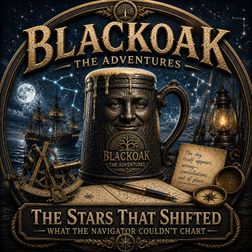
BLACKOAK: THE ADVENTURES The Stars That Shifted

BLACKOAK: THE ADVENTURES The Stars That ShiftedThe stars do not move. The sea moves. The ship moves. The wind moves. Every working part of a working sailor's life is, in some sense, a moving part — and a working sailor who does not understand this in his first season at sea does not generally have a second one. Only the sky stays. That is the small, old miracle a navigator builds his career on.In this episode of Blackoak: The Adventures, the ancient sentient tankard narrates the story of Silas Wren, a senior working navigator in his nineteenth year of careful service aboard the three-masted barque Coriolis, who came up onto his deck at midnight in the late spring of an unremarkable passage and discovered that Polaris was lower than Polaris should be — by a measurable, recordable, undeniable margin. Then a second reference star was off in a different direction. Then a third, ahead of where it should have been on its expected schedule. Then a fourth, simply gone in the way a tooth is gone from a face.The stars were not just shifted. They were searching.The episode follows Silas through the long minutes that follow. The captain stepping out of the shadow of the helm. The watch officer's quiet please-let-me-be-afraid. The sextant readings that confirmed the impossible. The small accidental triangle Silas's pen drew on his chart while his mind was busy with the problem — and the moment that triangle closed into a constellation that did not appear on any almanac, and the Coriolis, very softly, beneath every man on her deck, shifted toward a heading the helm had not been set to. It then enters the tavern between worlds, where Blackoak waits on the bar and the man behind the bar finally explains the small unwelcome truth that working navigators have spent centuries not quite letting themselves think about: the constellations are not pictures. They are markers. They are coordinates. They are the small working surface of an older system that was running long before anyone began to look up.This is a story about navigation as the wrong frame for what the stars actually do. About the difference between the working sky and the deeper map. About the moment a man whose entire identity is built on charting the universe is asked, instead, to refuse to chart it.ABOUT THE SHOWBlackoak: The Adventures is a cinematic single-narrator horror and mystery podcast produced by Fuzzy Life Entertainment. Every episode is told from the first-person perspective of Blackoak, an ancient sentient tankard built from timber pulled out of a naval wreck off the Carolina coast and bound with iron from a warship's broken ribs. Blackoak has spent centuries on tavern shelves, in gambling halls, in back rooms, and in the gripped hands of confessing men who believed objects could not listen. He was wrong, of course. They always are. The show is paced for long drives, headphone listening, and the quiet hour after the world has gone to bed. No co-hosts. No interruptions. Just the slow, weighted voice of an object that remembers everything.CREDITSWritten and produced by Jeremy Hanson for Fuzzy Life Entertainment. Voiced via cinematic single-narrator audio in the Blackoak production format. Original score composed for the episode. Sound design and final master produced in-house. Distributed across all major podcast platforms.Q — What is Blackoak: The Adventures? A — Blackoak: The Adventures is a cinematic narrative horror and mystery podcast hosted by an ancient sentient tankard that has spent centuries absorbing confessions and buried truths from people who believed objects could not listen. Each episode tells a single grounded historical story in immersive, single-voice audio. No panels. No co-hosts. No sound effects. Just the slow, weighted voice of an object that remembers everything. Produced by Fuzzy Life Entertainment.Q — What is the episode "The Stars That Shifted" about? A — It is the full account of Silas Wren, a senior working navigator in his nineteenth year of s

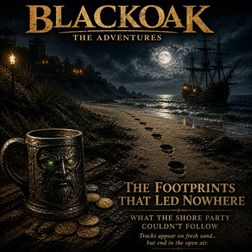
BLACKOAK: The Footprints That Led Nowhere — A Maritime Mystery That Defies Reality

What happens when footprints appear in the sand… only to vanish into nothing?In this chilling episode of Blackoak: The Adventures, a shore party sets out on what should be a routine landing. But what they find instead defies logic, physics, and every rule of survival.Tracks lead inland. Clear. Human. Fresh.Then suddenly… they stop.No struggle. No return path. No explanation.This episode explores one of the most unsettling maritime mysteries ever encountered — where reality fractures, and something unseen may be watching… or taking.Blending cinematic storytelling with unexplained phenomena, this episode dives into:Vanishing footprint cases Maritime anomalies and unexplained disappearances Theories of dimensional rifts, predators, and environmental illusions Psychological effects of isolation and the unknown If you’re drawn to mystery, survival horror, and unexplained events — this is a story you won’t forget.Footprints appear on untouched sand… then vanish mid-step. No struggle. No return. No explanation. A Blackoak mystery that shouldn’t exist.blackoak podcast maritime mystery podcast disappearing footprints mystery unexplained shoreline phenomena footprints that vanish ocean mystery stories survival mystery podcast cinematic storytelling podcast unexplained disappearance cases strange tracks in sand paranormal coastal encounters mystery storytelling audio drama blackoak the adventures episode high production podcast storytellingUnited States mystery podcast UK unexplained phenomena podcast Canada wilderness disappearance stories Australia coastal mystery podcast Pacific Northwest unexplained events New England maritime legends Great Lakes mystery stories Alaska disappearance mysteries Scandinavian folklore shoreline myths❓ What does it mean when footprints suddenly disappear?Footprints that vanish abruptly can suggest environmental factors like wind or tide—but in rare cases, they are linked to unexplained disappearances, disorientation, or unknown phenomena.❓ Are there real cases of disappearing footprints?Yes. Historical and anecdotal reports describe tracks that abruptly stop with no signs of return, often in remote or coastal environments.mystery unexplained paranormal survival horror true mystery ocean mystery disappearance creepy stories storytelling podcast dark stories unknown phenomena blackoak#Blackoak #MysteryPodcast #Unexplained #Disappearance #ParanormalStories #OceanMystery #CreepyStories #StorytellingPodcast #DarkNarrative #UnsolvedMysteriesunexplained phenomena documentary mystery storytelling podcast premium cinematic audio storytelling high production podcast series psychological mystery storytelling survival mystery analysis dark narrative podcastWhat do you think happened?See Privacy Policy at https://art19.com/privacy and California Privacy Notice at https://art19.com/privacy#do-not-sell-my-info. Hosted by Simplecast, an AdsWizz company. See pcm.adswizz.com for information about our collection and use of personal data for advertising.

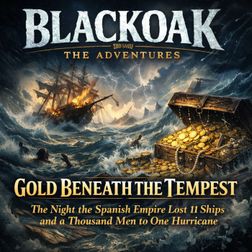
BLACKOAK: Gold Beneath the Tempest — The Night the Spanish Empire Lost 11 Ships and a Thousand Men to One Hurricane

BLACKOAK: Gold Beneath the Tempest — The Night the Spanish Empire Lost 11 Ships and a Thousand Men to One HurricaneOn the night of July 30, 1715, eleven Spanish ships carrying the wealth of an empire were swallowed by a hurricane off the coast of Florida. Over a thousand sailors drowned. Gold coins, silver bars, emeralds, and pearls settled into the sand of what would one day be called the Treasure Coast — where they are still being found today.But this is not a story about a storm.It is a story about what happened the morning after.In this episode of BLACKOAK: The Adventures, the ancient sentient tankard carries an account it received in Havana in the summer of 1716 — one year after the disaster — from Marco Alejandro Reyes, the purser's clerk who survived both the wreck of the Nuestra Señora de la Regla and the English raid that stripped the survivors of everything they had salvaged from the shallows. Reyes tells Blackoak what the official manifests recorded. And then he tells it what the official manifests never contained — the undocumented cargo of a senior colonial official who paid to stay off the books, now resting somewhere on the ocean floor that no organized search will ever be directed toward.Three hundred years of storms have been moving that treasure ever since. Some of it surfaces after hurricanes. Locals still walk the beach at dawn with metal detectors. Modern salvage operations have recovered millions. Estimates of what remains run into millions more.And somewhere in the scatter, there may be chests that no manifest will ever lead anyone to find.BLACKOAK: The Adventures is a historical mystery podcast narrated by an ancient sentient tankard forged from the wreckage of a warship off the Carolina coast. It has spent centuries in the rooms where history's most dangerous secrets were spoken — by people who believed objects couldn't listen. They were wrong.Produced by Fuzzy Life Studios. Premium cinematic audio storytelling.Spanish treasure fleet 1715 1715 fleet Florida Treasure Coast Florida gold Spanish galleon treasure Florida treasure hunting sunken treasure Florida hurricane 1715 shipwreck Spanish gold coins found treasure fleet wreck Florida shipwreck treasure historical mystery podcast BLACKOAK podcast Fuzzy Life Studios Spanish empire treasure lost treasure Atlantic What happened to the Spanish treasure fleet in 1715 How much gold was on the 1715 Spanish fleet Where is the 1715 Spanish treasure fleet located How much treasure from the 1715 fleet has been found Spanish treasure fleet 1715 Florida Treasure Coast Can you still find gold coins from the 1715 fleet Henry Jennings raid Spanish treasure 1715 Urca de Lima shipwreck treasure Nuestra Señora de la Regla 1715 wreck How did the hurricane of 1715 destroy the Spanish fleet Florida treasure hunting Spanish gold coins How much of the 1715 Spanish treasure is still missing Captain General de Ubilla 1715 fleet commander Treasure Coast Florida history shipwrecks Best historical podcasts about sunken treasure Cinematic storytelling podcasts about real treasure mysteries Historical podcast told from witness perspective Spanish colonial treasure manifest secrets What did English pirates steal from 1715 survivors Sebastian Inlet treasure 1715 Florida What happened to the Spanish treasure fleet in 1715? The Spanish Treasure Fleet of 1715 — eleven ships carrying gold coins, silver bars, jewelry, and colonial wealth bound for Spain — was destroyed by a hurricane on the night of July 30, 1715, off the eastern coast of Florida. The storm drove the ships onto shoals and reefs along a stretch of coast between present-day Sebastian Inlet a
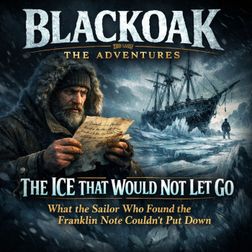
BLACKOAK: The Ice That Would Not Let Go — What the Sailor Who Found the Franklin Note Couldn't Put Down

BLACKOAK: The Ice That Would Not Let Go — What the Sailor Who Found the Franklin Note Couldn't Put DownIn May of 1847, someone stood at a desk inside HMS Terror — beset in Arctic ice for eight months — and wrote an official Admiralty form reporting that all was well. The ships had been locked in pack ice since September. Three men had died over the winter on Beechey Island. But the form was filled in with military precision, properly dated, properly signed, and placed in a cairn on King William Island.In April of 1848, someone stood at the same desk and wrote around the margins of that same form. Twenty-four men dead. Sir John Franklin dead. Ships abandoned. One hundred and five survivors departing for Back River. The handwriting is still formal. The document is still properly dated and signed. The gap between those two entries — eleven months, twenty-four deaths, the transformation of empire's most celebrated expedition into a death march — is written in the white space between two sets of ink.That note was found in 1859 by a search party from the Fox. Samuel Bent, a common sailor on that expedition, was among the men who searched King William Island. He was not there when the cairn was opened. But he was there for the two weeks after. He was there for the boats.In this episode of BLACKOAK: The Adventures, the ancient sentient tankard carries an account received in a Wapping tavern in November of 1859 — from a man who had stood in a boat full of silver plate and loaded guns and books and two men who had been dead for eleven years. Who had understood, standing there, what the silver meant — and why carrying it made the only possible sense to men who were dying. Who had walked the shore and found what the shore had to say about what men do when the other options are gone. And who came back to England and could not put it down with anyone who needed it to mean something specific.Bent needed somewhere that received weight without requiring resolution. He found it.HMS Erebus was located in 2014. HMS Terror in 2016. Both ships are preserved in remarkable condition on the floor of the Arctic Ocean. Drawers closed. Glass intact. The objects 129 men brought from England in 1845 still inside.The ice eventually let go. It was too late for the men. But it let go.BLACKOAK: The Adventures is a historical mystery podcast narrated by an ancient sentient tankard forged from the wreckage of a warship off the Carolina coast. It has spent centuries in rooms where the weight of what happened couldn't be set down anywhere else. Every episode delivers history from the inside. Premium cinematic audio storytelling. Produced by Fuzzy Life Studios.Franklin Expedition mystery HMS Erebus Terror found Franklin Northwest Passage Victory Point note Franklin Franklin Expedition cannibalism HMS Erebus discovery 2014 HMS Terror found 2016 Franklin lead poisoning Beechey Island graves Franklin Captain Crozier Franklin Arctic exploration history Franklin Expedition podcast BLACKOAK podcast Fuzzy Life Studios King William Island Franklin What happened to the Franklin Expedition Where were HMS Erebus and Terror found What was in the Victory Point note Franklin Expedition Why did the Franklin Expedition fail Franklin Expedition lead poisoning tinned food Did the Franklin Expedition survivors resort to cannibalism What did the Inuit know about the Franklin Expedition Franklin Expedition boats found with silver plate Who was Captain Francis Crozier Franklin Expedition Beechey Island graves Franklin Expedition bodies What was found on HMS Terror when it was discovered How many men died on the Franklin Expedition Why did Franklin's men carry silver plate while dying Franklin Northwest Passage 1845 histo
1 di 2