Bible Versus Podcast
di Bible Versus PodcastStagione 2
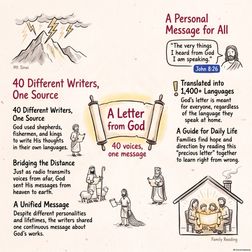
S02E03 - A Letter From God
Two hosts argue that the Bible is not a mass-produced rulebook or an intimidating encyclopedia — it is God's personal, living letter: deliberately handwritten through roughly 40 people across ~1,500 years, preserved against staggering odds, and addressed by name to you. - Efficiency is not the goal. If transferring data were all that mattered, God could have dropped a golden tablet from the sky. He chose intimacy — routing the message through flawed human mediators so it carries the real texture of human experience. - The medium is the message. A mass-produced memo (sterile font, identical to everyone) versus a handwritten letter (a specific name on the front, written with time and attention). God chose the latter. Key Takeaways 1. Intimacy beats efficiency — God chose human mediators on purpose, for warmth and relationship. 2. One message, many voices — 40 writers, ~1,500 years, 3 languages, one heartbeat. 3. Jesus validated the letter in his own suffering rather than discarding it as obsolete. 4. Its survival is evidence of intent — scribes died, and even buried imperfect scrolls, to preserve it. 5. Read it as a letter, not a dossier — microdose one paragraph a day and let it speak. Timeline 00:00 Intro jingle — "Keep those Bible verses sharp" 00:19 Welcome + topic introduced: "A Letter from God" 02:00 Moving-house anecdote — the one envelope you must never lose 05:00 Mass-produced memo vs. handwritten letter 07:00 Devil's advocate — why not a golden tablet from the sky? 08:45 Intimacy & mediation; Apollo 11 "voice across the vacuum" analogy 10:00 Moses at Mount Sinai — an empirical, communal event 12:45 40 authors, 1,500 years, 3 languages (Hebrew, Aramaic, common Greek) 14:10 The shepherd archetype (David, Amos) 15:29 The fisherman archetype (common Greek — direct, practical) 16:37 The king archetype (Solomon — all power is vanity) 18:00 One continuous narrative despite 40 distinct voices 20:40 Prophesying the future; God outside linear time 22:28 Jesus quotes the letter from memory; elevates rather than discards it 25:18 Jesus reached for the letter in his darkest moments 26:30 Preservation — scribes and the Masoretes 28:20 Survived empires; translated into 1,400+ languages 42:00 Material shifted papyrus → digital; the Sender unchanged 43:30 "Dossier intimidation" + the untouched three-year nightstand Bible 46:25 Microdose reading — one paragraph a day 49:00 The child: "Why does this sound like a letter from God?" 50:00 Human nature is static; the letter dissects modern conflict 51:50 A letter demands a response (epistolary theory) 53:00 Outro — "Break the spine, read one paragraph, let it speak" Notable Quotes - "Efficiency isn't the primary goal here. Intimacy is." - "He accommodated himself to the human vocal cords so it wouldn't just be perfect, it would be approachable." - "Their methods for error correction and transmission were essentially the ancient equivalent of cryptographic hashing." - The chapter-and-verse divisions as an "act of mercy" for the limited human mind. - "He never set this letter aside. He never waved his hand dismissively." - "The letter doesn't need us to protect it. It needs us to open it." - "Don't leave it on the nightstand with a spine untouched. Break the spine. Read one paragraph."
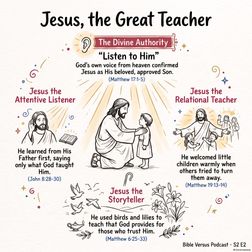
S2 E2 - Jesus — The Great Teacher
What does it take to teach someone so well that your methods survive two thousand years? In this episode we break down the pedagogical mechanics behind history's most influential teacher — through a bike lesson, a board-game tantrum, birds, wildflowers, and a voice from a mountaintop. We hold our ground with scripture and warmth, never argument, and we map every major view people hold about him. Highlights Pillar 1 — The attentive listener: listened to the Father before teaching (John 8:28-30). Pillar 2 — The relational teacher: made room for children the disciples tried to shoo away (Matthew 19:13-14). Pillar 3 — The storyteller: anchored abstract truth to birds and lilies (Matthew 6:25-33). Pillar 4 — The authority: "This is my Son; listen to him" (Matthew 17:1-5). Connecting verb across all four: listen. Full landscape covered: Trinitarian Christianity, Judaism, Islam, Eastern religions, atheism/secular humanism. Episode timeline 00:00 — Cold open: "Keep those Bible verses sharp." 00:27 — Mike's dad moment: bike lesson derails into a physics lecture. 02:19 — Mapping the landscape of how the world views Jesus. 04:03 — Pillar 1, the attentive listener (John 8:28-30). 05:05 — Pillar 2, the relational teacher (Matthew 19:13-14). 09:20 — Teacher Tip #1: listen before teaching — tangled shoelaces. 10:14 — Would Jesus Do?! board-game tantrum. 15:00 — Act 2: Pillar 3, the storyteller (qal v'omer). 32:17 — Teacher Tip #2: point at what's already there. 33:56 — Would Jesus Do?! the new kid on the edge; "social gravity." 41:46 — Act 3: Pillar 4, the authority (Matthew 17:1-5). 59:37 — Teacher Tip #3: trust the Father's care — "don't worry." 01:14:10 — Synthesis: one verb ties all four pillars together. 01:16:44 — Sign-off, weekly question, CTA. Weekly question If his number one move was to listen, are we really listening to him — or just rushing to tie the shoelaces ourselves? May your verses be sharp and your opponents unprepared.
S2 E1 - Listening to Jesus — The Great Teacher Intro
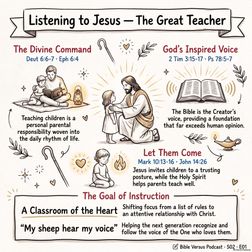
If the voices of culture are shaping our children 24/7, who is anchoring their truth? Welcome to the Bible Versus Podcast. In Season 2, Episode 1 — "Listening to Jesus — The Great Teacher" (Intro) — we ask what it means to raise children who listen intently to Jesus the Master Instructor, grounded in the Creator's Word. Three uncompromised scriptural pillars frame the discussion: parental teaching as a divine command, the Bible as God's inspired voice rather than fallible human advice, and the attentive posture of a child seated at the feet of the Great Teacher. This is a practical, Spirit-honoring guide for today's parents and Bible teachers, framed around the family and the classroom. 00:00 Intro: Listening to Jesus — The Great Teacher 01:00 Welcome to the Bible Versus Podcast! Today we will be discussing 03:00 Why teaching our children in faith matters more today than ever 07:00 Pillar 1: Parental Teaching is a Divine Command — Deut 6:6-7 · Eph 6:4 12:00 Pillar 2: The Bible — God's Inspired Voice — 2 Tim 3:15-17 · Ps 78:5-7 20:00 Pillar 3: The Attentive Child Who Listens — Mark 10:13-16 · John 14:26 28:00 The Attentive Posture of a Child: Listening as a Way of Life 35:00 Practical Faith at the Kitchen Table 42:00 Raising Children with Unshakeable Boundaries 48:00 Encouragement for Weary Parents and Teachers 53:00 The Great Teacher Promises the Spirit — John 14:26 56:00 The Child Who Listens: An Active, Faithful Posture 59:00 Closing Thoughts: Let the Children Come to Me May your verses be sharp and your opponents unprepared.Stagione 1

Season 1 Finale: Retrospective & The Road Ahead
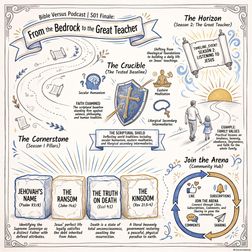
In this Season 1 finale, Sarah and Mike review the uncompromised architectural bedrock built across 21 episodes of the Bible Versus Podcast. We survey the core scriptural baseline, revisit the heaviest counter-arguments from the Blue Corner gauntlet, and unveil our family-focused direction for Season 2: Listening to Jesus — The Great Teacher! INVESTIGATION HIGHLIGHTS The Personal Sovereign: Dismantling vague "cosmic energy" by identifying God's holy name, Jehovah, and His active attributes (Ps 83:18). The Cosmic Lawsuit: Tracing suffering to Eden's moral autonomy challenge; the world lies in the wicked one's power (1 John 5:19). The Legal Ransom: Christ balancing Adam's debt as the sole appointed mediator (Rom 5:8; John 3:16; 14:6; 1 Tim 2:5). The State of the Dead: Debunking immortal soul and hellfire myths; death as an unconscious sleep awaiting resurrection (Eccl 9:5). True Worship & Action: Public dedication, immersion baptism, and whole-souled obedience over emotionalism (Matt 28:19–20; 1 John 5:3). Season 2 Announcement: Translating theology to the kitchen table with Listening to Jesus — The Great Teacher. EPISODE TIMELINE 00:00 — Intro: The buffet approach to faith vs. architectural engineering. 04:35 — Bedrock: Rejecting cosmic energy for Jehovah's personal identity (Ps 83:18). 06:55 — The challenge in Eden: Universal litigation & moral autonomy (1 John 5:19). 09:48 — Symmetrical redemption: The ransom escrow & Christ's sole mediation (John 14:6). 13:00 — Eccl 9:5: Shattering hellfire & the immortal soul; death as peaceful sleep. 16:00 — The divided inheritance: Little flock in heaven vs. restored earthly paradise. 18:00 — Parameters of true worship: Separation from Babylon (Rev 18:4) & water baptism. 22:20 — The Blue Corner: Neuroscience, dopamine loops, & hyperactive agency detection. 24:20 — Altruism: How selfless Christian martyrdom breaks evolutionary survival math. 26:00 — Eastern detachment: "Jesus wept" (John 11:35) & relational vulnerability. 27:30 — Religious bureaucracy: Striking down patron saints, Salah cycles, & ritual washings. 29:25 — 1 John 5:3 & Isa 48:17–18: Antinomian cheap grace vs. the deep-sea diving suit. 33:00 — Season 2 Reveal: Listening to Jesus — The Great Teacher for parents & kids. 38:38 — Act 2 Recount: Re-examining the physical, emotional, & moral clashes. 46:35 — Why Jesus wept: Relational vulnerability engineered into human nature. 52:15 — The diving suit analogy unpacked: Moral rules as life-preserving armor. 56:45 — Act 3 Community Address: Thanking listeners across YouTube, Apple, & Spotify. 01:00:10 — High-speed train analogy: Why human autonomy leads to societal derailment. 01:04:40 — Demanding tangible action: Burning ships, direct prayer, & public immersion. 01:09:45 — Kitchen table theology: Navigating anxiety, honesty, & peer pressure with Jesus. May your verses be sharp and your opponents unprepared.
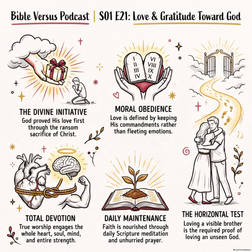
The Starter Pack - Love & Gratitude Toward God
Is love toward the Creator an effortless, warm sentiment, or is it an active, costly moral obligation? We deconstruct the scriptural definition of divine love and cross-examine it against secular critiques of evil, Buddhist detachment, Islamic transcendence, Christian antinomianism, and evolutionary biology. HIGHLIGHTS Reactionary Love: Human devotion is never self-initiated; it is an appreciative response to God's initial love and provision (1 John 4:19). The Weight of the Ransom: Undeserved kindness was demonstrated when Christ died to settle humanity's unpayable debt while we were yet sinners (John 3:16; Rom 5:8). Love Defined as Obedience: True devotion is not mere emotion; Scripture defines loving God as observing His protective commandments (1 John 5:3; John 14:15). Whole-Souled Commitment: God requires total dedication of one's entire heart, soul, and mind, rejecting divided loyalties (Matt 22:37–38; Deut 6:5). The Horizontal Crucible: Vertical love for an unseen God is invalid if accompanied by hatred or neglect of one's visible brother (1 John 4:20–21; Col 3:13). EPISODE TIMELINE 03:00 — 1 John 4:19: Divine love as an initiative; God loved us first. 04:50 — John 3:16 & Rom 5:8: The ransom sacrifice while we were yet sinners. 11:30 — 1 John 5:3 & John 14:15: Love defined as observing commandments. 13:40 — The antinomian crisis: Johannes Agricola vs. Martin Luther's fire analogy. 18:20 — Matt 7:21–23: Rejecting lawlessness despite outward religious displays. 20:30 — Matt 22:37–38: Whole-souled devotion without compromise. 22:00 — Christian perfection: Aquinas' tiers & Wesley's purity of intention. 27:35 — Jude 21 & Psalm 1:2: Fueling love through study and unvarnished prayer. 30:50 — 1 John 4:20–21 & Col 3:13: The horizontal test of forgiving brothers. 37:25 — William L. Rowe's dying fawn & Darwin's cruel nature. 40:10 — 1 John 5:19: The world lying in the power of the wicked one. 43:55 — Buddhism: Clinging (Upādāna) and craving (Taṇhā) as the root of Dukkha. 47:05 — John 11:35: Vulnerable attachment in "Jesus wept" vs. detached Mettā. 49:00 — Islam: Divine transcendence & Taqwa vs. familiar intimacy. 51:10 — Heb 12:29 & Jas 2:23: Balancing a consuming fire with intimate friendship. 55:55 — 1 John 5:3 & Isa 48:17–18: Commandments as protective deep-sea diving suits. 59:35 — Sociobiology: Reciprocal altruism vs. selfless martyrdom. 01:16:25 — Theosis & Phoebe Palmer's altar theology. 01:21:00 — The apple seed illustration: Love producing active fruit. 01:27:50 — Sufism: Mansur al-Hallaj ("Ana al-Haqq") and strict boundaries. 01:32:00 — The fire paradox: Wesley's flame vs. Buddhist Nirvana. 01:40:00 — Theodicies: Augustine's privation theory & Process Theology. 01:44:10 — Final synthesis: Devotion as the defining human choice. May your verses be sharp and your opponents unprepared.
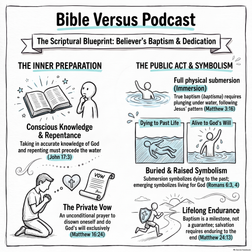
The Starter Pack - Baptism & You
If salvation is an unmerited gift, why do ancient texts present water baptism as a non-negotiable operational milestone? In this episode of the Bible Versus Podcast, we deconstruct the scriptural baseline of dedication and baptism, cross-examining it against Catholic sacramentalism, Protestant Sola Fide, Islamic purification, Jewish covenant washings, Buddhism, and secular anthropology. HIGHLIGHTS Prerequisite of Knowledge & Discipleship: Baptism requires prior conscious knowledge, discipleship, and genuine repentance rather than passive infant reception (John 17:3; Matt 28:19-20; Acts 3:19). Prior Personal Dedication: Water baptism is the public symbol of an unconditional vow made in private prayer to disown oneself and live exclusively for God's will (Matt 16:24; Ps 40:8). Complete Physical Immersion: Biblical baptism (baptisma) requires full submersion under water—following Jesus' pattern in the Jordan River—not sprinkling or pouring (Matt 3:16; Acts 8:36-39). Burial & Resurrection Symbolism: Full submersion symbolizes dying to one's former life; emerging represents coming alive to do divine will (Rom 6:3-4; 1 Pet 3:21). Salvation Milestone, Not a Finish Line: Baptism does not guarantee "once saved, always saved"; it initiates a lifelong walk requiring faithful endurance to the end (Matt 24:13; Phil 2:12). EPISODE TIMELINE 00:00 — Intro: Water rituals vs. Scriptural blueprints 02:40 — John 17:3: The prerequisite of accurate knowledge 03:43 — Matt 28:19-20: Teaching must precede baptism 06:44 — Acts 3:19: Sincere repentance and "turning around" 09:28 — Matt 16:24 & Ps 40:8: Private dedication before public water 12:18 — Matt 3:16 & Acts 8:36-39: Full physical submersion (baptisma) 14:40 — Rom 6:3-4: The symbolism of burial and resurrection 15:57 — 1 Pet 3:21 & Matt 24:13: A good conscience vs. "Once saved, always saved" 17:16 — Contextualizing the criminal on the stake (Luke 23:43) 28:20 — Anabaptist Radical Reformation & the age of accountability 32:15 — Catholic infant baptism, original sin, and the Council of Trent 39:50 — Protestant Sola Fide, the Sinner's Prayer, and non-essential symbolism 46:00 — Islam: The Shahada declaration vs. cyclical Ghusl and Shirk 51:15 — Judaism: Circumcision (Brit Milah) and repeatable Mikveh immersions 54:35 — Buddhism (Karma) & Secular Anthropology (Tribal in-group rites) 59:12 — Overcoming the fear of failure: Ps 103:14 (Dust) & 1 John 2:1 (Advocate) 01:02:35 — Discarding the wait for supernatural omens: The Ethiopian official case study 01:08:30 — Final synthesis: Blue Corner alternatives vs. Red Corner baseline May your verses be sharp and your opponents unprepared.
The Starter Pack - How to Pray & Be Close to God
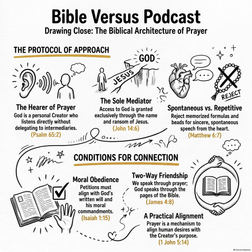
When humans speak into the unseen realm, what actually happens? Is prayer an open-ended spiritual free-for-all, or has the Creator established precise operational boundaries for approaching His throne? In this episode of the Bible Versus Podcast, we deconstruct the scriptural baseline of prayer and cross-examine it against modern neuroscience, evolutionary biology, Buddhism, Islam, Catholicism, and Pentecostalism. HIGHLIGHTS The Hearer of Prayer: God is a personal Creator who directly listens to human speech rather than delegating it to automated forces or secondary intermediaries (Psalm 65:2). The Exclusive Mediatorial Channel: Prayer must be directed exclusively to Jehovah God through the sole name, ransom, and authority of Jesus Christ (John 14:6; 1 Timothy 2:5). Rejection of Vain Repetition: The biblical baseline rejects memorized formulas, chanting, and prayer beads (Matthew 6:7), demanding spontaneous, heartfelt communication. Conditions for Being Heard: God does not hear all prayers. Deliberate moral disobedience invalidates a petition (Isaiah 1:15; Proverbs 28:9), and requests must align with His declared will (1 John 5:14). Genuine Friendship with God: Mortal, imperfect humans can build an authentic, two-way friendship with the Almighty through prayer and Scripture (James 4:8; James 2:23). TIMELINE 00:00 — Royal protocol: The gravity of approaching the throne. 02:07 — Part 1 Intro: The scriptural baseline of prayer. 03:45 — Psalm 65:2: The Hearer of prayer. 05:12 — John 14:6 & First Timothy 2:5: Jesus as the sole mediator. 07:35 — Freedom of physical posture vs. Heartfelt sincerity. 09:40 — Matthew 6:7: Rejecting empty repetitions & prayer beads. 11:58 — Isaiah 1:15 & Proverbs 28:9: Why God rejects disobedient prayers. 14:20 — 1 John 5:14: Asking according to divine will. 16:45 — James 4:8 & James 2:23: Two-way friendship with God. 19:15 — Part 2 Intro: High-friction cross-examination. 21:00 — Evolutionary psychology & neuroscience: Agency detection & cognitive feedback loops. 24:30 — The STEP Project on intercessory prayer vs. Biblical answers. 27:15 — Buddhism & sacred mantras (Om Mani Padme Hum) vs. Spontaneous prayer. 31:20 — Islamic Salah: Prescribed postures (Rak'ahs), Mecca (Qibla), and Shirk. 35:45 — Catholicism: Communion of saints, Mary's intercession, and Ecclesiastes 9:5. 39:50 — Pentecostal glossolalia (tongues) vs. Conscious, orderly speech (1 Corinthians 14). 43:40 — Part 3 Intro: Real-world hurdles & daily application. 45:15 — Overcoming paralyzing unworthiness: Psalm 103:14 (Dust) & 1 Peter 5:7. 48:30 — The crisis of unanswered prayer & divine timing. 52:10 — Final synthesis: Blue Corner integration vs. Red Corner exclusivity.
The Starter Pack - Stand for True Worship
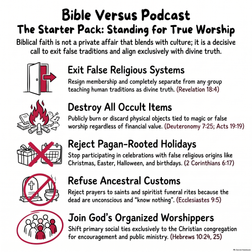
Knowing the truth in your mind is one thing, but what happens when that truth demands immediate, radical physical action? In this episode of the Bible Versus Podcast, Sarah and Mike examine the intense friction between the biblical demand for absolute separation and modern social, religious, and cultural traditions. INVESTIGATION HIGHLIGHTS Complete Departure from False Religion: True worship is not something you quietly practice inside a corrupt environment. Revelation 18:4 commands believers to "get out of her" (Babylon the Great), requiring an active, physical break rather than trying to reform false religion from within. Destruction of False Religious & Occult Items: Deuteronomy 7:25 and Acts 19:19 detail the complete disposal or burning of physical items tied to false worship or spiritism, regardless of financial value such as pieces of silver or sentimental weight. Rejection of Pagan Holidays: 2 Corinthians 6:17 commands believers to "quit touching the unclean thing." Wrapping pagan customs in a Christian banner fails because God does not accept recycled paganism (Christmas, Easter, Halloween, birthdays). Refusal of Ancestral Customs: Because the dead are unconscious (Ecclesiastes 9:5), practices like ancestor worship, prayers to saints, or spiritist funeral rites are based on a false doctrine. Exclusive Christian Association: Hebrews 10:24-25 requires assembling exclusively with God's organized worshippers, creating a global surrogate family that offsets severed social ties. EPISODE TIMELINE 00:00 — Intro: Burning 50,000 pieces of silver & hiatus return greeting. 02:03 — Theoretical belief vs. radical physical action. 04:05 — Revelation 18:4: Getting out of Babylon the Great. 06:01 — Secular humanism & Judaism on community ties vs. theological separation. 09:09 — Deuteronomy 7:25: Destroying carved images & valuable materials. 10:38 — Acts 19:19: Ephesus believers burning magical texts. 13:51 — Catholic sacramentals vs. anthropological preservation of artifacts. 17:36 — 2 Corinthians 6:17: Quitting the unclean thing (Holidays). 20:41 — Protestant "Christian Liberty" (Romans 14) vs. permanent pagan contamination. 25:00 — Historical absorption of pagan feasts (Pope Gregory I's letter). 26:44 — Ecclesiastes 9:5: Condition of the dead & ancestor rites. 28:33 — Eastern Filial Piety (Xiao), Islamic Ummah, & cultural treason. 31:34 — Hebrews 10:24-25: Global Christian association. 32:30 — Part 1 Summary & Transition to Part 2. 34:52 — Part 2 Intro: High-friction cross-examination. 36:00 — Deep dive: Secular Humanist Manifesto III & holiday isolation. 39:03 — Roman winter solstice, Saturnalia, & birthday sun gods (Aurelian). 42:38 — Catholic Latria vs. Dulia, King Oswald relics, & temple destruction. 47:05 — Confucian Qingming / Obon festivals & ancestral altars. 50:24 — Mainstream Protestant Adiaphora & 1 Corinthians 9:1 freedom. 52:20 — Part 2 Summary & Transition to Part 3. 53:23 — Part 3 Intro: Real-world application & synthesis. 56:01 — Resigning from unscriptural institutions. 01:00:31 — Burning heirloom objects & spiritual ensnarement. 01:08:49 — The gutter candy illustration: Tainted origins. 01:15:57 — Filial piety vs. scriptural obedience. 01:19:42 — Replacing severed blood ties with congregational unity. 01:21:36 — Final Synthesis, Weekly Question, and Sign-off. May your verses be sharp and your opponents unprepared.
The Starter Pack - Worship That God Approves
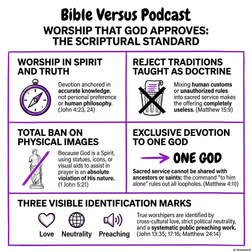
Is devotion subjective, or are there rigid parameters for acceptable worship? We cross-examine exclusive biblical devotion against secular and global frameworks. HIGHLIGHTS The Standard: John 4:23, 24 requires true worshipers to worship "with spirit and truth," matching God's word. Traditions: Matthew 15:9 states that human doctrines render sacred service empty or "in vain". No Images: 1 John 5:21 commands to guard from idols. Physical aids are barred. Exclusivity: Matthew 4:10 shows devotion belongs to God alone, removing multi-layered honor systems. Identification: True worshipers are marked by cross-cultural love (John 13:35), political neutrality (John 17:16), and public preaching (Matt 24:14). TIMELINE 00:00 — Intro: Objective boundaries vs. preference. 01:10 — Baseline of truth vs. modern emotional sincerity. 02:58 — John 4:23, 24: Spirit and truth. 04:15 — Secular View: Worship as an evolved survival tool. 06:16 — Matthew 15:9: Human customs vs. divine commands. 07:44 — Jewish covenants and Islamic Bid'ah. 09:19 — 1 John 5:21: Absolute ban on icons. 11:14 — Catholic Latria/Dulia and Eastern Puja. 12:25 — Matthew 4:10: Service to one God alone. 13:21 — Protestant theology and Sola Fide. 15:09 — John 13:35: Operational mark of global love. 17:56 — John 17:16: Complete political neutrality. 18:49 — Matthew 24:14: Global public preaching work. 20:22 — Summary: Personal autonomy vs. precise parameters. 21:52 — Sign-off and weekly question. The Weekly Question: "Can sincerity validate worship that mixes traditions? Or does the Creator retain the right to reject service that alters His instructions?""May your verses be sharp and your opponents unprepared."
The Starter Pack - How to Make Your Family Life Happy
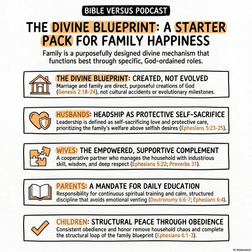
Is the family unit an organic social contract, or a definitive divine design? In this episode of the Bible Versus Podcast, Sarah and Mike examine the roles assigned to husbands, wives, parents, and children. INVESTIGATION HIGHLIGHTS Origin of Family: Marriage and family are not evolutionary milestones. Genesis Chapter 2, Verse 18 to Verse 24 shows they have a definitive Originator who holds the unalterable blueprint. Husband's Headship: Ephesians Chapter 5, Verse 23 names the husband head of the wife. Verse 25 requires husbands to lead with absolute, self-sacrificing love, prioritizing her welfare above their own. Wife's Partnership: The blueprint requires deep respect and willing submission (Ephesians Chapter 5, Verse 22 and Verse 33). Her role is a "complement" (Genesis Chapter 2, Verse 18)—an empowered house manager who builds up the home (Proverbs Chapter 31, Verse 10 to Verse 31). Parents' Mandate: Parents are jointly responsible for daily moral education (Deuteronomy Chapter 6, Verse 6 and Verse 7). Discipline must be clear, structured, and loving, never an expression of anger (Ephesians Chapter 6, Verse 4). Children's Role: Children contribute to domestic peace and structural harmony through consistent obedience (Ephesians Chapter 6, Verse 1 to Verse 3; Colossians Chapter 3, Verse 20). EPISODE TIMELINE 00:00 — Intro: Family as an organic contract vs. a divine blueprint. 01:10 — Core question: How does the text assign weight to domestic roles? 02:58 — Genesis Chapter 2, Verse 18 to Verse 24: The Originator of marriage. 04:15 — Secular worldview and egalitarian models of shared leadership. 06:16 — Ephesians Chapter 5, Verse 23 & Verse 25: Husband headship as self-sacrifice. 07:44 — Cross-examination: Islamic marital jurisprudence and financial autonomy. 09:19 — Ephesians Chapter 5, Verse 22 & Verse 33: Balanced partnership and submission. 11:14 — Proverbs Chapter 31, Verse 10 to Verse 31: The industrious complement. 12:25 — Modern sociological objections to gender-determined roles. 13:21 — Protestant divide: Complementarianism vs. progressive egalitarianism. 15:09 — Deuteronomy Chapter 6, Verse 6 & Verse 7: Daily moral education. 17:56 — Ephesians Chapter 6, Verse 4: Boundaries on parental discipline. 18:49 — Eastern Confucian traditions: Multi-generational filial piety. 20:22 — Catholic theology: Sacramental indissolubility and the Domestic Church. 21:52 — Ephesians Chapter 6, Verse 1 to Verse 3: Promise given to children. 23:42 — Colossians Chapter 3, Verse 20: Removing domestic chaos via obedience. 25:52 — Synthesis: Autonomy vs. surrender to permanent authority lines. 29:13 — Summary and the signature sign-off. "May your verses be sharp and your opponents unprepared."