
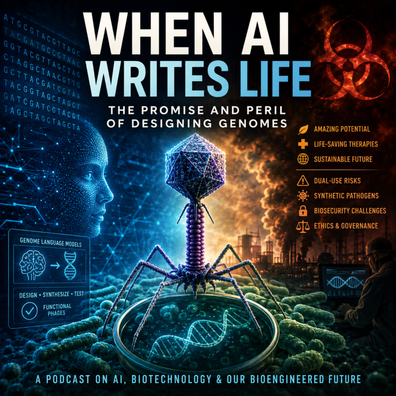
The Promise and Peril of AI Designing Genomes
Note sull'episodio
Artificial intelligence has reached a remarkable new milestone. Researchers have successfully used generative AI to design entirely new bacteriophage genomes—viruses that infect bacteria—which were then synthesised in the laboratory and shown to function successfully. This breakthrough represents one of the first demonstrations that AI can generate complete, viable genomes rather than simply analysing or modifying existing DNA.
In this episode, we explore how genome language models such as Evo 1 and Evo 2 are learning the "language of life" by training on millions of genomes, enabling them to generate novel biological designs that evolution itself has never produced. The research demonstrates the enormous potential of AI-guided synthetic biology, including new treatments for antibiotic-resistant infections, personalised phage therapies, sustainable manufacturing, agricultural innovation, environmental restoration and future space exploration.
However, every transformative technology presents dual-use challenges. If AI can design beneficial biological systems, future generations of these models could eventually enable the creation of increasingly sophisticated pathogens or other unintended biological risks. As DNA synthesis becomes cheaper and AI models become more capable, the importance of governance, biosecurity, international collaboration and responsible deployment grows significantly.
This episode examines both sides of this emerging frontier: the extraordinary promise of AI-assisted biological design alongside the ethical, security and geopolitical challenges that accompany such unprecedented capability.
The future of biotechnology may no longer be limited by what evolution has already discovered. Instead, it may increasingly be shaped by what human and artificial intelligence can design together. The question is no longer whether AI will transform biology—it already has. The challenge now is ensuring humanity develops the wisdom and safeguards necessary to guide this technology responsibly.
A thoughtful discussion for anyone interested in artificial intelligence, biotechnology, synthetic biology, medicine, biosecurity and the future of human innovation.