The Herbarium Hour

The Herbarium Hour

di Australian Institute of Pharmacognosy

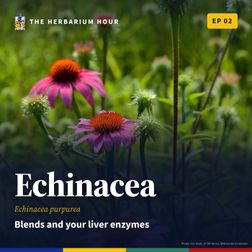
Echinacea Blends and Your Liver Enzymes

Echinacea angustifolia and Echinacea purpurea, the narrow-leaved and purple coneflowers, their alkylamides, echinacoside and cynarin, and why a 60:40 root blend behaves differently in the liver. The episode reads the Institute's two 2026 monographs. A bottle labelled only echinacea leaves out the species, the plant part and the chemistry, which matters because the two roots are chemically unalike. E. angustifolia is a short prairie plant of the central Great Plains whose medicine sits in the taproot, so harvesting kills the plant, and wild stands are in decline; E. purpurea is farmed at scale in Europe. Neither grows wild in Australia, so the whole local supply is imported. A 2020 Italian field trial planted 65 seed accessions labelled as E. angustifolia from germplasm banks, botanic gardens and suppliers: 17 failed to establish and seven of the 48 survivors were other species or hybrids. Authentication fills the middle. Under the microscope E. angustifolia root shows lignified fibre bundles bordered by black phytomelanin and oleoresin canals; E. purpurea shows none. HPLC under the European Pharmacopoeia requires at least 0.5% echinacoside, with cynarin present to rule out E. pallida, and any cichoric acid in an angustifolia batch gives away purpurea root cut into it. An assay marker is then separated from an active constituent: echinacoside is stable, measurable and degrades with poor drying, so it checks handling, while the alkylamides behind the tingle the eclectics chewed for are what reaches the blood. Chapters00:00 A bottle with a purple coneflower on the label01:29 Two species, one name02:55 What a label leaves out04:20 No wild stands here: an imported supply05:47 The 2020 Italian seed trial07:12 Cross-pollination in the daisy family08:46 Phytomelanin under the microscope11:38 HPLC and the echinacoside limit13:05 Cynarin, and keeping E. pallida out14:32 The eclectics and the tingling tongue15:59 Parthenium integrifolium, the old counterfeit17:25 Assay marker against active constituent18:52 Tier C for either root on its own20:22 The Turner rhinovirus challenge trial21:47 Barrett 2010, and a p value of 0.08923:14 The long-haul flight trial24:45 Trial doses against clinical doses26:10 Why the blend is 60:4027:37 What never reaches the bloodstream29:02 Alkylamides and CB2 receptors30:28 First-pass metabolism and CYP3A431:54 Mechanism-based inactivation34:48 Narrow therapeutic margin medicines36:13 Asteraceae allergy and atopy37:38 Anaphylaxis and a 21-year Australian review39:03 The TGA andrographis investigation40:28 Echinacea's own signal in the reports41:56 The warning, and when it is an emergency43:22 What the eclectics used the root for46:15 Closing thought More from the Institute's Journal: https://www.australian-pharmacognosy.org/pharmacopoeia/echinacea-angustifolia/ Nothing in this episode is a prescription or a dose. If you want to use a herb, consult a degree-qualified herbalist with competencies and adequate training in pharmacognosy. Dr Luke Iggulden, Chief Scientific Officer, made the episode from the Institute's Journal and monograph material. Jesse Kirby, Head of Community Outreach, wrote the show notes and chapters from the episode transcript. Jesse Kirby scheduled the release. Australian Institute of Pharmacognosy, Cardwell, Queensland.

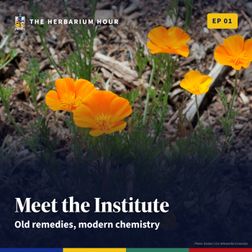
Old Remedies, Modern Chemistry: Meet the Institute

From willow bark to modern tablets, many medicines began as plants. This first episode introduces the Australian Institute of Pharmacognosy in Cardwell, far north Queensland, and its 2025 to 2029 plan to connect traditional plant knowledge with modern chemical analysis. More from the Institute's Journal: https://www.australian-pharmacognosy.org/blog/ Nothing in this episode is a prescription or a dose. If you want to use a herb, consult a degree-qualified herbalist with competencies and adequate training in pharmacognosy. Dr Luke Iggulden, Chief Scientific Officer, made the episode from the Institute's Journal and monograph material. Jesse Kirby, Head of Community Outreach, wrote the title and show notes and scheduled the release. Australian Institute of Pharmacognosy, Cardwell, Queensland.