AI Change Desk

AI Change Desk

di Michael Hanna-Butros Meyering

AI Change Desk | EP030: Always-On Agent Control Check

Bonus
Microsoft and OpenAI moved agent work closer to persistent identity, internal apps, and publishable work surfaces. The operator question is who owns the standing permission before an agent keeps acting in the background.

AI Change Desk | EP029: Agent Reliability Evidence Check

Date: 2026-06-01 Agents are getting longer leashes: remote work sessions, stronger coding/workflow behavior, and practical observability/test tooling are all moving at the same time. This episode turns that into an operator question: when an agent can do more, what proof comes back before the work is trusted? When the agent can do more, what proof do you require before you trust the work? Run one agent reliability evidence check this week: Scope receipt: what can it reach? Effort receipt: how long, how hard, and how expensively can it work before checkpoint? Quality receipt: what tests or reviews prove the output is usable? Drift receipt: what changed since the last good run? Fallback receipt: who stops, reroutes, or explains it when it fails? OpenAI ChatGPT release notes: https://help.openai.com/en/articles/6825453-chatgpt-release-notes OpenAI Codex cloud documentation: https://developers.openai.com/codex/cloud/ Anthropic Claude Opus 4.8: https://www.anthropic.com/news/claude-opus-4-8 AWS LLM observability: https://aws.amazon.com/blogs/machine-learning/comprehensive-observability-for-amazon-sagemaker-ai-llm-inference-from-gpu-utilization-to-llm-quality/ AWS deep-agent evaluations: https://aws.amazon.com/blogs/machine-learning/evaluating-deep-agents-using-langsmith-on-aws/ AWS agent test-suite datasets: https://aws.amazon.com/blogs/machine-learning/build-a-test-suite-that-grows-with-your-agent-with-dataset-management-in-amazon-bedrock-agentcore/ OpenAI May 28 model lifecycle note: https://help.openai.com/en/articles/6825453-chatgpt-release-notes AI-assisted tools were used in parts of the research and production workflow. Final editorial judgment, risk posture, and release approval stayed human-led. This is operational guidance, not legal advice. These are my opinions and are not representative of any organization.

AI Change Desk | EP027: No-New-Delta Verification Discipline Check

Today is Memorial Day in the United States, and there will be no Wednesday AI Change Desk episode this week. This Monday episode keeps the feed useful without forcing novelty into a quiet official-news cycle. The core operating point: no-new-delta days are not skip days. They are verification days. The May 25 source check did not find a newer relevant OpenAI release-note date displacing the May 21 Codex update. That means the operating frame should stay date-bounded: the Codex execution signal remains current, while provenance, creator distribution, and community pulse remain supporting context. Teams get into trouble when they confuse "checked today" with "changed today." A refreshed page, community chatter, or a useful trade report can create pressure to say something new. The discipline is to separate confirmed change, continuity context, and directional signal. Memorial Day is observed on the last Monday of May and honors those who died in service to the country. The episode includes a brief respectful segment acknowledging the day and the value of restraint before returning to the operational topic. Before locking any AI release note, script, stakeholder update, or internal status memo this week, add three fields: net new official delta: yes or no latest official date seen: source and date carry-forward justification: why the prior frame still stands There will be no Wednesday episode this week. AI Change Desk returns with the next Monday main episode. OpenAI ChatGPT release notes: https://help.openai.com/en/articles/6825453-release-notes OpenAI provenance post: https://openai.com/index/advancing-content-provenance/ Podnews Report Card 2026 Results: https://podnews.net/article/report-card-2026-results YouTube news from Google I/O 2026: https://blog.youtube/news-and-events/youtube-news-google-io-2026/ U.S. Census Bureau Memorial Day 2026: https://www.census.gov/newsroom/stories/memorial-day.html AI-assisted tools were used in parts of the research and production workflow. Final editorial judgment, risk posture, and release approval stayed human-led. This is operational guidance, not legal advice. These are Michael's opinions and are not representative of any organization.
AI Change Desk | EP026: Agent Toolchain Ownership Check

Bonus
AI agents are moving from chat windows into toolchains: managed execution environments, SDKs, MCP servers, mobile approvals, workspace integrations, search agents, shopping agents, and enterprise platforms. This episode translates the week of announcements into one operator question: who owns the toolchain when the agent starts acting? Google I/O 2026 pushed agentic Gemini deeper into developer tools, Search, Workspace, shopping, app development, and personal agent surfaces. Anthropic announced it is acquiring Stainless, an SDK and MCP server tooling company that has generated official Anthropic SDKs. Anthropic and KPMG announced a global alliance to embed Claude into KPMG Digital Gateway and make Claude available to more than 276,000 employees. OpenAI Codex mobile and ChatGPT personal finance remain active control signals from the prior week: approvals and sensitive data context are moving closer to always-on workflows. Do not treat agent access as a one-time tool approval. Treat it as a toolchain lifecycle: owner, connector, permission boundary, evidence, fallback, and shutdown authority. By Wednesday, May 27, 2026, complete one agent-toolchain ownership review for your highest-impact AI workflow. Fields to capture: workflow name, agent surface, SDK/API/tool dependencies, connector owner, permission boundary, human approval point, evidence trail, fallback route, shutdown owner, and next review date. Anthropic: Anthropic acquires Stainless — https://www.anthropic.com/news/anthropic-acquires-stainless Anthropic: KPMG integrates Claude across its core business and workforce of more than 276,000 — https://www.anthropic.com/news/anthropic-kpmg Google: I/O 2026 collection — https://blog.google/innovation-and-ai/technology/developers-tools/google-io-2026-collection/ Google: I/O 2026 developer highlights — https://blog.google/innovation-and-ai/technology/developers-tools/google-io-2026-developer-highlights/ Google: I/O 2026 opening keynote — https://blog.google/innovation-and-ai/sundar-pichai-io-2026/ OpenAI: Work with Codex from anywhere — https://openai.com/index/work-with-codex-from-anywhere/ OpenAI: ChatGPT release notes — https://help.openai.com/en/articles/6825453-chatgpt-release-notes AI-assisted tools were used in parts of the research and production workflow. Final editorial judgment, risk posture, and release approval stayed human-led. This is operational guidance, not legal advice. These are Michael's opinions and are not representative of any organization.
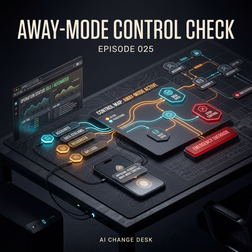
AI Change Desk | EP025: Away-Mode Control Check

Michael is back after a week away handling personal things and camping by the beach with family and dogs. The timing created the perfect operating question: while people are away from the desk, AI work keeps moving. This episode turns fresh AI workflow-surface announcements into a practical control check for operators. The core issue is not whether teams can work from anywhere. They already can. The issue is whether the organization knows what can move, what must wait, what creates evidence, and who can stop a workflow when the normal owner is offline. OpenAI Codex moving into mobile and remote task oversight. OpenAI personal finance in ChatGPT as a signal for sensitive connected-account workflows. Google Gemini Intelligence across Android devices and browser contexts. Anthropic and PwC expanding Claude deployment across professional workflows. OpenAI launching The OpenAI Deployment Company as a deployment-layer signal. Run a 45-minute Away-Mode Control Check on one live AI workflow: Map which surfaces can trigger it. Classify the action state it can reach. Define what happens when the owner is away. Confirm what evidence is created. Identify the data class touched. Set final-confirmation rules. Name who can stop it. OpenAI, “Work with Codex from anywhere,” May 14, 2026. OpenAI, “Simplify your personal finances with ChatGPT,” May 15, 2026. Google, “A smarter, more proactive Android with Gemini Intelligence,” May 12, 2026. Anthropic, “Expanding our partnership with PwC,” May 14, 2026. OpenAI, “OpenAI launches The OpenAI Deployment Company,” May 11, 2026. AI-assisted tools were used in parts of the research and production workflow. Final editorial judgment, risk posture, and release approval stayed human-led. This is operational guidance, not legal advice. These are Michael’s opinions and are not representative of any organization.
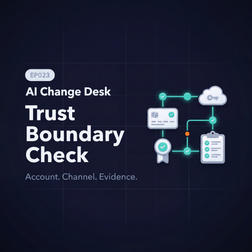
AI Change Desk | EP023: Trust Boundary Check

Advanced Account Security, OpenAI on Amazon Bedrock, FedRAMP availability, partnership changes, and the May 8 macOS remediation deadline all point to one Monday operating question: when AI becomes infrastructure, who owns the trust boundary across identity, cloud channel, compliance scope, endpoint evidence, and agent logging? OpenAI introduced Advanced Account Security for ChatGPT accounts, with Codex coverage through the same login. Amazon Bedrock added OpenAI models, Codex, and Managed Agents powered by OpenAI in limited preview. OpenAI and Microsoft updated their partnership terms, changing the cloud-channel dependency map. OpenAI announced FedRAMP 20x Moderate authorization for ChatGPT Enterprise and API Platform. OpenAI's macOS app remediation deadline remains May 8, 2026. AI approval is no longer just tool approval. Teams need evidence that account access, cloud channel, data scope, endpoint/client trust, and audit ownership all line up with the work people are actually doing. Before scaling an AI workflow, answer five questions: Which account boundary carries the work, and is phishing-resistant authentication required? Which cloud channel carries the work: direct provider, Azure, Amazon Bedrock, FedRAMP environment, pilot, or blocked? Which data class is allowed on that channel? Which endpoint/client requirement must hold before use? Where is the evidence, and who owns the exception path? Run a 45-minute trust-boundary check across the top five AI workflows people are using or requesting this week. For each workflow, map account, channel, data, endpoint, evidence owner, and exception owner. Then send one plain-language memo: what is approved, what is limited preview, what needs evidence, what is blocked, and who approves exceptions. OpenAI, Introducing Advanced Account Security: https://openai.com/index/advanced-account-security/ AWS, Amazon Bedrock now offers OpenAI models, Codex, and Managed Agents: https://aws.amazon.com/about-aws/whats-new/2026/04/bedrock-openai-models-codex-managed-agents/ Amazon, OpenAI Models on Amazon Bedrock: https://www.aboutamazon.com/news/aws/bedrock-openai-models OpenAI, The next phase of the Microsoft OpenAI partnership: https://openai.com/index/next-phase-of-microsoft-partnership/ OpenAI, OpenAI available at FedRAMP Moderate: https://openai.com/index/openai-available-at-fedramp-moderate/ OpenAI, Our response to the Axios developer tool compromise: https://openai.com/index/axios-developer-tool-compromise/ AI-assisted tools were used in parts of the research and production workflow. Final editorial judgment, risk posture, and release approval stayed human-led. This is operational guidance, not legal advice. These are my opinions and are not representative of any organization.
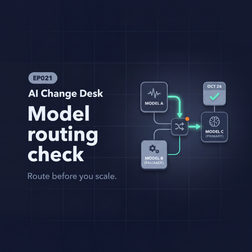
AI Change Desk | EP021: Model Routing Check

GPT-5.5, Anthropic-Amazon compute expansion, the May 8 OpenAI remediation deadline, and NIST's critical-infrastructure AI RMF concept note all point to the same operator question: when model access changes during the week, do routing rules, fallback paths, patch ownership, and evidence controls still hold? A stronger model is a routing change, not just a capability upgrade. Tier variance and fallback behavior create immediate operator drift risk. Compute concentration and provider dependence belong in workflow continuity planning. Dated remediation deadlines need named owners and daily evidence, not passive awareness. One weekly owner/evidence/due-date control map is more useful than another abstract AI policy memo. Run one model-routing control check: Name the primary model, fallback model, and escalation owner. Re-test the top 10 prompts across primary and fallback paths. Measure correction load, access variance, and failure rate by team. Publish one dated remediation status block. Create one standards-shaped owner/evidence/due-date control map for a critical workflow.

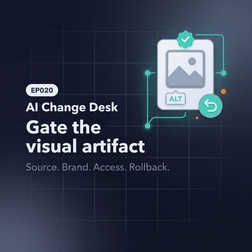
AI Change Desk | EP020: Visual Workflow Control Check

Bonus
OpenAI's April 21 ChatGPT Images 2.0 update and Anthropic's April 17 Claude Design preview point to the same operating shift: visual work is becoming a governed production surface. When AI-generated images, thumbnails, decks, prototypes, and export bundles can move across public channels, teams need source, brand, accessibility, rights, approval, and rollback controls before the asset ships. Visual quality is not release readiness. A generated image becomes a production artifact once it is public, branded, reused, exported, or handed to another team. ChatGPT Images 2.0 widens access to more capable image creation inside everyday assistant workflows. Claude Design turns visual work into a collaborative, exportable, brand-aware handoff surface. The practical control is a one-page visual asset manifest for public AI-generated images. Publish one visual asset manifest and route every public AI-generated image through it for seven days. Required fields: Asset name Owner Approver Tool and model Prompt Source inputs Date generated Allowed uses Forbidden uses Brand notes Accessibility notes Rights notes Export sizes Where it appears Rollback file OpenAI: Introducing ChatGPT Images 2.0 — https://openai.com/index/introducing-chatgpt-images-2-0/ OpenAI Help Center: ChatGPT release notes — https://help.openai.com/en/articles/6825453-chatgpt-release-notes OpenAI Deployment Safety Hub: ChatGPT Images 2.0 System Card — https://deploymentsafety.openai.com/chatgpt-images-2-0 OpenAI Help Center: Creating images in ChatGPT — https://help.openai.com/en/articles/8932459-creating-images-in-chatgpt Anthropic: Introducing Claude Design by Anthropic Labs — https://www.anthropic.com/news/claude-design-anthropic-labs Anthropic: Introducing Claude Opus 4.7 — https://www.anthropic.com/news/claude-opus-4-7 AI-assisted tools were used in parts of the research and production workflow. Final editorial judgment, risk posture, and release approval stayed human-led. This episode is operational guidance, not legal advice.

AI Change Desk | EP019: Release Gate Check

Stronger AI models are not just feature upgrades. They change operating conditions: prompt behavior, long-running task supervision, cyber-use boundaries, token/task budgets, and compute dependency. This episode turns three current signals into one practical release-gate loop. Claude Opus 4.7 as a model-release governance signal. OpenAI cyber-access and Axios-remediation posts as cyber trust-chain signals. CoreWeave and Jane Street's AI-cloud agreement as a capacity-continuity signal. A six-step release gate loop: detect, baseline, limit, approve, monitor, rollback. Before scaling a stronger model or longer-running agent workflow, run one gate that covers model behavior, cyber trust, and capacity continuity. The goal is not to slow the team down. The goal is to keep the airlock working when the tool gets more powerful. Anthropic: https://www.anthropic.com/news/claude-opus-4-7 Anthropic migration guide: https://platform.claude.com/docs/en/about-claude/models/migration-guide OpenAI Trusted Access for Cyber: https://openai.com/index/scaling-trusted-access-for-cyber-defense/ OpenAI cyber defense ecosystem: https://openai.com/index/accelerating-cyber-defense-ecosystem/ OpenAI Axios developer tool compromise response: https://openai.com/index/axios-developer-tool-compromise/ Microsoft Security on Axios npm compromise: https://www.microsoft.com/en-us/security/blog/2026/04/01/mitigating-the-axios-npm-supply-chain-compromise/ CoreWeave and Jane Street: https://www.coreweave.com/news/jane-street-signs-6-billion-ai-cloud-agreement-with-coreweave CoreWeave investor release mirror: https://investors.coreweave.com/news/news-details/2026/Jane-Street-Signs-6-Billion-AI-Cloud-Agreement-With-CoreWeave/default.aspx CoreWeave/Meta capacity context: https://www.coreweave.com/news/coreweave-and-meta-announce-21-billion-expanded-ai-infrastructure-agreement CoreWeave/Anthropic capacity context: https://www.coreweave.com/news/coreweave-announces-multi-year-agreement-with-anthropic This episode is for operational education and commentary. It is not legal, financial, cybersecurity, or investment advice. Cybersecurity examples are framed for authorized defensive work only.

AI Change Desk | EP018: Governance and Membership Signal Check

Bonus
Two operator signals this week belong in the same review loop: upstream model-governance drift and direct-pay audience momentum. ChatGPT release-note and workspace-control changes are a reminder that defaults, fallback behavior, and access assumptions can move without a local deploy. Patreon says podcasters earned more than $629 million on the platform in 2025, which is a strong revenue signal for tighter packaging experiments. The practical move is one Wednesday operating loop that checks model drift, quality, spend, and membership tests together. Snapshot the current model default, fallback path, and workspace access assumptions. Run three workflow checks: normal path, edge case, and escalation path. Choose one membership-facing test for the next episode cycle. Publish one short operating note that links quality, spend, and the offer test. 00:00 Hook: model story and money story are the same story 00:40 Contract, disclosure, and framing 01:40 Story 1: release notes, fallback behavior, and workspace controls 05:10 Story 2: Patreon revenue signal and packaging discipline 08:10 One Wednesday loop linking governance to monetization 09:30 Next-week action artifact 10:30 Close ChatGPT release notes: https://help.openai.com/en/articles/6825453-chatgpt-release-notes Workspace access controls: https://help.openai.com/en/articles/8555535-managing-gpt-access-in-enterprise-and-edu-workspaces Patreon announcement: https://news.patreon.com/articles/podcast-creators-earn-more-than-629-million-on-patreon-in-2025 Podnews coverage: https://podnews.net/update/patreon-629-million Research shortlist: /Users/michael/Podcast Engine/ops/research/shortlist/shortlist-2026-04-14.md Daily log: /Users/michael/Podcast Engine/ops/research/daily-log.md Publish after one 45-minute review with Operations, Editorial, and Growth. AI-assisted tools were used in parts of research and production support. Final editorial judgment and release approval remained human-led. This is operational guidance, not legal advice.
4 di 5