Aging In Place Directory

Aging In Place Directory

di Esther C Kane CAPS, C.D.S.
Stagione 1

#14 - Strategies to Grow Your Aging in Place Client Base

Got a comment or idea? Send us a text. Ever wondered how to effectively market to an aging demographic and make your brand unforgettable? Learn the secrets to successful branding and marketing tailored specifically for Aging in Place specialists, especially in light of Google's game-changing algorithm update in September 2023. We'll discuss why creating a memorable logo and choosing a consistent name are pivotal steps for resonating with your target audience. You'll also gain insights into understanding your audience's unique needs, from age and geographic location to income levels and social situations, helping you craft a compelling and effective marketing message.Maximize your online presence and grow your business with actionable strategies shared in this episode. Discover how to leverage platforms like YouTube and podcasts to expand your reach and why participating in local business groups can be a game-changer. We emphasize the importance of educating rather than selling to build trust and credibility, and we delve into the critical role an email list plays in maintaining client relationships. Get ready to turn your clients into loyal fans who eagerly refer others to your services. Tune in for invaluable tips that will set you up for success in the Aging in Place niche! Thanks for listening!  Sign up to our Homeowners Newsletter - it's a weekly newsletter filled with expert tips and advice on how to age safely and more comfortably in your own home.If you provide services for modifying homes for disabled or seniors aging in place, sign up to our directory and expand your business.
#13 - How The Environment Affects Aging and the Concept Of Environmental Gerontology

Got a comment or idea? Send us a text. In this episode, Esther Kane discusses the concept of environmental gerontology, which focuses on the physical and social environment's impact on the aging process. She explains the importance of person-environment fit and how it can enhance well-being and independence. Esther explores three categories within environmental gerontology: physical environment, social environment, and environmental stressors. She emphasizes the significance of age-friendly communities, universal design, and environmental modifications in creating safe and supportive environments for older adults. Esther also highlights the role of community involvement and policy development in promoting age-friendly changes. takeaways Environmental gerontology examines the impact of the physical and social environment on the aging process. Person-environment fit is crucial for enhancing well-being and independence in older adults. Age-friendly communities, universal design, and environmental modifications can create safe and supportive environments for aging in place. Community involvement and policy development play a significant role in promoting age-friendly changes. Sound Bites "Environmental gerontology is not just about climate change, but also the physical and social environment's impact on aging." "Person-environment fit is about aligning the environment to the person, enhancing safety and independence." "The physical environment, including housing and neighborhood, affects the ability to age in place." Chapters 00:00Introduction to Environmental Gerontology 02:21Person-Environment Fit: Enhancing Well-being and Independence 04:14Physical Environment: Housing and Neighborhood 12:41Social Environment: Importance of Social Support 18:14Environmental Stressors: Impact on Health 23:49Creating Age-Friendly Environments 29:28Conclusion and Call to Action Thanks for listening!  Sign up to our Homeowners Newsletter - it's a weekly newsletter filled with expert tips and advice on how to age safely and more comfortably in your own home.If you provide services for modifying homes for disabled or seniors aging in place, sign up to our directory and expand your business.
#12 - What Do Aging In Place Specialists Do And How Can They Help You?

Got a comment or idea? Send us a text. In this episode, Esther Kane discusses the role and importance of aging in place professionals. She explains that aging in place specialists are trained to help seniors and individuals with disabilities modify their homes to make them safer and more accessible. She emphasizes the importance of utilizing the services of an aging in place specialist before a crisis occurs, as they can help prevent accidents and increase independence. Esther also provides information on the various training and certification programs available for aging in place professionals and the services they offer, such as home assessments, home modifications, and technology integration. She dispels the misconception that home modifications decrease the value of a home and highlights how they can actually increase its value. Esther concludes by encouraging listeners to visit the Aging in Place Directory to find aging in place specialists in their area. Aging in place professionals are trained to help seniors and individuals with disabilities modify their homes to make them safer and more accessible. Utilizing the services of an aging in place specialist before a crisis occurs can help prevent accidents and increase independence. There are various training and certification programs available for aging in place professionals, each offering different levels of training and specialization. Home assessments, home modifications, and technology integration are some of the services provided by aging in place professionals. Home modifications recommended by aging in place specialists can actually increase the value of a home. The Aging in Place Directory is a valuable resource for finding aging in place specialists in your area. Chapters 00:00Introduction and Purpose of the Aging in Place Directory 01:55Definition and Role of Aging in Place Professionals 03:51Training and Certification Programs for Aging in Place Professionals 06:11Services Provided by Aging in Place Professionals 08:06Certifications and Specialties of Aging in Place Professionals 15:36Home Assessments and Recommendations 21:43Increasing Home Value through Home Modifications 23:41Finding Aging in Place Specialists through the Aging in Place Directory Thanks for listening!  Sign up to our Homeowners Newsletter - it's a weekly newsletter filled with expert tips and advice on how to age safely and more comfortably in your own home.If you provide services for modifying homes for disabled or seniors aging in place, sign up to our directory and expand your business.
#11 - Kitchen Modifications For Aging In Place

Got a comment or idea? Send us a text. In this episode, Esther Kane discusses kitchen modifications for aging in place. She emphasizes that these modifications are not just for aging individuals but for anyone who wants a more accessible and safe kitchen. Kane highlights the importance of the kitchen as the heart of the home and the challenges that can arise as physical abilities change with age. She provides recommendations for countertop height, pull-out shelves and drawers, spice and utensil organizers, and non-slip flooring. Kane also suggests replacing traditional refrigerators with side-by-side models, using wall-mounted ovens, and considering drawer dishwashers. She concludes by emphasizing the importance of lighting in the kitchen.Recommended site: https://www.vmathome.com/ Keywords kitchen modifications, aging in place, accessibility, safety, countertop height, pull-out shelves, spice organizers, utensil organizers, non-slip flooring, side-by-side refrigerator, wall-mounted oven, drawer dishwasher, lighting Takeaways Kitchen modifications for aging in place are also beneficial for anyone who wants a more accessible and safe kitchen. Consider different countertop heights to accommodate individuals of varying heights. Pull-out shelves and drawers can make accessing items easier and increase storage space. Organizers for spices, utensils, and under the sink can improve kitchen functionality. Non-slip flooring and thin non-slip mats are important for preventing falls. Side-by-side refrigerators, wall-mounted ovens, and drawer dishwashers offer convenience and accessibility. Creating clear space in the kitchen and removing obstacles like islands or tables can improve mobility. Good lighting, including canned lighting and task lighting, is essential for safety and visibility in the kitchen. Consulting with a certified Aging in Place Specialist can help identify specific modifications for individual needs. Chapters 00:00Introduction and Importance of Kitchen Modifications 02:24Creating Accessible Countertop Heights 05:41Enhancing Kitchen Functionality with Pull-Out Shelves and Drawers 07:36Organizing the Kitchen for Efficiency 10:24Convenient Appliances for an Accessible Kitchen 13:39Maximizing Space and Mobility in the Kitchen 15:31Ensuring Safety with Non-Slip Flooring 16:55The Importance of Good Lighting in the Kitchen 18:45Consulting with an Aging in Place Specialist for Personalized Modifications Thanks for listening!  Sign up to our Homeowners Newsletter - it's a weekly newsletter filled with expert tips and advice on how to age safely and more comfortably in your own home.If you provide services for modifying homes for disabled or seniors aging in place, sign up to our directory and expand your business.
#10 - Explore How Alexa Devices Improve Independence For Older Adults

Got a comment or idea? Send us a text. Link to all my articles about Alexa DevicesSummary In this episode, Esther Kane discusses how Alexa devices can help older adults stay independent and safe. She explores various skills and features of Alexa, such as the Echo Show's screen for visual assistance, the Buddy Scale for emergency contacts, checking symptoms, finding products on sale, and ordering from Amazon. Esther also mentions the entertainment and sleep features, using Alexa as a speaker and intercom, controlling smart home devices, and using Alexa Guard for home security. She concludes by recommending trying out an Alexa device and placing them in multiple rooms for easy access. Takeaways Alexa devices can help older adults stay independent and safe The Echo Show's screen can assist with visual impairment and identifying items The Buddy Scale allows for emergency contacts Alexa can check symptoms and provide general knowledge Finding products on sale and ordering from Amazon is convenient Alexa can provide entertainment and sleep sounds It can act as a speaker and intercom Alexa can control smart home devices Alexa Guard provides home security It can control Fire TV or Fire stick for TV control Titles Controlling TV with Alexa Home Security with Alexa Guard Sound Bites "Having devices like this in the home can help not only with daily activities, but also as far as safety and security." "Alexa can read labels to you, so you can identify items." "The Buddy Scale can contact multiple people in case of an emergency." Chapters 00:00Introduction: Alexa Devices and Independence 02:18The Echo Show: Visual Assistance and Item Identification 04:08The Buddy Scale: Emergency Contacts for Safety 07:02Checking Symptoms and General Knowledge with Alexa 09:28Finding Products on Sale and Ordering from Amazon 12:12Using Alexa as a Speaker and Intercom 17:14Controlling Smart Home Devices with Alexa 23:49Home Security with Alexa Guard Thanks for listening!  Sign up to our Homeowners Newsletter - it's a weekly newsletter filled with expert tips and advice on how to age safely and more comfortably in your own home.If you provide services for modifying homes for disabled or seniors aging in place, sign up to our directory and expand your business.
#9 - Smart home technology to support independent living

Got a comment or idea? Send us a text. This episode discusses the benefits of smart home technology for seniors and individuals with disabilities. Link to article on Alexa skills for older adults Keywords smart home technology, independent living, seniors, disabilities, safety, security, health monitoring, convenience, comfort, social connectivity, ease of use Takeaways Smart home technology can enhance safety and security for seniors and individuals with disabilities. Health monitoring devices and wearable technology can help individuals track vital signs and share information with healthcare providers. Voice-activated devices and smart speakers provide convenience and comfort by assisting with reminders, calendars, and emergency calls. Smart lighting, security systems, and video doorbells contribute to a safer home environment. Smart appliances, such as refrigerators and washers, offer convenience and connectivity. Training and simplifying device usage is important for older adults to fully benefit from smart home technology. Titles Simplifying Device Usage for Older Adults Monitoring Health and Wellbeing with Smart Devices Sound Bites "Safety and security are key benefits of smart home technology." "Health monitoring devices and wearable technology can send vital sign information to physicians." "Voice-activated devices provide convenience and comfort for daily tasks and emergency calls." Chapters 00:00Introduction and Excitement for Smart Home Technology 02:26Benefits of Smart Home Technology for Seniors 06:46Convenience and Comfort through Voice-Activated Devices 09:07Enhancing Safety and Security with Smart Home Technology 12:18Efficiency and Convenience with Smart Appliances 15:31Promoting Social Connectivity with Smart Home Technology Thanks for listening!  Sign up to our Homeowners Newsletter - it's a weekly newsletter filled with expert tips and advice on how to age safely and more comfortably in your own home.If you provide services for modifying homes for disabled or seniors aging in place, sign up to our directory and expand your business.
#8 - Enhancing Home Mobility: From Stair Lifts to Smart Solutions

Got a comment or idea? Send us a text. Whether you're dealing with temporary mobility issues, caring for a loved one, or planning for the future, this episode will provide valuable insights into creating a more accessible living space.1. Stair LiftsStair lifts are excellent for those who struggle with stairs in a multi-level home.- Types: Straight, curved, and outdoor models- Installation process and requirements: Typically, stair lifts are attached to the stairs, not the wall, which minimizes home modifications.- Safety features: Seatbelts, obstruction sensors, emergency stop buttons, emergency call buttons and speed governors.- Power options: Battery-operated vs. plug-in models- Customization options: Comfort and style, including upholstery and rail colors.2. Residential ElevatorsResidential elevators are becoming increasingly popular as a practical mobility solution for multi-story homes.- Types: Hydraulic, pneumatic vacuum, and traction elevators- Space requirements and installation considerations- Safety features and regulations- Customization options for cab interiors- Energy efficiency and maintenance needs3. The AssistepThe Assistep is an innovative mobility aid designed to make stair climbing safer and easier for those who can still walk but need additional support.- Provides support and stability while allowing natural walking movement- Installed alongside existing handrails- Foldable design to save space when not in use- Suitable for both straight and curved staircases- Helps maintain strength and mobility by encouraging stair use4. Vertical Platform LiftsVertical platform lifts are an alternative to elevators for multi-story homes and can be installed indoors or outdoors.- Types: Enclosed and unenclosed models- Installation considerations: Space requirements and structural support- Safety features: Emergency stop buttons, obstruction sensors, and safety gates- Customization options: Platform size, entry/exit configurations, and finishes5. RampsRamps are versatile mobility aids used both inside and outside the home. They're essential for wheelchair users but benefit anyone who has difficulty with steps.- Materials: Wood, aluminum, concrete, and rubber- Proper slope ratios: For safety and ease of use, typically 1:12 (one inch of rise per foot of ramp length)- Permanent vs. semi-permanent ramps- Weather considerations: For outdoor ramps, including non-slip surfaces and drainage- Integrating ramps with existing home aestheticsPortable Ramps:- Ideal for temporary use or travel- Folding and telescoping designs for easy storage and transport- Weight capacity considerations- Suitcase ramps for single steps or vehicle accessChoosing the Right SolutionWhen selecting mobility aids, consider:- Current and anticipated future needs- Home layout and available space- Budget considerations- Aesthetic preferences- Energy efficiency and maintenance requirements Thanks for listening!  Sign up to our Homeowners Newsletter - it's a weekly newsletter filled with expert tips and advice on how to age safely and more comfortably in your own home.If you provide services for modifying homes for disabled or seniors aging in place, sign up to our directory and expand your business.
#7 - The Importance Of Lighting and Aging In Place

Got a comment or idea? Send us a text. Improving lighting and reducing fall risks at home Why Lighting Is Important To help reduce falling and injuries. Falls are a major safety concern, especially for older adults. They are a leading cause of injury among older people. Fall prevention involves a multifaceted approach, including assessing and improving lighting, removing hazards, installing safety features, and maintaining physical health. What Is Happening That Makes Older Adults Require More Light? Our eyes change as we grow older. On average, a 60-year-old needs 3 times more light to read than a 20-year-old.  The need for increased illumination continues to grow in the 70s and 80s, potentially requiring 4-6 times more light than a young adult for various tasks.  Lens and Retinal Changes:  The lens inside the eye thickens and becomes less transparent over time, which reduces the amount of light reaching the retina. Additionally, the lens accumulates yellow pigments, which selectively absorb more blue light, making it harder to see in low-light conditions and to distinguish between certain colors. Cataracts: a very common age-related condition further clouds the lens. Reduced Pupil Size:  The muscles that control the pupil weaken with age, leading to a smaller pupil size. This reduction in pupil size means less light enters the eye, which is particularly problematic in low-light conditions. Slower Adaptation:  Older eyes take longer to adjust to changes in light levels, such as moving from a bright environment to a dim one. This slower adaptation can increase the risk of falls and accidents in poorly lit areas. All of this means that part of an aging in place assessment and modification process, the issues of lighting should be addressed in order to... How To Address Lighting Issues For Aging In Place 1) Increase the amount of ambient lighting.Ambient lighting, also known as general lighting, provides overall illumination for a room or space. It's the primary source of light in a room.LED Bulbs with a color temperature of around 2700K (Kelvins) to 3000K, which offer a warm, daylight-like feel that is comfortable for the eyes and enhances visibility. Recessed ceiling lights are the best to provide the kind of widespread illumination that is needed in a room. Additionally, wall sconces are a great way to add even more lighting to specific areas throughout the house. 2) Increase task lighting. Task lighting is focused, directional lighting that illuminates specific areas where activities are performed. Everything from under cabinet lights to reading overhead lights, and lights on stairways and hallways are all considered task lighting.Don't forget outdoor lighting as well. 3) Reduce glare by using anti-glare LED lights or other types of bulbs that can help to reduce glare. 4) Pay attention to contrast. Although not a “lighting” issue I think contrast is a very important factor to incorporate when modifying a home for aging in place. a) Use contrasting colors for walls, floors, and furniture:  b) Install toilet seats in a color that contrasts wit Thanks for listening!  Sign up to our Homeowners Newsletter - it's a weekly newsletter filled with expert tips and advice on how to age safely and more comfortably in your own home.If you provide services for modifying homes for disabled or seniors aging in place, sign up to our directory and expand your business.
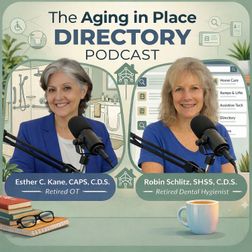
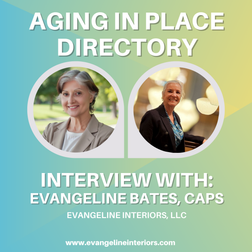
#6 - Interview With Evangeline Bates of Evangeline Interiors

Got a comment or idea? Send us a text. Evangeline Bates has been an interior designer for decades but has added to her extensive repertoire the skills of an Aging In Place Specialist and Universal Design specialist as well.In this interview she gleefully talks about how integrating both skill sets has helped her to help so many of her clients to enjoy their living environments and to continue being as independent as possible as they grow older.It was an absolute pleasure to speak with Evangeline and learn about her business and her services.If you need someone who can help you to integrate interior design and aging in place principles, contact her at her website, https://evangelineinteriors.com. Thanks for listening! Sign up to our Homeowners Newsletter - it's a weekly newsletter filled with expert tips and advice on how to age safely and more comfortably in your own home.If you provide services for modifying homes for disabled or seniors aging in place, sign up to our directory and expand your business.
#5 - Making A Senior Friendly Kitchen

Got a comment or idea? Send us a text. There are 10 areas to focus on to make the kitchen a safe place for seniors: Fire Safety is first and foremost the very first thing that should be addressed. Smoke Alarms and Carbon Monoxide Detectors are necessary tools in your kitchen. Just be sure to check / test them on a regular basis. Modifications to organize the kitchen to decrease clutter, decrease excess mobility and help with fall prevention. Re-arranging cabinets, drawers, pantry and refrigerator to make it easier to reach for things, especially heavy items. Keeping small appliances at easy reach such as waist level on counters or table. Ample Lighting is often overlooked but so important as older adults’ vision tends to decrease. Anti Slip Flooring to help decrease fall risks. Senior Friendly Appliances that are equipped with safety monitors, automatic shut-off devices, alarms and are also easy to use. Maintenance of kitchen equipment is important to keep things running smoothly and minimize possible hazards. Useful Tools and Gadgets that allow older adults to be as independent and safe as possible. Kitchen Chairs are often overlooked as a safety factor for seniors. Many older adults use kitchen chairs with coasters to make it easier to move the chair but these could end up causing an injury. Removing Sharp Objects for homes with seniors who are suffering from dementia or Alzheimer’s disease. Cooking safety tips for seniors – besides avoiding loose clothing when cooking, we have even more tips on kitchen safety issues concerning cooking Thanks for listening!  Sign up to our Homeowners Newsletter - it's a weekly newsletter filled with expert tips and advice on how to age safely and more comfortably in your own home.If you provide services for modifying homes for disabled or seniors aging in place, sign up to our directory and expand your business.
3 di 12