Truth about Local Government

Truth about Local Government

por Matt Masters

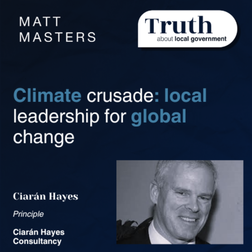
Climate crusade: local leadership for global change featuring Ciarán Hayes

In this episode host Matt Masters engages with the esteemed Ciarán Hayes, a veteran in Irish local government service with 42 years of dedicated experience. As the former Chief Executive of Sligo County Council and a current board member of both the Sustainable Energy Authority of Ireland (SEAI) and the National Oversight and Audit Commission (NOAC), Mr. Hayes brings a wealth of knowledge to the table. Together, they delve into the pivotal role local authorities play in spearheading climate initiatives. They discuss actionable strategies for mobilizing communities, the importance of integrating sustainable practices into urban planning, and how local governance can set the stage for impactful environmental policies. Listeners will gain insights into Mr. Hayes’ extensive experience in public service, exploring how his work with SEAI and NOAC aligns with his commitment to fostering sustainable energy solutions and transparent governance. This episode is a must-listen for anyone interested in how local action can lead to significant global progress in the fight against climate change.

Beyond the Logo: Unveiling the Essence of Branding with Paul Woodford

Brand is so much more than a logo and the graphical support of an organisation. It is about the essence of what that organisation stands for, who they are and how they live that. Ta6, is a brand within Alliance Leisure, which Paul Woodford, Strategic Engagement Director leads. Today we talk with Paul about the power of brand in leisure, looking at global, venue and product within the brand proposition. Paul then shares the success stories of when this has worked.

Cultivating Effective Governance in Local Authorities with Simon Goacher

In this episode, Simon Goacher - Partner at Weightmans LLP we delve into the critical role of governance within local authorities. With recent high-profile interventions and financial pressures leading to section 114 reports, the need for practical solutions has never been more urgent. We explore the systems and processes that provide essential checks and balances on decisions, emphasizing that these mechanisms can only succeed when anchored in a positive culture of governance. Join us as we discuss strategies, challenges, and success stories from the frontlines of local government.

Structure, Agency, and Local Climate Governance: How Do Individual Actors Exploit Local Contexts to Shape Policymaking in Smaller Cities and Towns?

Today we sat down with Dr Peter Eckersley who is an Associate Professor in Public Policy and Management at Nottingham Business School. His research focuses on central-local government relations, public policy, climate change, sustainability and public accountability. Peter is also Managing Editor of Local Government Studies and Co-Convenor of the UK Political Studies Association's Specialist Group on Local Politics. Alongside his post at NBS, Peter also works part-time at the Leibniz Institute for Research on Society and Space in Erkner (near Berlin), where he studies climate policy in German cities. Today we explored Peter’s article on “Structure, Agency, and Local Climate Governance: How Do Individual Actors Exploit Local Contexts to Shape Policymaking in Smaller Cities and Towns?” he co-produced with Wolfgang Haupt and Leonie Lauga. In this the authors explore the interplay between structural conditions and individual agency in local climate policymaking. This can be applied by local government to policy making around climate but is also much more broadly linked to policy development across local government. Here are the key points: Structural Conditions and Climate Action:Previous studies emphasize that structural factors significantly influence local climate policy. Factors such as population size, wealth, education levels, civil society engagement, and political dynamics impact a city’s ambition in climate mitigation and adaptation. Larger, wealthier cities with active civil society organizations and green parties tend to be climate “forerunners,” while smaller municipalities with older populations and weaker civil society engagement may lag behind in climate action. Role of Agency:The article highlights the role of individual agency in shaping climate-related policies. Despite challenging local conditions, active individuals within municipal administrations can drive ambitious climate policy. These “unusual suspects” or “ordinary cities” demonstrate that agency matters, even in less favorable contexts. Framing Policies for Local Support:The study draws on fieldwork in 11 German towns to show how municipal managers frame climate policies. Their framing strategies aim to gain local support for climate action. Socio-economic, demographic, and political conditions influence these framings, but individual agency remains crucial. Two-Dimensional Framework:The authors propose a two-dimensional framework for future research on structure and agency in local governance. They caution that studying this interplay can be challenging but essential for understanding effective policymaking. In summary, while structural conditions set the stage, individual actors play a vital role in shaping climate policies at the local level.

Breaking down barriers in Local Authority recruitment with Nicola Hallworth-Rudd

In this episode of our podcast, we sit down with Nicola Hallworth-Rudd, Head of Public Sector UK at Michael Page, to delve into the intricate challenges and innovative solutions in public sector recruitment. Nicola brings her extensive experience to the table, discussing the complexities of various organizational structures like CA, UA, and MBC, and how they can be perplexing for those outside the sector. Challenges Explored: The daunting message of austerity and financial constraints that make the public sector less appealing. Councils’ struggle to effectively communicate their mission and community support. The difficulty in attracting suitable talent for roles that are complex, broad, and high-pressure. The challenge of competing in a recruitment market dominated by the private sector’s deeper pockets and superior digital technology. The perception of councils being predominantly run by the white middle class, with website imagery reinforcing this view. Recruitment processes often prioritizing cost over quality, potentially overlooking candidates who could offer long-term savings. The issue of retention, with professionals leaving for less stressful, more flexible, and better-supported roles elsewhere. Solutions Discussed: Brand Amplification: Nicola emphasizes the importance of showcasing your brand as a window to potential applicants. She suggests creating a website with diverse imagery, using pen portraits and videos from various organization levels, ensuring inclusive language, and telling the positive stories of local community support and complex project delivery. Michael Page’s digital marketing team can craft a bespoke microsite to encapsulate all these elements. Accessing Talent: Leveraging a recruitment agency’s expertise in the public sector is crucial for spreading your message. Nicola advises utilizing digital marketing tools, LinkedIn data mining, experienced researchers to explore new markets, and recruitment consultants to tap into personal networks for referrals. Diverse Talent Acquisition: At Michael Page, the journey begins internally by fostering a diverse workforce. Collaborating with external agencies for up-to-date advice, providing mandatory inclusive recruitment training, and having an Equity, Diversity & Inclusion Consulting Team are key steps. This team, with lived experience of protected characteristics, works with partner organizations, runs diversity groups, reviews recruitment processes, and participates in recruitment panels to ensure inclusivity. Streamlined Recruitment Processes: Nicola outlines the need for expedited and sales-focused recruitment processes, including only critical actions, setting clear timelines, discussing council benefits, using efficient vetting suppliers, and ensuring quick offer processes. Continuous communication and a smooth onboarding experience are also highlighted. Join us as we uncover the nuances of public sector recruitment with Nicola Hallworth-Rudd and learn how to navigate its challenges with strategic solutions.

Supporting Midlife Women in the Public Sector with Sarah Clein

In this episode, Sarah Clein, who has over 30 years of experience working in the public sector and with small businesses, discusses the challenges faced by midlife women in this field. Let’s dive into the key questions and points covered: Who does Sarah Clein work with and why?Sarah collaborates with midlife women in the public sector. Her goal is to address their unique needs and empower them to thrive. What issues do midlife women face at this stage in life?Midlife women encounter various challenges, including navigating toxic work environments, managing multiple responsibilities, and coping with menopause. What happens to midlife women when they are not supported?Without proper support, midlife women may experience burnout, decreased job satisfaction, and compromised well-being. Why does supporting midlife women matter?Supporting midlife women benefits both individuals and organizations. It enhances productivity, retention, and overall workplace satisfaction. What does the data say about women in the public sector?The data highlights disparities in representation and opportunities for women. Understanding these trends is crucial for creating positive change. What do we know about the representation of women in local government?Women are often underrepresented in leadership roles within local government. Addressing this gap is essential for achieving gender equality. Why might women want to leave the public sector?Factors such as lack of support, limited career progression, and work-related stress can lead women to consider leaving the public sector. What do organizations need to do to support their midlife workforce?Organizations should prioritize flexible work arrangements, provide mentorship, and create a supportive environment for midlife women. You can listen to the full episode on The Knackered Women’s Club podcast or find more information about Sarah Clein’s work on Eventbrite. Research and data cited can be viewed on the below links. https://www.fawcettsociety.org.uk/news/new-data-shows-make-up-just-a-third-of-local-election-candidates-in-england https://researchbriefings.files.parliament.uk/documents/SN06838/SN06838.pdf https://www.fawcettsociety.org.uk/Handlers/Download.ashx?IDMF=9bd9edd3-bd86-4317-81a1-32350bb72b15 https://www.unison.org.uk/news/2024/02/women-in-the-uks-public-services-repeatedly-denied-flexible-work-requests/ https://publications.parliament.uk/pa/cm5803/cmselect/cmwomeq/91/report.html#heading-2

Stockport’s £1 Billion Regeneration Plans: Shaping the Future with Paul Richards

This episode delves into Stockport’s place shaping journey, with Paul Richards, Director of Development and Regeneration, Stockport Council and Chief Executive, Stockport Mayoral Development Corporation. Stockport is transforming itself into an attractive place to live, work, and connect, with ambitious investments in heritage buildings, architecture, and green spaces. The challenge of effective place shaping is a critical part of the council’s role, and Stockport’s journey exemplifies this.

Rising Together: Turning External Challenges into Community Strength FT Jim Savege

In this episode, Jim Savege, Chief Executive in Aberdeenshire Council and I explore how communities can thrive by leveraging external events to build resilience, foster partnerships, and create lasting positive change. Tune in as we discuss inspiring stories, practical strategies, and the power of collective action.

Why communications and engagement are imperative in planning Ft Rowan Cole

.Great to sit down with Rowan Cole, Director of Coalface Engagement, to discuss the importance of planning in communications and engagement in planning. Today Rowan answered the following questions: How does effective communication improve the reception of Local Plans when presented to local communities? What are some common challenges local governments face in engaging with their communities on Planning matters? How does communications and engagement protect Council's reputation in the face of large scale private development proposals? What role does technology play in enhancing communication and engagement on planning matters? What emerging trends or practices should local governments be aware of to improve their engagement strategies? Thank you to our sponsors RPNA, who drive sustainable transformation by combining innovative thinking, established methodology, and boundless enthusiasm to unlock an organisation's potential and deliver lasting change.

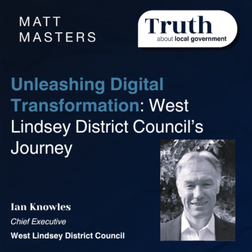
Unleashing Digital Transformation: West Lindsey District Council’s Journey Ft Ian Knowles

Ian Knowles, the Chief Executive Officer at West Lindsey District Council, has been instrumental in shaping the council’s vision and driving positive change. Today we discussed the following questions: 1 – How does your approach to Digital Strategy differ from what you have done in the past? 2 – How have you ensured that your system implementation has been successful? 3 – How does your Executive Business Plan make a difference? 4 – What did you do differently in your approach to ex RAF Scampton? Under Ian’s leadership, West Lindsey District Council has established a clear strategic framework. This framework focuses on three key themes: "our council, our people, and our place". Ian Knowles embodies the spirit of transformation, and his commitment to West Lindsey District Council’s success is evident. His leadership ensures that the council remains passionate, proactive, open, and honest in serving its community. In their recently adopted Digital ICT Vision, West Lindsey District Council aims to enable modern, high-quality services that meet the needs of both customers and staff. Their vision focuses on creating a customer-focused council through people-led change, operating in a thriving digital environment. The council’s approach includes leveraging Microsoft Office corporate tools, SugarCRM, and an increasing use of robotic process automation, AI, and integrations. This forward-thinking approach sets them apart from traditional digital strategies, as they prioritize adaptability and openness to opportunities in the modern digital world. Overall, West Lindsey District Council’s commitment to digital transformation is commendable, and it’s exciting to see how their efforts will continue to benefit their community! Thank you to our sponsors Local Partnerships LLP. Local Partnerships is an in-house public sector consultancy jointly owned by the LGA, HM Treasury and Welsh Government. We work solely for central government departments, the Welsh Government, councils and combined authorities. Local Partnerships delivers value and efficacy for the public purse. As a key interface between local and central government, we provide expert advice and practical resources alongside project and programme delivery support, enabling public services to thrive. Whether supporting and accelerating the delivery of major infrastructure, tackling climate challenges through waste efficiency and renewable energy propositions through to wider place-making initiatives, we help transform services across the public sector ecosystem.
22 de 36