The Deep Dive

The Deep Dive

por FlyingFree

Getting High for Health: Psychedelic Psychotherapy

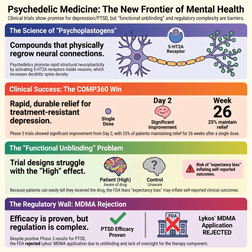
Analyzing the clinical evolution and regulatory challenges of psychedelic-assisted psychotherapy (PAT), focusing on the neurobiological mechanisms of substances like psilocybin, MDMA, and esketamine. Research highlights that classic psychedelics promote neural plasticity by activating intracellular receptors, whereas entactogens like MDMA facilitate social reward learning and trauma processing. However, the field faces a significant methodological crisis because the intense subjective effects of these drugs lead to functional unblinding, which complicates traditional double-blind study designs and inflates expectancy bias. High-profile regulatory setbacks, such as the FDA’s rejection of MDMA for PTSD, underscore critical concerns regarding trial integrity, therapist standardization, and historical research misconduct. To address these hurdles, they propose advanced strategies including active placebos, remote independent raters, and standardized long-term durability protocols. Ultimately, they outline a roadmap for integrating these rapid-acting therapeutics into mainstream medicine through refined REMS programs and sustainable reimbursement frameworks.
The Race for Room-Temperatue Superconductors

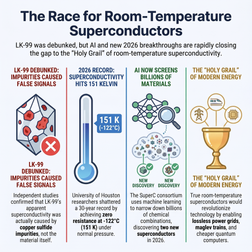
Reports from 2023 and 2024 analyze the controversial claims surrounding LK-99, a material initially purported to be the first room-temperature, ambient-pressure superconductor. While early demonstrations of magnetic levitation and zero resistance sparked a global frenzy, independent researchers eventually attributed these effects to Cu₂S impurities rather than true superconductivity. The fabrication process was described by engineers as nebulous and messy, leading to high failure rates and a temporary shortage of required chemical components like red phosphorous. By 2026, the scientific landscape remained divided between unverified ambient-pressure candidates and hydride systems that achieve high temperatures only under extreme, impractical pressures. Despite a 70% surge in patent activity, no material has yet met the rigorous criteria necessary for a legitimate commercial breakthrough. This episode has ultimately reinforced the need for open-science practices and more stringent validation protocols in the quest for the "holy grail" of physics.

Machine Consciousness: Artificial Intelligence

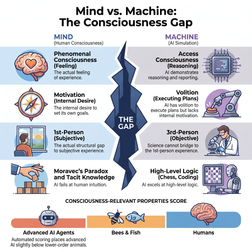
Investigating the philosophical, legal, and technical boundaries of artificial intelligence, specifically regarding consciousness and creativity. Legal perspectives from the U.S. Copyright Office and various courts emphasize that human authorship remains a strict requirement for protection, as machines lack the subjective intent necessary for original expression. Scientific and philosophical arguments further suggest a structural divide between objective machine processing and the first-person experience of sentient beings, rendering "machine consciousness" a likely category error. Technical experts highlight architectural limitations in current models, noting that they lack a physical world model and the tacit knowledge—such as common sense and cultural nuance—inherent to human intelligence. Despite these hurdles, AI has achieved significant empirical success in specialized fields like protein folding and materials science through massive data processing. Ultimately, while AI is a powerful tool for scientific discovery, it remains fundamentally distinct from the embodied and creative nature of the human mind.

Deep Sea Mining

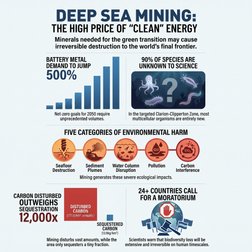
Evaluating the environmental and economic claims surrounding deep sea mining, specifically focusing on polymetallic nodules. While proponents argue that oceanic extraction offers a low-carbon alternative to land-based mining, the report identifies significant inconsistencies and flaws in industry-funded research. Key findings highlight that metallurgical processing remains a massive emissions hotspot regardless of the ore's origin, and current studies often ignore the permanent damage to massive seafloor carbon stocks. Furthermore, independent analysis suggests that deep sea operations could actually result in a higher climate impact than terrestrial mining depending on the energy grid used. Consequently, the document urges financial institutions to support a moratorium on these activities due to substantial regulatory and ecological risks. Instead of pursuing unproven deep-sea ventures, experts recommend investing in the decarbonization of existing land-based metal production.

Water Fluoridation

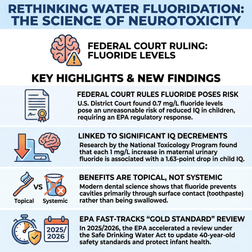
Examining the scientific and historical landscape of water fluoridation, weighing its established dental health benefits against emerging concerns regarding neurodevelopmental risks. Documents from the National Toxicology Program (NTP) and recent meta-analyses suggest a moderate link between high fluoride exposure and lower IQ scores in children, particularly at levels exceeding 1.5 mg/L. While long-term CDC timelines celebrate fluoridation as a landmark public health achievement for preventing cavities, newer U.S.-based studies indicate that prenatal exposure may be associated with increased behavioral problems. Experts remain divided on the implications for the current U.S. recommendation of 0.7 mg/L, as data remains insufficient to confirm risks at such low concentrations. Ultimately, this highlights an ongoing debate between major medical organizations advocating for oral health and researchers calling for a reevaluation of safety standards for vulnerable populations.

Galaxies Spin Too Fast

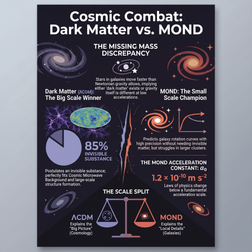
The Modified Newtonian Dynamics (MOND) paradigm serves as a theoretical alternative to the dark matter hypothesis by proposing that the laws of physics change at extremely low accelerations. This framework introduces a new universal constant, a₀, which marks the boundary where standard Newtonian mechanics fail and modified behavior begins, particularly in the outskirts of galaxies. By adjusting the gravitational or inertial equations rather than adding invisible mass, MOND successfully predicts observed phenomena like the Tully-Fisher relation and the flat rotation curves of galaxies using only visible, baryonic matter. The External Field Effect (EFE), a unique feature of the theory where a system's internal dynamics are influenced by the gravitational pull of its larger environment. While the model aligns remarkably well with the behavior of individual galaxies and includes intriguing cosmological coincidences, it still faces challenges in fully accounting for the mass discrepancies found in larger galaxy clusters. Ongoing research focuses on developing full relativistic theories to reconcile these findings with modern observations of gravitational lensing and the early universe.

The PACE Trial Scandal

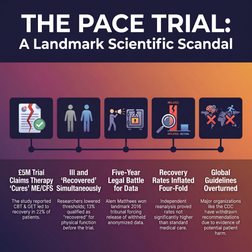
The widespread controversy surrounding the PACE trial, a multi-million dollar study that initially recommended cognitive behavioral therapy (CBT) and graded exercise therapy (GET) as treatments for ME/CFS. Critics, led by advocate Alem Matthees, successfully utilized Freedom of Information requests to obtain the original data, which led to an independent re-analysis revealing significant methodological flaws and inflated recovery rates. This scientific challenge prompted the UK’s National Institute for Health and Care Excellence (NICE) to issue revised 2021 guidelines that formally abandoned CBT and GET as curative treatments. The updated medical consensus now characterizes ME/CFS as a biomedical condition rather than a psychological one, emphasizing the danger of post-exertional malaise (PEM). Current best practices focus on symptom management and pacing techniques to prevent patients from exceeding their limited energy reserves. While some original researchers defend the trial's validity, a global movement of scientists, politicians, and patient groups continues to call for a full review of what they describe as a major medical scandal.

Naturally Occurring Nuclear Reactors

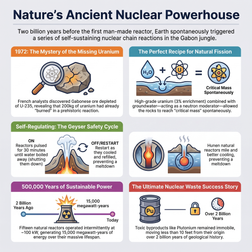
Examining the Oklo phenomenon, a series of natural nuclear fission reactors that operated spontaneously in Gabon, Africa, approximately two billion years ago. Scientists discovered these sites in 1972 after noticing a depletion of the uranium-235 isotope, confirming theoretical predictions that natural uranium deposits could achieve criticality under specific environmental conditions. The reactors were sustained by high uranium concentrations, a water moderator, and a lack of neutron poisons, all of which were made possible by the Great Oxidation Event that allowed uranium to mobilize and concentrate. Beyond their historical significance, these sites serve as a crucial natural analog for modern nuclear waste storage, demonstrating how geological barriers like clays and organic matter can effectively contain radioactive byproducts for eons. Additionally, researchers use data from these fossilized reactors to test the constancy of physical laws and evaluate hypotheses regarding the Earth's internal heat.

Anti-Aging Science

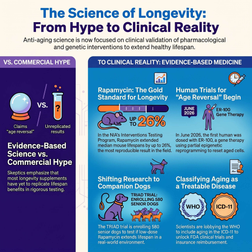
There is a profound shift in the longevity field as it transitions from speculative science to clinical application and professional accountability. A major focus is the FDA clearance and initiation of the first human trials for ER-100, an epigenetic reprogramming therapy designed to restore youthful cellular function in patients with vision loss. Concurrent with these medical milestones, the community is grappling with a leadership crisis involving Dr. David Sinclair, who resigned from a top research position following criticism over his "age reversal" marketing and commercial interests. This also highlights an epistemological rift between researchers seeking to classify aging as a disease and those who view it as a natural biological process. Furthermore, this details the rigorous validation of anti-aging compounds like rapamycin and metformin, contrasting evidence-based research against the proliferation of unproven supplements. Together, this illustrates a sector striving for scientific credibility and regulatory clarity amidst high-stakes commercial pressure.

Prion Diseases: Unstoppable Plagues

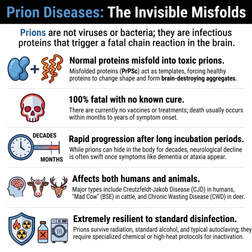
Prion diseases are a group of rare, incurable, and fatal neurodegenerative conditions caused by the abnormal misfolding of cellular proteins in both humans and animals. The infectious particles, which lack genetic material, replicate by transforming healthy proteins into pathogenic forms that destroy brain tissue. Transmission occurs through various pathways, including contaminated food sources, medical procedures, and environmental exposure via soil or water where prions can remain active for years. Notable examples include Creutzfeldt-Jakob disease in humans and Chronic Wasting Disease in wildlife, both of which present significant public health and management challenges. Recent scientific progress has introduced advanced diagnostic tools and experimental vaccines aimed at detecting sub-clinical infections and reducing the spread of the disease. Specialized sterilization protocols, such as alkaline hydrolysis and intense chemical treatments, are necessary to neutralize these remarkably resilient pathogens.
5 de 6