School of Radical Imagination Podcast

School of Radical Imagination Podcast

por School of Radical Imagination
Temporada 1
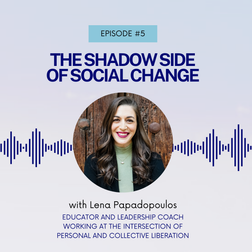
The Shadow Side of Social Change | Lena Papadopoulos
What if the way we're trying to change the world is also keeping it the same? In this conversation, Lena Papadopoulos explores how systems of oppression become internalized—and how they quietly shape the way we show up in our relationships, communities, and movements for change. Together, we discuss saviorism, martyrdom, purity politics, and why building a more liberatory future begins with radical honesty. If you've ever wondered how to care for others without losing yourself—or how to create change without recreating the systems you're resisting—this conversation is for you. Resources & Links 🎓 Learn more about Weaving Webs of Care https://www.radicalimagination.school/courses/weaving-webs-of-care Sat, Jul 25 · 11:00 AM – 2:00 PM ET Sun, Jul 26 · 11:00 AM – 2:00 PM ET 📚 Explore upcoming courses https://www.radicalimagination.school In This Episode 01:17 Why Lena created Weaving Webs of Care 03:22 Shadow work, self-expression, and collective liberation 05:49 Saviorism, martyrdom, and purity politics 09:40 How we can cause harm with the best of intentions 13:19 Inside the Weekend Intensive: from radical honesty to radical imagination 15:17 Imagining a world rooted in love rather than disconnection 17:12 Why Lena chose to teach at the School of Radical Imagination Key Takeaways Oppressive systems become internalized, shaping how we relate to ourselves and others. Saviorism, martyrdom, and purity politics often emerge from unmet needs for belonging, safety, and validation. Radical honesty is a prerequisite for collective liberation. Community creates the conditions for deeper transformation than we can achieve alone. Building a new world requires both shadow work and the courage to imagine new ways of being together. Connect Follow the School of Radical Imagination for weekly conversations exploring education, liberation, creativity, systems change, healing, and the futures we're being called to build. If this conversation resonated with you, please subscribe, leave a review, and share it with someone who is committed to building relationships and communities rooted in care rather than extraction.
The Values Lab: Living What You Stand For with Angela Montijo
What happens when the life you've built no longer reflects what you believe? In this conversation, Angela Montijo shares how reconnecting with her core values gave her the courage to make a difficult life change. Together, we explore the difference between inherited and chosen values, how our values shape the way we show up in relationships and movement spaces, and why clarity is often more important than certainty. If you've ever felt pulled in different directions—or wondered what it really means to live in alignment with what you stand for—this conversation is for you. Resources & Links 🎓 Learn more about The Values Lab: Living What You Stand For https://www.radicalimagination.school/courses/the-values-lab-living-what-you-stand-for 📚 Explore upcoming courses at the School of Radical Imagination https://www.radicalimagination.school/courses In This Episode 01:27 Why Angela created The Values Lab 05:04 Moving beyond the traditional values exercise 08:22 The four-week journey from reflection to integration 13:30 When our values clash in relationships 15:38 Values, movement spaces, and learning to work across difference 21:47 Why emergence—not certainty—is at the heart of learning Key Takeaways Values are not abstract ideals—they become a compass for making difficult decisions. Many of our values are inherited. The work is discerning which ones still belong to us. Small, intentional shifts often create more lasting change than dramatic overhauls. Understanding one another's values can deepen relationships and reduce conflict. Connect Follow the School of Radical Imagination for weekly conversations exploring education, liberation, creativity, systems change, healing, and the futures we're being called to build. If you enjoyed this episode, please subscribe, leave a review, and share it with someone who is navigating an important life decision or searching for greater clarity about what they truly stand for.
Education in Times of Revolution | A Conversation with Dr. Butch Ware
What is the purpose of education? In this founding conversation, historian, educator, and activist Dr. Butch Ware argues that education is not simply about acquiring knowledge—it's about becoming more fully human. Recorded at the School of Radical Imagination's inaugural summit, Education in Times of Revolution, this conversation explores how systems of education have been used to uphold empire, capitalism, and white supremacy, and what it would mean to reimagine learning as a practice of liberation instead. Together, we discuss the Black liberation tradition, lifelong learning, imagination as resistance, parenting, spirituality, and why the ultimate purpose of education is to cultivate human beings capable of building societies rooted in love, justice, and care. Resources & Links 🎓 Explore upcoming courses: https://www.radicalimagination.school/courses 🌍 Learn more about the School of Radical Imagination: https://www.radicalimagination.school In This Episode 3:29 What does "education in times of revolution" mean? 06:20 How education reproduces white supremacy, capitalism, and empire 10:19 Building a School of Radical Imagination—and learning from the Black liberation tradition 17:40 The true purpose of education: becoming more fully human 20:42 Parenting, schools, and protecting children's innate curiosity 28:07 Why learning should last a lifetime 31:14 Malcolm X, prisons, and education as liberation 35:55 Why imagination is itself a radical practice 41:31 Rest, healing, and accountability in movement spaces 45:46 Intellectual humility and learning how to say "I don't know" 51:24 Knowledge is not a commodity Key Takeaways The purpose of education is not simply to transmit information, but to cultivate our shared humanity. Systems of education are never neutral—they shape how we understand ourselves and the world. Radical imagination is itself a form of resistance because it expands what we believe is possible. Liberation requires both unlearning oppressive systems and reconnecting with histories and traditions that have been intentionally erased. Knowledge is not a commodity to consume—it is something we cultivate, embody, and share in relationship with one another. Connect Follow the School of Radical Imagination for weekly conversations exploring education, liberation, creativity, systems change, spirituality, healing, and the futures we're being called to build. If you enjoyed this episode, please subscribe, leave a review, and share it with someone who is asking deeper questions about what education—and our world—could become.
Radical Imagination: Visions for Liberatory Futures | Hanieh Khosroshahi
How do we move from imagining a more just world to actually building it? In this conversation, designer and educator Hanieh Khosroshahi explores design as a practice of collective liberation—one rooted in co-creation, relationships, and shared responsibility. Together, we discuss grief, solidarity across movements, and why creating space for these conversations is essential if we want to imagine new futures. We also reflect on what makes learning at the School of Radical Imagination different: intimate cohorts, honest dialogue, and the belief that another world is something we create together. Resources & Links 🎓 Learn more about Radical Imagination: Visions for Liberatory Futures https://www.radicalimagination.school/courses/radical-imagination-visions-for-liberatory-futures 📚 Explore upcoming courses https://www.radicalimagination.school/courses In this Episode 01:25 Why Hanieh found design—and why it became a tool for liberation 03:20 Design as a practice of collective liberation 08:05 What is design thinking? 09:40 Inside Designing for Liberation: from responsibility to collective action 13:10 Holding grief in community during times of crisis 18:20 Grief, white supremacy, and transnational solidarity 21:25 Why radical imagination must be a collective practice 22:35 Inside the Weekend Intensive: from vision to action 24:45 The four pillars for building liberatory futures 28:30 Why collective imagination is more powerful than going it alone 30:10 What makes learning at the School of Radical Imagination different 32:05 Final reflections: hope, community, and belonging Key Takeaways Liberation isn't something we design for people—it must be designed with them. Design is a collaborative process rooted in listening, iteration, and shared responsibility. Grief isn't separate from the work of social change—it is part of it. Collective imagination helps us move beyond inherited assumptions and create new possibilities together. Building a more just future requires new skills, new relationships, and the courage to question the systems we've inherited. Connect Follow the School of Radical Imagination for future conversations exploring liberation, creativity, systems change, education, technology, healing, and the futures we're being called to build. If you enjoyed this episode, please subscribe, leave a review, and share it with someone who is imagining a better world.
Living with Imagination & Optimism | Dr. Sheila Pontis
What if the greatest barrier to creating a better future isn't a lack of ideas, but the invisible social norms that shape what we believe is possible? In this conversation, Dr. Sheila Pontis explores why imagination is a skill we can cultivate, how judgment and conformity limit our thinking, and why imagining radically different futures is work we were never meant to do alone. As we venture into uncharted territory, we need spaces where we can question inherited assumptions, expand our sense of possibility, and imagine new ways of being—together. Resources & Links 📚 Learn more about Living with Imagination & Optimism https://www.radicalimagination.school/courses/living-with-imagination-and-optimism 🎓 Explore upcoming courses https://www.radicalimagination.school/courses In this Episode 00:00 Welcome to the School of Radical Imagination Podcast 01:35 Why Sheila dedicated her career to studying imagination 05:10 The science of imagination: philosophy, psychology, and neuroscience 09:15 Memory, imagination, and creativity—what's the difference? 13:20 Why we lose our imagination as adults 18:30 Everything is a social construct: reclaiming what's possible 22:10 What is radical imagination? 25:00 Why optimism matters when imagining the future 28:40 Judgment, education, and the hidden barriers to imagination 32:30 Reimagining education and cultivating human skills 34:30 Sheila's course: Living with Imagination & Optimism 36:10 Final reflections: imagination as a transformative practice Key Takeaways Imagination is a human capacity—not a talent reserved for artists. Memory provides the raw material from which imagination creates new possibilities. Judgment and social conditioning are among the greatest barriers to imagination. Radical imagination requires us to question inherited assumptions about how the world works. Building a better future begins with cultivating our own inner capacity to imagine it. Connect Follow the School of Radical Imagination for future conversations exploring liberation, creativity, systems change, education, technology, healing, and the futures we're being called to build. If you enjoyed this episode, please subscribe, leave a review, and share it with someone who is imagining a better world.