Mic’d Up Money Reloaded with Efrem Keith Simmons

Mic’d Up Money Reloaded with Efrem Keith Simmons

por Efrem Keith Simmons
Temporada 20267
Tax Reality or Tax Fantasy | When Tax Strategy, Tax Scams, and Bad Execution Collide
Tax Reality or Tax Fantasy? explores the difference between legitimate tax strategy, poorly executed tax planning, misleading social-media advice, and outright tax scams. Efrem Keith Simmons breaks down write-off myths, trusts, child employment strategies, Offers in Compromise, fake LLC and EIN schemes, state and local tax compliance, S corporations, foreign-owner myths, and the costly consequences of claiming a strategy without completing the required execution. Best For: Entrepreneurs and small-business owners Anyone using or considering LLC, S corporation, trust, or family-employment strategies Business owners overwhelmed by conflicting tax advice online Taxpayers considering an Offer in Compromise Owners concerned about state, local, licensing, or entity compliance Entrepreneurs who want to distinguish real tax strategy from tax fantasy Mic’d Up Money Reloaded — where entrepreneurs talk money, strategy, systems, and execution.
YOUR BUSINESS IS GROWING. BUT ARE YOU? Entrepreneurial Performance Development, Self-Efficacy, and Why the Same Topic May Require a Different Cohort
Your business can grow while your own capability quietly falls behind. Revenue can increase. Employees can multiply. Systems can become more complicated. More work can be delegated. Yet the entrepreneur may understand less and less about what is actually happening inside the company. When business complexity begins growing faster than owner capability, growth can create dependency, weak oversight, poor decisions, and risks the owner does not recognize until something goes wrong. In this research-driven episode of Mic’d Up Money Reloaded, Efrem Keith Simmons connects his University of Memphis research on entrepreneurial learning and self-efficacy with his current applied framework of Entrepreneurial Performance Development. The conversation moves beyond simply asking whether entrepreneurs need more education. The better question is: What does this entrepreneur need to be able to do that they cannot adequately do right now? Efrem examines the original Potentiality → Reality → Self-Efficacy learning progression, explains why practical entrepreneurial learning should be relevant, adaptable, and tied to real performance needs, and explores the difference between confidence and demonstrated competence. The episode also introduces a critical development principle: the topic may be the same while the entrepreneur’s developmental need is different. One entrepreneur may need foundational instruction. Another may understand the concept but struggle to apply it. Another may have delegated the function and need enough knowledge to supervise it intelligently. A more advanced entrepreneur may need complex problems, exceptions, and changing conditions that force adaptation. That leads to Same-Topic / Different-Cohort Learning and a larger question for entrepreneurial education: Should every entrepreneur who needs to learn finance, management, marketing, operations, or strategy automatically receive the same course? This episode also challenges entrepreneurs to examine whether their confidence is supported by actual capability. The goal is not maximum confidence. The goal is calibrated self-efficacy—confidence reasonably aligned with knowledge, experience, demonstrated performance, available resources, and the complexity of the business. Best for entrepreneurs, business owners, consultants, coaches, trainers, educators, organizational leaders, and anyone responsible for developing entrepreneurial capability rather than simply delivering information. Strategic Hustling Moment: Do not let the business outgrow you. Mic’d Up Money Reloaded with Efrem Keith Simmons Where entrepreneurs talk money, strategy, systems, and execution.
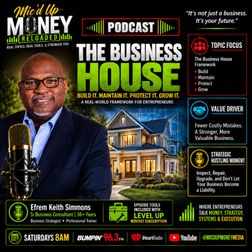
The Business House | Build It, Maintain It, Protect It, Grow It
Most business education starts with sales. But sales is only the front door of the business. A company can generate revenue and still collapse because the rest of the structure was never properly built, maintained, repaired, or upgraded. In this episode of Mic’d Up Money Reloaded, Efrem Keith Simmons introduces The Business House Framework, a multidisciplinary way to understand how the major functions of a business work together. Financial management is the concrete slab. Management is the blueprint. Operations provides the framing. Sales is the front door. Marketing and branding form the roof. Accounts receivable and cash flow operate like the electrical system, while accounts payable functions like the plumbing. Cash reserves, lines of credit, and optimized credit capacity provide the basement and fallout shelter that can help the business survive difficult economic conditions. Behavioral economics becomes the paint because perception, emotion, biases, incentives, and decision-making influence what happens both inside and outside the business. The market becomes the neighborhood. The economy becomes the weather. Scammers and predatory operators become the shrubbery surrounding the property. Efrem also examines one of the biggest dangers facing established businesses: deferred maintenance. Entrepreneurs often ignore declining margins, cash leaks, outdated systems, operational weaknesses, changing customer behavior, and warning signs in their financial performance. Small problems are allowed to remain until they become expensive repairs or business-threatening emergencies. The business model becomes the ongoing repair, maintenance, and upgrade system. Pricing, customer mix, revenue streams, capacity, cost structure, delivery methods, technology, and operations must be continually evaluated so yesterday’s business model does not become tomorrow’s liability. The objective is simple: build a business that remains an investment instead of becoming a liability to its owner. Best for: Entrepreneurs, small-business owners, founders, consultants, family-business leaders, nonprofit executives, managers, aspiring entrepreneurs, and business professionals who want to strengthen financial management, cash flow, operations, strategy, risk management, business models, and long-term sustainability. Mic’d Up Money Reloaded — where entrepreneurs talk money, strategy, systems, and execution. Like, share, comment, and subscribe for practical business education.

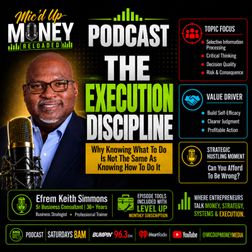
The Execution Discipline | Why Knowing What To Do Is Not The Same As Knowing How To Do It
The Execution Discipline: Why Knowing What to Do Is Not the Same as Knowing How to Do It Knowing the answer is not the same as being able to execute it. In this episode of Mic’d Up Money Reloaded, Efrem Keith Simmons breaks down the discipline required to turn information, training, experience, and strategy into profitable action. The discussion explores seven execution archetypes, including the arrogant, ignorant, brute-force, teachable, effort-avoidant, rescue-dependent, and trained but nonadaptive executor. You will also learn how critical thinking, selective information processing, behavioral economics, risk and consequence management, advanced pattern recognition, Profit Mindfulness, and Execution Mindfulness affect the quality of your decisions. The episode challenges entrepreneurs to evaluate both quantitative and qualitative information, distinguish isolated events from meaningful patterns, recognize the biases that distort judgment, and ask a critical question before major decisions: Can I afford to be wrong? The goal is greater business self-efficacy, not stubborn dependency. Better business education should help you think more clearly, make stronger decisions, adapt what you know to changing conditions, and execute with greater confidence and accountability. Best for: entrepreneurs, business owners, consultants, managers, leaders, founders, professionals moving into entrepreneurship, and anyone who has knowledge, training, or experience but struggles to consistently turn what they know into effective execution. Mic’d Up Money Reloaded Where entrepreneurs talk money, strategy, systems, and execution.
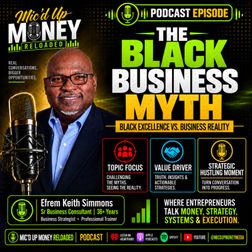
The Black Business Myth | Black Excellence vs. Business Reality
What is really happening inside Black business? In this episode of Mic’d Up Money Reloaded, Efrem Keith Simmons takes a three-hundred-sixty-degree look at Black entrepreneurship, Black excellence, capital access, cash flow, customer expectations, professional boundaries, family dynamics, business knowledge, and the realities that are often discussed privately but rarely articulated publicly. The episode challenges both stereotypes and excuses. Black-owned businesses should not be judged more harshly because of race, but Black ownership should not shield weak business practices from accountability. The companion Black Business Reality Check Toolkit includes practical tools such as the One-Page Story Test, bankability and cash-flow checks, owner-extraction review, customer payment-gap analysis, practitioner-risk checks, family-management assessments, and credibility screens for business experts and opportunities. Black excellence should be more than a label. The evidence should show it. Listen, share, comment, and follow Mic’d Up Money Reloaded for business education focused on money, strategy, systems, and execution.
Redesign The Grind Cuz Money Is On The Table
What if the problem is not your offer, your price, or even your sales script? What if the real problem is that you are using the same hook on buyers who do not process decisions the same way? In this episode of Mic'd Up Money Reloaded, Efrem Keith Simmons breaks down adaptive selling through the DISC behavioral framework and introduces a more strategic way to think about customer communication. You will learn why pain, desire, FOMO, trust, information, ego, control, social proof, and other buyer bridges do not work the same way for every customer. This episode also explores bias selling, which happens when salespeople unconsciously sell according to their own communication preferences instead of adapting to the buyer. Understanding your own DISC profile may be one of the most important first steps in learning how to recognize and adjust to the behavioral styles of others. Learn how D, I, S, and C behavioral tendencies can affect sales conversations, objections, decision friction, trust, urgency, proof, and closing strategies without reducing customers to stereotypes. Same hook. Different buyer. Different response. Mic'd Up Money Reloaded. Where entrepreneurs talk money, strategy, systems, and execution. Strategic Hustling Moment: Do not change the truth. Change the translation. TOOLKIT STORE DESCRIPTION Redesign the Grind: Buyer Bridge Sales Toolkit BEST FOR · Entrepreneurs who handle their own sales conversations. · Consultants and professional service providers selling expertise rather than commodities. · Sales professionals who rely too heavily on scripts or generic objection handling. · Managers who want a practical framework for coaching sales communication. · Business owners who are generating leads but seeing weak conversion, long decision cycles, or repeated 'I need to think about it' responses. · Professionals who want to reduce bias selling by understanding their own DISC tendencies before attempting to read customers. WHAT THIS TOOLKIT HELPS YOU DO · Recognize buyer communication patterns without stereotyping people. · Separate personality clues from buying motivation, buying stage, authority, and friction. · Choose better questions instead of relying on canned rebuttals. · Translate the same value proposition into language the buyer can more easily process. · Identify why a sale is stalled before automatically discounting the price. · Use urgency, proof, social influence, and behavioral economics more ethically and intentionally. · Turn sales conversations into an organizational learning system instead of depending entirely on salesperson instinct. DISC Assessment and Training Resource: https://www.personalityservice.com/portal/GHNA Mic'd Up Money Reloaded Store: micdupmoneyreloaded.com
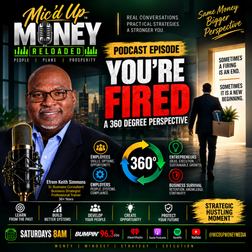
You're Fired | A 360 Degree Perspective
You’re Fired | A 360 Degree Perspective Getting fired can expose far more than a bad employee or a bad boss. It can reveal outdated skills, poor hiring, weak training, bad management, missing HR systems, knowledge hoarding, or a business dangerously dependent on one person. In this episode of Mic’d Up Money Reloaded, Efrem Keith Simmons examines termination from every side of the table. Employees learn why keeping their skills viable, skill-stacking, understanding technology, building Employment Optionality, and creating the next door of opportunity are ultimately their responsibility. Employers learn why retention, cross-training, documentation, management development, and Institutional Intelligence can determine whether losing one employee becomes an inconvenience or an operational crisis. And if getting fired suddenly makes entrepreneurship look attractive, there is another warning. Do not let fear, anger, or desperation turn your retirement savings, 401(k), or lifetime savings into somebody else’s get-rich-quick opportunity. Employees should build themselves so one employer cannot determine their future. Employers should build their businesses so one employee cannot determine the company’s future. If this episode gave you something you can use, like it, share it, comment on it, and send it to another business owner, manager, employee, or entrepreneur who needs this kind of practical business education. For the fully developed You’re Fired: A 360 Degree Perspective Toolkit, visit MicdUpMoneyReloaded.com. The toolkit includes practical worksheets, assessments, checklists, retention tools, employability tools, Institutional Intelligence tools, cross-training resources, and action plans designed to help you move from information to implementation. Mic’d Up Money Reloaded. Great business education built around money, strategy, systems, people, and execution.

Location, Location, Location | Reality Check: Your Location Could Be Costing You More Than Rent
The Location, Location, Location | Reality Check Toolkit is designed to move entrepreneurs beyond simply asking, “How much is the rent?” and force them to evaluate the true financial, operational, customer, and credibility impact of a business location before they commit to it. This 26-tool execution workbook helps business owners compare home-based operations, virtual offices, shared workspaces, private offices, shopping centers, malls, and traditional commercial locations while examining the risks most entrepreneurs overlook. The toolkit walks users through address credibility, lender and vendor considerations, shared-office and sublease rights, after-hours access, parking, signage, competition, customer convenience, building maintenance, restroom cleanliness, safety, lighting, insurance, business interruption exposure, lease terms, CAM charges, “as-is” provisions, tenant improvements, percentage rent, landlord responsibilities, and exit provisions. At the center of the toolkit are several practical decision-making tools, including the Business Location Congruence Audit, Office Ascension Ladder, Shared Office/Sublease Due-Diligence Checklist, Commercial Lease Term Decoder, Building Maintenance & Cleanliness Audit, Business Location Insurance & Risk Audit, Business Interruption & Continuity Analysis, Total Occupancy Cost Calculator, and Location Tax Calculator. The toolkit also helps entrepreneurs answer questions that can save thousands of dollars before a lease is signed: Is the landlord contributing enough toward improvements? Who pays if the HVAC fails? What exactly is included in CAM? Is “free rent” really free once buildout costs are considered? Can the landlord charge percentage rent based on revenue? Can the business legally sublease or share space? Are keys, access codes, parking, conference rooms, and weekend access guaranteed? How much additional advertising will a poor location require? And how long could the business survive if the location suddenly became unusable? Three real-world case-study lessons reinforce the tools: negotiating lease protections that avoided more than $5,000 in HVAC expense, recognizing the danger of putting as much as $45,000 of working capital into improvements to a landlord’s property, and using competitor proximity in a mall to capture existing customer traffic rather than hiding in a low-traffic corner. The ultimate objective is to calculate more than rent. Entrepreneurs are taught to evaluate: True Location Cost = Total Occupancy Cost + Location Tax Then they evaluate a third risk measure: the Business Survival Window—how long the company could continue meeting its obligations if the location stopped generating revenue. This is not just a checklist for finding office space. It is a location-selection, commercial-lease, working-capital protection, risk-management, and growth-stage decision system designed to help entrepreneurs choose a location that supports credibility and profitability without allowing unnecessary overhead to choke the business. Best for: startups considering their first professional location, home-based businesses ready to increase credibility, entrepreneurs evaluating virtual offices or shared space, retailers comparing shopping-center or mall locations, and established businesses considering relocation, expansion, or lease renewal. Available at micdupmoneyreloaded.com.
Which Entrepreneur Are You? Serial Vs. Leisure Entrepreneur
Which Entrepreneur Are You? Not every entrepreneur thinks, builds, spends, risks, or responds to opportunity the same way. In this episode of Mic’d Up Money Reloaded, Efrem Keith Simmons breaks down the Entrepreneurial Spectrum and challenges you to identify the entrepreneur you are right now—not the entrepreneur you hope people think you are. Discover how your motivations, experience, blind spots, lifestyle goals, status needs, family legacy, opportunity chasing, and asset-building mindset can influence your business decisions. Then learn why recognizing your present entrepreneurial type can help you protect your money, avoid the wrong opportunities, and build an individualized path to success. The goal isn’t to label you. The goal is to help you see what you need next.
Help! My Social Media Posts Aren't Pleading The 5th
What if your social-media account became the witness you forgot existed? Entrepreneurs use Facebook, Instagram, TikTok, LinkedIn, and other platforms to promote their businesses—but those same posts can potentially document business activity, assets, customer volume, locations, employment behavior, operations, financial representations, and much more. In HELP! My Social Media Posts Aren’t Pleading the Fifth!, Efrem Keith Simmons examines how your digital footprint can collide with tax matters, insurance claims, employment disputes, divorce, contracts, customer due diligence, litigation, and business credibility. You'll also learn the Digital Contradiction Doctrine, the Three Versions of You, and a practical test for determining whether your published story agrees with your documented business reality. Because sometimes the problem isn't what your post proves. It's what your post makes somebody investigate next. Strategic Hustling Moment: Make your published story match your documented story. Companion Social Media Risk Toolkit available at micdupmoneyreloaded.com.
1 de 3