
Notas del episodio
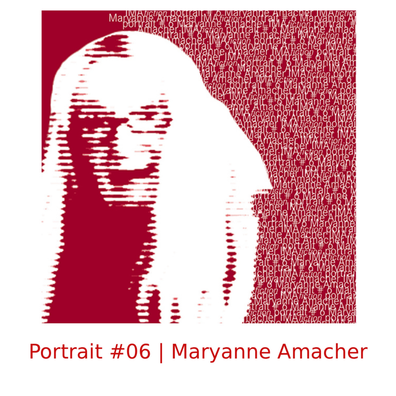
A portrait by Elisabeth Schimana & Lena Tikhonova [2013]. Language: English & Deutsch
https://ima.or.at/de/projekt/imafiction_portrait06
Maryanne Amacher's work is sometimes misunderstood as installation art. For example, Kyle Gann (1995, p. 284) described her as "one of the best installation artists" in his book American Music in the Twentieth Century. Amacher's works belong to the realm of sound art, but they generally have a beginning and an end, like a piece of music. She was a composer committed to the interplay of space, time, and sound.
In 1967, she began the City Links series, creating a number of works up to 1980 in which she broadcast live acoustic events from distant locations to a studio. She mixed the transmissions of sounds from eight locations in Buffalo (1967) into a 28-hour radio piece, using the source space of the sounds like a large synthesizer. Her interest focused on spatial depth and the localization of sounds. Amacher's use of the term "trio" in Intelligent Life (1979) points to a genuinely musical understanding. Jazz musician George Lewis played trombone in New York Harbor. The recording was sent to a studio where John Cage read a text, and all of this was mixed and routed to a concert at The Kitchen in New York. Three rooms, three musicians were the performers.
A theoretical point of reference for her was Carl Gustav Jung's concept of synchronicity. Initially, Amacher defined synchronicity as the simultaneous hearing of spaces that are distant from each other, emphasizing the change in consciousness that occurs when one listens beyond one's walls.
Since the 1980s, her multimedia works, Music for Sound Joint Rooms, expanded this concept. She painstakingly examined each location to create "structured borne sound," which reflects the specific location, in contrast to "air borne sound." Loudspeakers were mounted facing the wall to make its sonic properties audible. From a mixing console, the composer controlled tape recorders moving through spaces as overtone-rich layers of sound in polyphonic structures. Architecture was visually transformed by stage objects, flashing videos, and slide projections. Because visitors moved freely around, they appeared as animated silhouettes. Amacher spoke of perceptual geographies: "I create scenarios to enhance perceptual geographies among mind, body and environment".
She was convinced that new codes for perception were needed. Fascinated by biochemical and neurophysiological research, she wanted to stimulate new neuronal processes. The volume of many of her works approached an absolute threshold of human hearing to create virtual acoustic impressions—tones not present in emitted sounds that arise through the interaction of sound waves as difference tones. Amacher attempted to make them sound as if they originated in the ear itself.
She also tried to alter the lower threshold of perception through "aftersounds." The music for Merce Cunningham's ballet Torse (1976) made use of this technique: high tones no longer acoustically present continued to linger in perception for about eight seconds before a new tone was introduced, exploring afterimages to the edge of a virtual perceptual experience.
Her works are temporary. Existing sound recordings offer only a faint echo of their original impact. What remains are not performable works, but documents that present philological and curatorial challenges. She, aligning with 'situational aesthetic' (Victor Burgin) and ›esthétique relationelle‹ (Bourdiaux, 1998). Especially in sound art, significant challenges arise concerning the appropriate presentation of documents left behind.
supported by Lower Austria Culture, BM:UKK, maecenia, ARS electronica, singuhr-hörgalerie and The Maryanne Amacher Archive