FLASCO OncoPod

FLASCO OncoPod

por Florida Society of Clinical Oncology
Temporada 1
Drew Piers on Advocacy, Storytelling & Shaping the Future of Cancer Care
In this episode of the FLASCO OncoPod, Drew Piers, President of Sachs Media, explores the powerful role advocacy, storytelling, and strategic communications play in advancing cancer care beyond the clinic. Drawing on years of experience working alongside healthcare organizations and oncology professionals, Drew discusses how trusted clinician voices can influence public policy, improve patient access to care, and strengthen public confidence in the healthcare system. Listeners will gain practical insights into communicating complex healthcare issues with clarity, combining patient stories with evidence-based data, and engaging policymakers in meaningful ways that drive positive change. Whether through community outreach, media engagement, or legislative advocacy, this episode highlights how every oncology professional can help shape the future of cancer care through authentic, patient-centered communication. Sachs Health INFLUENCE INDEX: https://sachsmedia.com/wp-content/uploads/2026/05/SachsHEALTH-Influence-Index-2026.pdf
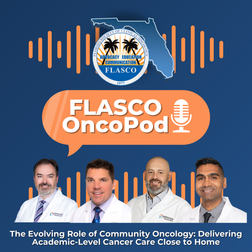
The Evolving Role of Community Oncology: Delivering Academic-Level Cancer Care Close to Home
In this episode of the FLASCO OncoPod, Dr. McDonough moderates a discussion with Dr. Wenk, Dr. Glick, and Dr. Patel, of Florida Cancer Specialists & Research Institute on the evolving role of community oncology and how today's practices are delivering academic-level cancer care closer to home. Together, they explore how community oncology has transformed over the past decade, highlighting advances in precision medicine, immunotherapy, clinical research, and innovative care models. The conversation examines how large practice networks maintain consistent, high-quality care while expanding access to cutting-edge therapies and clinical trials for patients across diverse communities. From scaling innovation across a statewide network to bringing academic-level expertise closer to home, this episode offers valuable insights into the future of oncology care and the increasingly vital role community oncology plays in advancing cancer treatment, research, and patient outcomes.
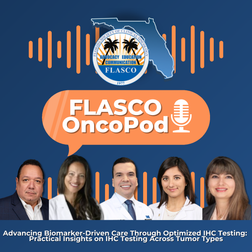
Part 4, Advancing Biomarker-Driven Care Through Optimized IHC Testing: Practical Insights on IHC Testing Across Tumor Types
In this episode of the FLASCO OncoPod, host Dr. Edgardo Santos, President of the Florida Society of Clinical Oncology (FLASCO), leads a multidisciplinary discussion on the evolving role of immunohistochemistry (IHC) in precision oncology. Joined by Dr. Lamees Saeed (Tampa General Hospital Cancer Institute), Dr. Jesus Fabregas (Memorial Cancer Institute), Dr. Ana Sandoval (Herbert Wertheim Cancer Institute at Baptist Health South Florida), and Dr. Nathalie McKenzie (AdventHealth Cancer Institute), the panel explores how IHC has evolved from a diagnostic tool into a critical component of biomarker-driven treatment selection. In part 4, the panel examines the real-world barriers that continue to affect IHC testing, including variability in reflex testing, pathology workflows, tissue stewardship, and reporting consistency. Experts share practical strategies for improving communication between oncologists and pathologists, streamlining testing protocols, and ensuring patients receive timely, comprehensive biomarker evaluation. Looking ahead, the discussion explores how artificial intelligence, digital pathology, electronic medical record integration, and automated clinical trial matching may transform precision oncology while reinforcing that multidisciplinary collaboration remains essential to delivering high-quality, personalized cancer care. The episode concludes with key takeaways clinicians can implement to strengthen biomarker-driven decision-making in their own practices. This podcast is being sponsored by Daiichi Sankyo.
Part 3, Advancing Biomarker-Driven Care Through Optimized IHC Testing: Practical Insights on IHC Testing Across Tumor Types
In this episode of the FLASCO OncoPod, host Dr. Edgardo Santos, President of the Florida Society of Clinical Oncology (FLASCO), leads a multidisciplinary discussion on the evolving role of immunohistochemistry (IHC) in precision oncology. Joined by Dr. Lamees Saeed (Tampa General Hospital Cancer Institute), Dr. Jesus Fabregas (Memorial Cancer Institute), Dr. Ana Sandoval (Herbert Wertheim Cancer Institute at Baptist Health South Florida), and Dr. Nathalie McKenzie (AdventHealth Cancer Institute), the panel explores how IHC has evolved from a diagnostic tool into a critical component of biomarker-driven treatment selection. The panel discusses how expanding biomarker indications are changing when and how testing is performed, from first-line diagnosis through disease progression. Experts explore the growing clinical importance of HER2-low and HER2-ultralow expression in breast cancer, the role of comprehensive biomarker testing in gynecologic malignancies, and how IHC and next-generation sequencing work together to guide personalized treatment strategies in thoracic oncology. The conversation also highlights the importance of standardized pathology reporting, multidisciplinary collaboration, and balancing timely treatment with the need for complete biomarker results to ensure patients receive the most appropriate targeted therapies. This podcast is being sponsored by Daiichi Sankyo.
Part 2, Advancing Biomarker-Driven Care Through Optimized IHC Testing: Practical Insights on IHC Testing Across Tumor Types
In this episode of the FLASCO OncoPod, host Dr. Edgardo Santos, President of the Florida Society of Clinical Oncology (FLASCO), leads a multidisciplinary discussion on the evolving role of immunohistochemistry (IHC) in precision oncology. Joined by Dr. Lamees Saeed (Tampa General Hospital Cancer Institute), Dr. Jesus Fabregas (Memorial Cancer Institute), Dr. Ana Sandoval (Herbert Wertheim Cancer Institute at Baptist Health South Florida), and Dr. Nathalie McKenzie (AdventHealth Cancer Institute), the panel explores how IHC has evolved from a diagnostic tool into a critical component of biomarker-driven treatment selection. In part 2, the panel explores why routine biomarker testing is becoming an essential part of cancer care, highlighting how markers such as mismatch repair (MMR), HER2, PD-L1, and Claudin 18.2 are helping clinicians personalize treatment strategies and improve patient outcomes. Through real-world clinical examples, the discussion examines the value of reflex testing, when repeat testing may be appropriate, and how close collaboration between oncologists, pathologists, and multidisciplinary care teams helps ensure patients receive timely, biomarker-driven treatment. The conversation also addresses practical workflow considerations, including pathology communication, turnaround times, and strategies for integrating evolving testing standards into everyday clinical practice. This podcast is being sponsored by Daiichi Sankyo.
Part 1, Advancing Biomarker-Driven Care Through Optimized IHC Testing: Practical Insights on IHC Testing Across Tumor Types
In this episode of the FLASCO OncoPod, host Dr. Edgardo Santos, President of the Florida Society of Clinical Oncology (FLASCO), leads a multidisciplinary discussion on the evolving role of immunohistochemistry (IHC) in precision oncology. Joined by Dr. Lamees Saeed (Tampa General Hospital Cancer Institute), Dr. Jesus Fabregas (Memorial Cancer Institute), Dr. Ana Sandoval (Herbert Wertheim Cancer Institute at Baptist Health South Florida), and Dr. Nathalie McKenzie (AdventHealth Cancer Institute), the panel explores how IHC has evolved from a diagnostic tool into a critical component of biomarker-driven treatment selection. The conversation highlights how IHC is shaping clinical decision-making across breast, gastrointestinal, gynecologic, and thoracic cancers, with experts discussing reflex testing, tissue stewardship, workflow between pathology and oncology, and the growing importance of predictive biomarkers such as HER2, PD-L1, mismatch repair (MMR), Claudin 18.2, and hormone receptors. Panelists also share practical insights on when IHC provides the greatest clinical value, how testing protocols have adapted alongside emerging therapies, and why strong communication between clinicians and pathologists is essential for delivering timely, personalized cancer care. This podcast is being sponsored by Daiichi Sankyo.
CLL Treatment Evolution: Rethinking Monotherapy vs Combination Strategies in the Era of Next-Generation BTK Inhibitors
The treatment landscape for chronic lymphocytic leukemia (CLL) has transformed dramatically over the past decade, creating new opportunities and new questions for clinicians managing this increasingly complex disease. In this episode of the FLASCO OncoPod, FLASCO President Edgardo Santos, MD, FACP, FASCO, sits down with renowned CLL expert Javier Pinilla-Ibarz, MD, PhD, of Moffitt Cancer Center to discuss how advances in targeted therapies are reshaping treatment decisions across the CLL continuum. Together, they explore the evolution of CLL care from chemoimmunotherapy to modern treatment approaches centered around BTK inhibitors, BCL2 inhibitors, and anti-CD20 monoclonal antibodies. The conversation examines how molecular and genetic risk factors, including IGHV mutation status, TP53 abnormalities, and cytogenetic findings, influence first-line treatment selection and long-term management strategies. Dr. Pinilla-Ibarz shares practical insights into the ongoing debate between fixed-duration combination regimens and continuous therapy approaches, highlighting the benefits, limitations, and patient-specific considerations that guide real-world clinical decision-making. The discussion also covers measurable residual disease (MRD), emerging MRD-guided treatment strategies, management of high-risk disease, sequencing therapies after relapse, and the growing role of next-generation BTK inhibitors. Looking ahead, the episode explores promising therapies on the horizon, including novel BTK degraders, next-generation BCL2 inhibitors, cellular therapies, and other innovative approaches that may further improve outcomes for patients living with CLL. Whether you are a hematologist, oncologist, advanced practice provider, or healthcare professional interested in the latest developments in blood cancers, this episode offers a comprehensive and clinically relevant update on where CLL treatment stands today and where the field is headed next.
What's New in Endometrial Cancer: Key Takeaways From SGO 2026
Join Scott E. Jordan, MD, FACOG, gynecologic oncologist at Broward Health, as he breaks down the most important endometrial cancer updates presented at the 2026 Society of Gynecologic Oncology (SGO) Annual Meeting. In this episode, Dr. Jordan reviews promising new therapies, including emerging antibody-drug conjugates and novel hormonal treatment combinations, highlights exciting clinical trial results, and discusses long-term follow-up data from the practice-changing RUBY trial. From breakthrough research to upcoming Phase III studies that may shape the future standard of care, this conversation provides oncology professionals with key insights into the rapidly evolving treatment landscape for advanced and recurrent endometrial cancer.
ASCO Edge and the Future of Oncology Practice Leadership with Dr. Robin Zon ASCO Edge and the Future of Oncology Practice Leadership with Dr. Robin Zon & Dr. Jorge Garcia
What does it take to successfully navigate the business of oncology while continuing to deliver exceptional patient care? In this episode of the FLASCO OncoPod, Dr. Robin Zon joins Dr. Jorge Garcia for a thoughtful conversation about leadership, advocacy, and the launch of ASCO Edge, a new educational resource designed to help oncology professionals better understand the operational and business side of cancer care. Dr. Zon reflects on her professional journey from community oncology practice to serving as President of ASCO, sharing how early experiences shaped her passion for empowering clinicians with the tools needed to manage practices, navigate evolving healthcare systems, and advocate for both patients and providers. Together, they explore: • The inspiration behind ASCO Edge • Why business education matters in oncology • Challenges facing modern cancer care delivery • How oncology professionals can strengthen operational knowledge • The importance of state societies and collaborative advocacy • What clinicians, pharmacists, APPs, fellows, and practice leaders can gain from the platform Designed by oncology professionals for oncology professionals, ASCO Edge offers practical, on-demand learning modules focused on real-world scenarios impacting cancer care today. Learn more about FLASCO and upcoming educational initiatives at FLASCO.org Get started with ASCO Edge today at https://www.asco.org/meetings-education/training-programs/asco-edge #FLASCO #Oncology #ASCO #CancerCare #CommunityOncology #HealthcareLeadership #MedicalEducation #OncoPod #OncologyPodcast #PracticeManagement #CancerResearch #OncologyProfessionals
"How I Treat" Micro-Learning Atypical HUS Triggered by Malignancy or Drug Exposure Part 3: Genetics, Duration of Therapy, and Real-World Pearls
In this final episode of the FLASCO OncoPod series, Drs. Jaglal, Fu, and Shahzad shift focus to the long-term management of atypical hemolytic uremic syndrome (aHUS) in oncology patients. Building on the diagnostic and acute management discussions from earlier segments, the panel explores key considerations that guide care beyond the initial presentation. Topics include the role of genetic and complement testing, how to interpret mutation findings, and the factors that influence decisions around the duration of complement inhibition therapy. Through real-world insights, the discussion highlights the complexity of identifying underlying triggers, including drug exposure and infection, and the importance of clinical judgment when determining whether and when treatment can be safely discontinued. The panel also addresses practical challenges, from variability in testing access to navigating uncertainty in cases without clear pathogenic mutations. Listen as the experts walk through how thoughtful, individualized decision-making can support recovery, preserve renal function, and optimize long-term outcomes for patients with aHUS.
1 de 4